
What is the ACD in Ivory Coast?
The Definitive Concession Decree (ACD — Arrêté de Concession Définitive) is a unilateral administrative act by which the State definitively grants urban land. It is signed by the Minister of Construction (in Abidjan) or by the Prefect (outside Abidjan). Once published in the Land Register by the CPFH, the ACD is itself opposable, unassailable and imprescriptible (ACD published = TF published). Official timeframe: 180 calendar days (BÂTIR N°004, 2022); often longer in practice.
Definition complete
Official Process in 11 Steps
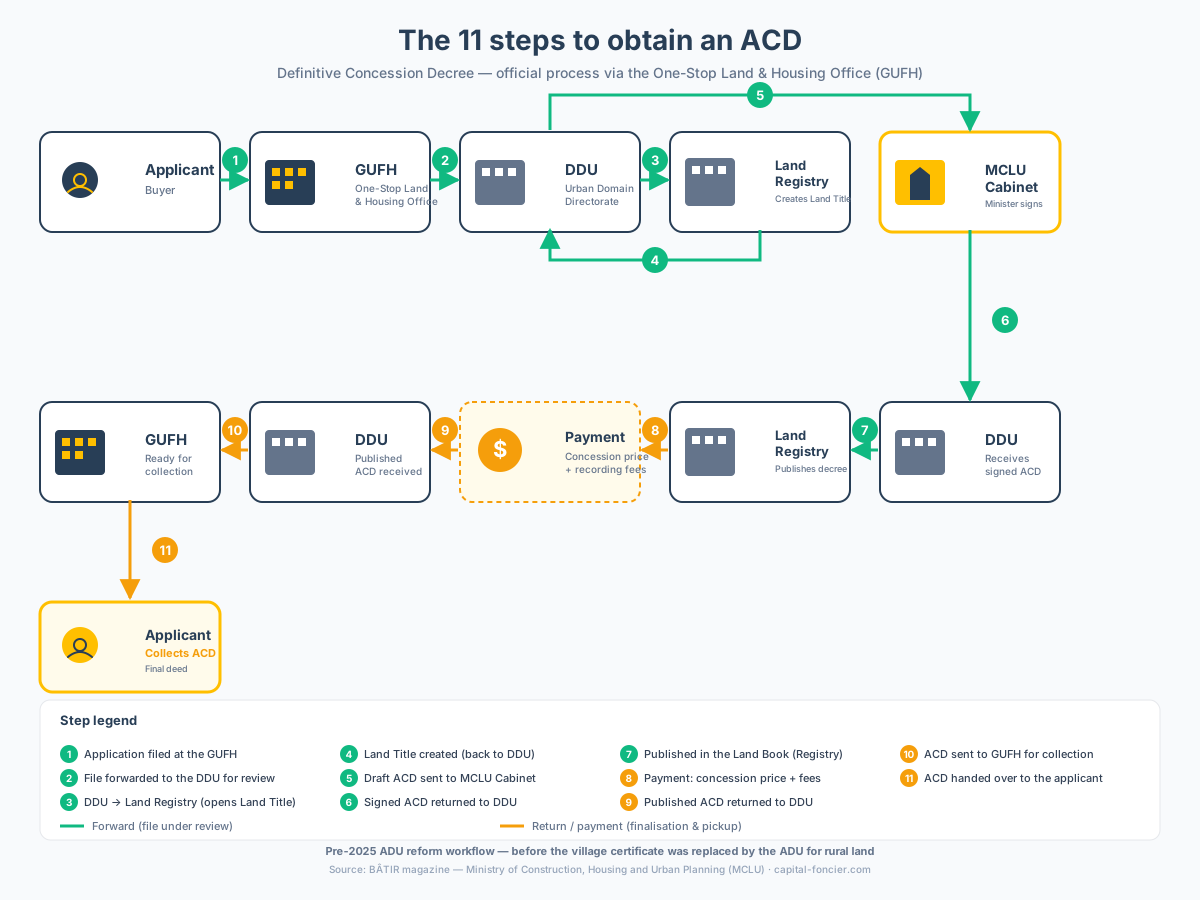
Diagram of the administrative process: One-Stop Land & Housing Office (GUFH / Guichet Unique Foncier et de l'Habitat) → Urban Domain Directorate (DDU / Direction du Domaine Urbain) → Land Registry → Office of the Minister of Construction, Housing and Urban Planning (MCLU / Ministère de la Construction, du Logement et de l'Urbanisme) → return to GUFH for collection. Source: Magazine BÂTIR (MCLU, 2019). Procedure as it stood before the ADU reform, which replaced the Village Certificate with the Customary Right of Use Certificate (ADU / Attestation de Droit d'Usage coutumier) on July 1, 2024.
Legal Definition
The ACD (Arrêté de Concession Définitive / Definitive Concession Decree) is a unilateral administrative act in the urban land acquisition process in Ivory Coast, governed by Ordinance No. 2013-481 of July 2, 2013, its implementing decrees No. 2013-482 and No. 2021-785, and the principles integrated into the Urban Planning Code (Law 2020-624). It is signed by the Minister of Construction (for land in the autonomous district of Abidjan) or by the Prefect (outside Abidjan, residential lots from an approved subdivision, under 1 hectare). The ACD is then published in the Land Register by the Land Registry Office (DGI / Direction Générale des Impôts), which gives rise to the Land Title. Official timeframe: 180 calendar days (BÂTIR N°004, 2022); often longer in practice. The ACD alone may be challenged before the administrative court for abuse of power; only the Land Title is unchallengeable and imprescriptible (Torrens system).
Why the ACD is Essential
- It confers a real right over the land, enforceable against third parties
- It is the mandatory prerequisite for requesting a land title
- It protects against subsequent claims
- It is the fundamental element for obtaining a real estate loan
Obtaining Process (Reformed Procedure)
- Possess a Letter of Attribution or a Provisional Concession Decree (ACP / Arrêté de Concession Provisoire) on a lot from an approved subdivision
- File submission at the One-Stop Land Office (GUF / Guichet Unique du Foncier), Tower D, ground floor, Abidjan Plateau
- Verification by the Control and Document Production Service (authenticity, compliance, absence of suspension)
- Contradictory boundary survey by cadastral services
- Transmission for land title creation
- Notification for payment of the cession price and land registration taxes
- Signature of the ACD by the Minister (Abidjan) or the Prefect (outside Abidjan)
- Publication in the Land Register by the land registry office
Remedies Against the ACD
The ACD is subject to prior administrative remedies (amicable or hierarchical) and proceedings for abuse of power before the State Council (Law No. 2018-978 of December 27, 2018).
Warning: Land sold with only a Village Certificate, without an ACD, offers no real legal security.
Exemple concret
Amenan acquired a plot in an approved subdivision in Anyama in 2022. She first obtained her ADU (Customary Land Use Certificate), then filed her land-position application with the Single Land Window (a step that became mandatory on 31 March 2025), before assembling her ACD (Definitive Concession Decree) file with the help of a licensed OGECI surveyor. After the Minister's electronic signature through the SIGNE platform, she received her ACD and her land was entered into the Land Book. She then submitted her building permit file to the GUPC before starting any construction work. In practice, these steps can take several months — sometimes significantly longer than the official timelines — but that does not authorize building without an ACD and a building permit.
Sources juridiques
Ordonnance n° 2013-481 du 2 juillet 2013 (réforme domaniale fondatrice). Décret n° 2013-482. Décret n° 2021-785 du 8 décembre 2021. Loi n° 2020-624 du 14 août 2020 (Code de l'Urbanisme et du Domaine Foncier Urbain), article 3 (définition) et articles suivants. Loi n° 2024-351 du 6 juin 2024 (modificative du Code de l'Urbanisme). Loi n° 2019-868 du 14 octobre 2019. Loi n° 2018-978 du 27 décembre 2018 (Conseil d'État — recours contre l'ACD). Magazine BÂTIR N°000 (MCLU, octobre-décembre 2019), pages 14 et 17 (procédure en 11 étapes).
Questions frequentes
How much does it cost to obtain an ACD (Arrêté de Concession Définitive / Definitive Concession Decree)?
How long does it take to obtain an ACD (Arrêté de Concession Définitive / Definitive Concession Decree)?
Can a property with an ACD (Arrêté de Concession Définitive / Definitive Concession Decree) be seized?
Who signs the ACD (Arrêté de Concession Définitive / Definitive Concession Decree)?
Besoin de conseils sur votre projet foncier ?
Nos experts vous accompagnent dans toutes les demarches.
Autres termes du glossaire
The ADU (Attestation de Droit d'Usage Coutumier / Customary Right of Use Certificate) is the single, secure document that has replaced the former Village Certificate since July 1, 2024; it is free of charge (MCLU, August 2024). Provided for by Order No. 0059/MCLU/DGUF/DDU of December 7, 2022, under Decree No. 2021-784, it is drawn up by the Ministry of Construction in the SIGFU (Decree No. 2021-862), with a unique IDUFCI, then handed over by the village chieftaincy. Only the village chief's signature is mandatory; those of the CVGFR president and the developer depend on the community's decision. The ADU is not a property title: it constitutes a provisional recognition opening the path to the ACD (Arrêté de Concession Définitive / Definitive Concession Decree) — the ACD published in the Land Register IS the Land Title. In practice, the time between ACD signature and its publication in the Land Register is often longer than the official 180 calendar days (BÂTIR N°004, 2022). Published ACD = published Land Title — same legal deed, two stages.
The Rural Land Agency (AFOR — Agence Foncière Rurale) is the public institution responsible for implementing rural land policy in Ivory Coast. It oversees land certification, registration of rural properties, and coordination of boundary demarcation and surveying operations.
Legal document drafted by a notary that formalizes the transfer of land ownership between a seller and a buyer. The notarized deed of sale is mandatory and confers authenticity on the transaction.
Legal entity that must be established with a minimum share capital of 2 million FCFA held by Ivorian nationals, holding an approval from the Minister responsible for Housing and a financial guarantee from a bank or insurance company.
The alienation price is the sum that the buyer must pay to the State to obtain the Definitive Concession (ACD — Arrêté de Concession Définitive) of urban land. Calculated by an ad hoc commission, it corresponds to the market value of the parcel according to the official schedule.