
Chargement...
Chargement...
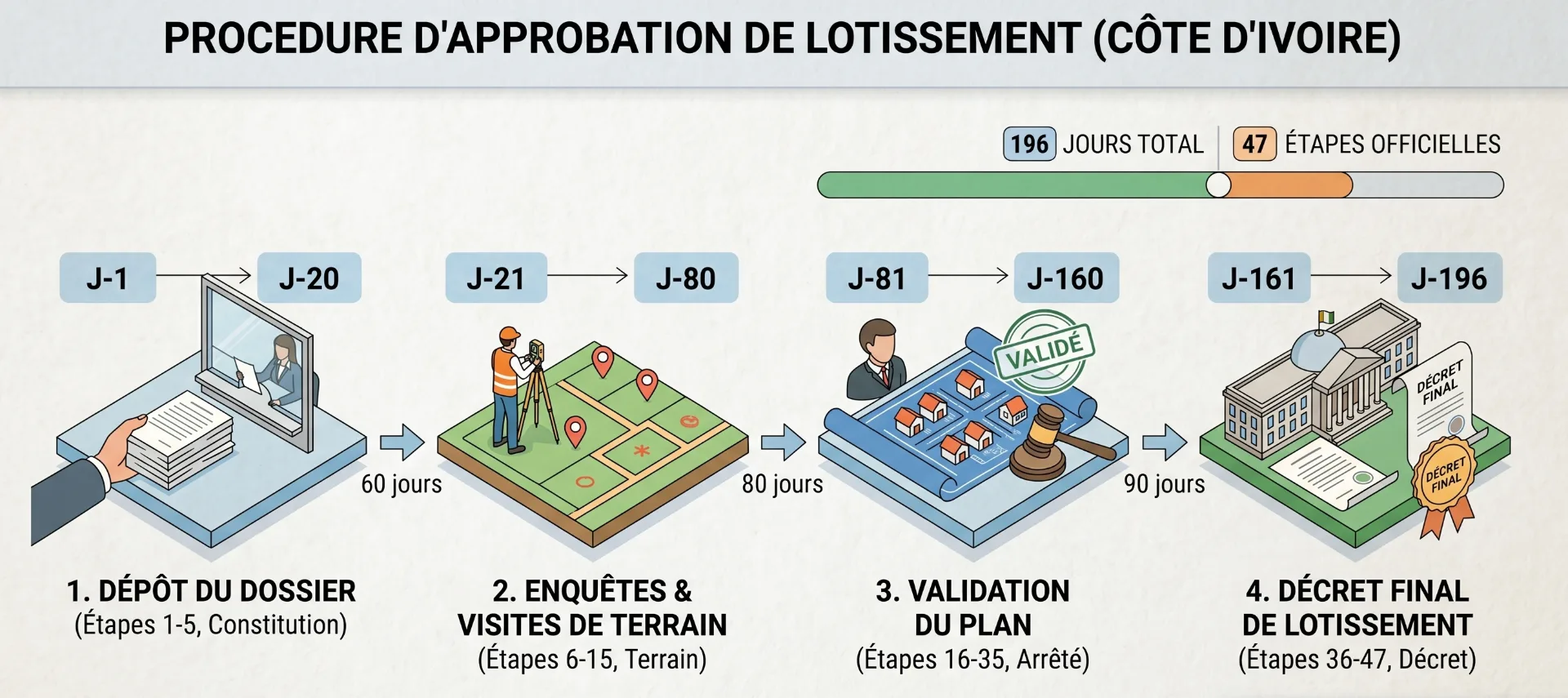
The 47 official steps and 196 calendar days required for administrative subdivision approval in Ivory Coast, according to BÂTIR N°004 (2022). 6 phases, 10 institutional stakeholders, official timeline versus reality comparison.
Need a land expert?
Speak with an advisor for free. Response within 2 hours.
Purchasing land in Ivory Coast without ensuring it comes from a regularly approved subdivision is exposing your investment to a major risk that regulations name unambiguously. The Urban Code (Law No. 2020-624 of August 14, 2020) and Decree No. 2021-784 of December 8, 2021 governing the procedures for developing, approving, and implementing subdivision plans are unequivocal: only plots resulting from a subdivision approved by decree of the Minister responsible for Urban Affairs can be subject to a Definitive Concession Decree (ACD).
It was Mr. KRA KOUMAN, Director General of Urban Affairs and Land, who stated this clearly in the pages of BÂTIR Magazine No. 004 (January-March 2022), a publication of the Ministry of Construction, Housing, and Urban Affairs (MCLU): "Subdivision approval takes place within a legal framework defined by decree. All the steps of this procedure make it possible to avoid, among other things, overlaps and conflicts."
This rule has a direct consequence for every investor: land in an unapproved subdivision does not allow its holder to consolidate their rights through an ACD. They are exposed to loss of their investment, reduction of their plot, or demolition of their building if a public facility must cross that plot. Conversely, purchasing a plot from an approved subdivision opens the right to an ACD, which incorporates the creation of a Land Title (TF) by the Land Property and Mortgage Registry (CPFH) at step 3 of the official ACD procedure. The ACD published in the Land Register is thus unassailable and imprescriptible. This is not a hierarchy between two distinct titles — it is the same legal act at two stages of the administrative process.
This guide details the 47 official steps of the subdivision approval procedure for administrative or rural subdivisions, as documented by the Urban Affairs Directorate in BÂTIR No. 004 (2022), supplemented by the provisions of Decree No. 2021-784. The official total timeframe is 196 calendar days. In practice, actual processing times are often longer, particularly at the public inquiry stages, corrections by the surveyor, and ministerial signature — we indicate this at each critical point.
Before entering the procedure, it is important to establish the framework. Decree No. 2021-784 (article 3) and article 18 of the Urban Code 2020-624 distinguish three types of subdivision:
1. Administrative Subdivision, initiated by the Sub-Prefect or Mayor. It concerns urban land from the private domain of the State or local authorities. This is the type of subdivision subject to the 47-step procedure documented in BÂTIR No. 004 (2022).
2. Private Residential Subdivision, initiated by a private owner to produce land intended for sale, either vacant or after real estate development. The dedicated procedure comprises 33 steps for a total of 105 calendar days (according to the same official source, BÂTIR No. 004, p. 11-13).
3. Village or Rural Subdivision, carried out on unregistered land, for the benefit of one or more village communities.
Article 5 of Decree No. 2021-784 specifies that any subdivision project is subject to prior approval from the Minister responsible for Urban Affairs, which results from the issuance of a decree authorizing the subdivision. In the Autonomous District of Abidjan, this decree is signed by the Minister responsible for Urban Affairs. Outside Abidjan, by delegation of the Minister, the decree authorizing the subdivision is signed by the Prefect following a report drawn up by the Regional or Departmental Director of Construction and Urban Affairs.
The subdivision approval procedure mobilizes a network of institutional actors whose coordination is governed by the MCLU. Understanding their role allows you to anticipate steps and avoid blockages.
The Single Land Window (GUF) is the unique entry point to the Ministry. This is where every subdivision file is deposited. It receives documents, verifies them, registers them, and transmits them to the Urban Affairs Directorate (DU). The GUF also intervenes in the final distribution phase.
The Urban Affairs Directorate (DU) is the conductor of the procedure. It receives the file from the GUF, transmits it to competent sub-directorates (notably the SDAPU), coordinates exchanges between services, prepares draft decrees, and ensures liaison with the Minister's Office.
The Topography and Cartography Directorate (DTC) is responsible for numbering subdivision plans, verifying land status (in liaison with the Cadastre), and the global registration file. It is at the center of technical steps that condition the regularity of the subdivision.
The Sub-Directorate of Prior Urban Approval (SDAPU) verifies the positioning and uniqueness of the project, analyzes the plot plan, evaluates urban ratios, prepares draft decrees for public inquiry and approval, and prepares correspondence with the subdivider.
The Sub-Directorate of Urban Planning (SDPU) verifies the consistency of the project with the applicable master plan or detailed urban plan.
The Sub-Directorate of Topographic Works (SDTT) performs technical verifications while awaiting the Cadastre's response, confirms whether the land is already registered, and transmits a copy of the status plan and verification report.
The Inquiry Commissioner, appointed by the Mayor or Sub-Prefect, conducts the public inquiry (commodo and incommodo) over a period of one month. They collect public observations and draft an end-of-inquiry report addressed to the Sub-Prefect or Prefect.
The Land Property and Mortgage Registry (CPFH), attached to the Secretariat of State to the Prime Minister responsible for Budget and State Portfolio (SEPMBPE), intervenes upstream: when an ACD is issued on an approved subdivision, it is the CPFH that creates the Land Title in its register at step 3 of the official ACD procedure, before ministerial signature. The CPFH is not under the supervision of the MCLU.
The Approved Urbanist is mandated by the subdivider to develop the plot plan, specifications, presentation note, and particular urban regulations. They must be registered with the National Order of Urbanists.
The Approved Land Surveyor conducts the status survey, detailed survey, coordinate calculations, contradictory boundary marking, and implementation missions for the subdivision plan. They must be registered with the Order of Land Surveyors of Ivory Coast (OGECI).
Primary Source: Urban Affairs Directorate, MCLU — BÂTIR No. 004, January-March 2022, p. 8-10
The procedure is presented in the official table under the heading: "Procedure for Administrative and Rural Subdivisions — Timeframes: 196 days". The sequence number and timeframes reproduced below are those from the official table.
Step 1 — Deposit and Registration at GUF (1 day — Actor: GUF). The Single Land Window receives the file comprising an administrative copy and a technical copy; verifies the constituent documents, registers it, assigns it an identifying number, and transmits it to the Urban Affairs Directorate (DU).
What this means for the subdivider: The file must be complete upon deposit. Any missing document triggers an immediate return that is not included in the official one-day timeframe.
Step 2 — Assignment to SDAPU (1 day — Actor: DU). The DU assigns the registered file under the same identifying number to the Sub-Directorate of Prior Urban Approval (SDAPU).
Step 3 — Verification of Positioning and Uniqueness (2 days — Actor: SDAPU). The SDAPU verifies the positioning and uniqueness of the project and transmits a topographic extract and digital file to the SDPU for verification and opinion.
Step 4 — SDPU Verification and Opinion (5 days — Actor: SDAPU). The SDPU performs verification and returns its opinion to the SDAPU. In case of an unfavorable reasoned opinion, the application is rejected and the entire file is returned to the GUF to be held at the applicant's disposal. In case of a favorable opinion, the technical file is transmitted to the Topography and Cartography Directorate (DTC), with copy to the DGUF.
Field Note: An unfavorable opinion at this step resets the counter. The subdivider must revise their file and start again from step 1.
Step 5 — Assignment to SDTT (1 day — Actor: DTC). The DTC receives the file and assigns it to the Sub-Directorate of Topographic Works (SDTT).
Step 6 — Request for Land Status from Cadastre (1 day — Actor: SDTT). The SDTT submits to the DTC a letter requesting land status addressed to the Cadastre.
COUNTER STOPS (awaiting Cadastre response)
Step 7 — Technical Verifications (5 days — Actor: SDTT). While awaiting the Cadastre's response, the SDTT performs technical verifications.
Step 8 — DTC-DU Return (3 days — Actor: DTC-DU). In case of a favorable opinion for technical verifications and if the Cadastre's response confirms that the land is not already registered, the DTC returns a copy of the status plan and verification report to the DU and informs the DGUF in writing. In case of necessary corrections, the DTC informs the Surveyor and the DU of what needs to be done. COUNTER STOPS (Surveyor Correction — For DTC timeframe).
Step 9 — Correspondence to Initiator (3 days — Actor: SDAPU). The DU assigns the file to the SDAPU which prepares correspondence to the initiator, to have a plot plan file developed by an approved urbanist taking into account observations from the Urban Sanitation and Drainage Directorate (DAUB).
Step 10 — File Submission by Urbanist (15 days — Actor: Urbanist). The urbanist via the project initiator transmits to the DU the file composed of the plot plan, specifications, presentation note of the particular urban regulations.
Field Note: This 15-day timeframe is a deadline for the subdivider, not the administration. In practice, preparing a complete plot plan file often takes several additional weeks, depending on terrain complexity and the availability of the urban planning firm.
Step 11 — Assignment to SDAPU (2 days — Actor: DU). The DU assigns said file to the SDAPU.
Step 12 — Analysis of Plot Plan (5 days — Actor: SDAPU). The SDAPU analyzes the plot plan (evaluation of ratios, plan analysis).
Step 13 — Information in Case of Correction (3 days — Actor: SDAPU). In case of correction, the initiator is informed. COUNTER STOPS
Step 14 — Preparation of Public Inquiry File (3 days — Actor: SDAPU). In case of a favorable opinion, the SDAPU prepares the file comprising a draft Public Inquiry Decree and the request for insertion in the Official Journal of the Republic of Ivory Coast (JORCI) of the public inquiry notice and transmits it to the DU.
Step 15 — Transmission to DGUF (2 days — Actor: DU).
Step 16 — DGUF Visa (3 days — Actor: DGUF). The DGUF analyzes and affixes its visa to the file and transmits it by schedule to the SCPA.
Step 17 — SCPA Reception (1 day — Actor: SCPA).
Step 18 — Verification of Regularity (2 days — Actor: Control Cell).
Step 19 — Securing or Return to DGUF (1 day — Actor: SCPA).
Step 20 — Assessment by DIR CAB (3 days — Actor: DIR CAB-SCPA).
Step 21 — Ministerial Signature of Public Inquiry Decree (5 days — Actor: MINISTER). The Minister signs the draft public inquiry decree.
Field Note: Ministerial signature is one of the most sensitive steps regarding actual timeframes. Since January 2024, it is electronic via SIGNE (DMISSA/MCLU + MFPMA), which increased the monthly pace from ~1,000 to 2,000-2,500 acts (BÂTIR No. 008, 2024). That said, the Minister's schedule remains a factor.
Step 22 — Registration and Numbering (2 days — Actor: SCPA).
Step 23 — Transmission to DGUF (1 day — Actor: SCPA).
Step 24 — Assignment to DU (2 days — Actor: DGUF).
Step 25 — Preparation of Public Inquiry (2 days — Actor: DU). The DU assigns the file to the SDAPU for preparation of the public inquiry. COUNTER STOPS FOR PAYMENT OF DISTRIBUTION FEES.
Step 26 — Distribution of Public Inquiry Decree (3 days — Actor: DU). Copy transmitted to all concerned services and actors with copy to the GUF.
Step 27 — Public Inquiry (30 days — Actor: Mayor or Sub-Prefect). The Mayor or Sub-Prefect appoints an inquiry commissioner who conducts a public inquiry lasting one month. Decree No. 2021-784, article 13, specifies that the inquiry is open for a period of one month. At least 30 days before its opening, the inquiry is announced in three major newspapers, on national radio and in two local radios, and by public posting.
Step 28 — End-of-Inquiry Report (15 days — Actor: Inquiry Commissioner). Once the inquiry is complete, the inquiry commissioner drafts an end-of-inquiry report which they address to the Sub-Prefect or Prefect (article 15 of Decree No. 2021-784).
Step 29 — Convocation of Mixed Commission (5 days — Actor: Prefect or Sub-Prefect). Article 16 of Decree No. 2021-784 provides that the commission is chaired by the Prefect or their representative when it meets at the departmental seat, and by the Sub-Prefect in other cases.
Step 30 — Opinion of Mixed Commission (15 days — Actor: Competent Authority). The Commission issues a favorable opinion on the adoption of the project as is or proposes its revision. The opinion is recorded in a session minutes attached to the file.
Step 31 — Assignment to DU (2 days — Actor: MINISTER-DU).
Step 32 — Analysis and Numbered Plot Plan (5 days — Actor: DU-SDAPU).
Step 33 — Verification of Global Registration File (5 days — Actor: DTC).
Step 34 — Numbering and Counter-Tracing (5 days — Actor: DTC-SDCMT).
Step 35 — Drafting of Approval Decree (5 days — Actor: DU-SDAPU).
Step 36 — Transmission to DGUF (2 days — Actor: DU).
Step 37 — DGUF Visa (3 days — Actor: DGUF).
Step 38 — Reception and Assignment to Control (1 day — Actor: SCPA).
Step 39 — Verification of Regularity (2 days — Actor: Control Cell).
Step 40 — Securing or Return to DGUF (1 day — Actor: SCPA).
Step 41 — Assessment by DIR CAB (3 days — Actor: DIR CAB).
Step 42 — Ministerial Signature of Approval Decree (5 days — Actor: MINISTER). The Minister reviews the file and signs the approval decree. Since January 2024, via SIGNE.
Step 43 — Registration and Numbering (2 days — Actor: SCPA).
Step 44 — Transmission to DGUF then to DU (2 days). The file comprising the signed decree is transmitted to the DGUF, which transmits it to the DU.
Step 45 — Preparation of Distribution (5 days — Actor: DU). Registration of the decree number on the tracing, signature by the DU, plan printing, drafting of distribution letters. COUNTER STOPS FOR PAYMENT OF DISTRIBUTION FEES TO GUF.
Step 46 — Official Distribution to All (5 days — Actor: DU). Copy of the approval decree and approved plan distributed to the Directorates and recipient services: Urban Domain Directorate, Cadastre, DTC, DAUB, District, City Hall, Prefecture, Sub-Prefecture, CIE, SODECI, Urban Planning Firm, Surveyor Firm, GUF, JORCI.
This moment is critical for the investor: The distributed approval decree constitutes the legal basis that allows each plot purchaser to request an ACD. Article 95 of the Urban Code 2020-624 provides that the authorization decree must be published in the sub-prefectures and city halls of the affected localities until the end of subdivision operations.
Step 47 — End of Procedure. The subdivision is legally approved. Plot purchasers can now proceed with ACD applications to the GUF of the MCLU.
| Phase | Steps | Official Timeframe | Field Reality Observed | Main Delay Factor |
|---|---|---|---|---|
| Initialization and Positioning | 1-6 | 11 days | 11-20 days | Incomplete file at deposit, variable Cadastre timeframe |
| Technical Verification and Plot Plan | 7-13 | 26 days | 30-60 days | Plot plan development by urbanist, surveyor corrections |
| Public Inquiry | 14-27 | 65 days | 80-120 days | Ministerial signature, legal publications, inquiry commissioner appointment |
| Consultative Commission and Approval | 28-43 | 49 days | 60-100 days | Commission delays, new ministerial signature |
| Official Distribution | 44-46 | 12 days | 15-25 days | Distribution fee payment, service coordination |
| Closure | 47 | — | — | — |
| TOTAL | 47 | 196 days | 200-320 days in practice | Cumulative correction and signature delays |
Important Note: The official 196-day calendar timeframe is that published by the Urban Affairs Directorate in BÂTIR No. 004 (2022). It represents the theoretical timeframe if each step proceeds without file returns or corrections. In practice, returns for corrections at step 4, step 8 (surveyor correction), step 13, and at signature steps can cumulatively double or triple this timeframe. Distribution fee payment delays (two counter stops in the procedure) are also the subdivider's responsibility.
The following table reproduces official fees published by the Single Land Window (GUF), as documented in BÂTIR No. 004 (2022, p. 7):
| Subdivision Type | Area | Amount (FCFA/plot) |
|---|---|---|
| Village Subdivision Abidjan and Yamoussoukro — Amending Decree | < 50 ha | 200,000 |
| Village Subdivision Abidjan and Yamoussoukro — Amending Decree | > 50 ha | 400,000 |
| Village Subdivision Interior of Country — Amending Decree | — | 400,000 |
| Plan Subdivision and Regularization | — | 70,000 (interior of country) |
| Regularization | — | 100,000 |
| Private Subdivision | — | 200,000 |
Source: Single Land Window (GUF), BÂTIR No. 004, 2022.
These amounts are the subdivision approval fees, charged to the subdivider. They do not include surveyor fees (150,000 to 500,000 FCFA depending on area, source: OGECI), approved urbanist fees, JORCI insertion fees, legal publication fees, and customary rights clearance when the land originates from a village.
When the land to be subdivided originates from village occupation, the subdivider must clear customary rights before beginning the approval procedure. Official rate (Decree 2013-224 as amended by Decree 2014-25): 2,000 FCFA/m² in Abidjan, 1,500 in Yamoussoukro, 1,000 in Regional seat, 750 in Departmental seat, 600 in Sub-prefectural seat.
To estimate the clearance envelope applicable to a specific land: Customary Rights Clearance Calculator.
Aminata, an executive in the Ivorian diaspora in France, wishes to acquire a 500 m² plot in Cocody to build her residence. The seller presents her with a document titled "village attestation" and assures her that the land is part of an approved subdivision. Before signing anything, Aminata contacts Capital Foncier.
Documentary verification reveals that the subdivision in question does not benefit from an approval decree filed at the Urban Affairs Directorate. Mr. ABDOULAYE DIALLO, Director of Urban Domain, recalled in BÂTIR No. 004 (p. 16): "Ensuring that the land comes from a regularly approved subdivision by a decree of the Minister of Construction, Housing, and Urban Affairs" is the first verification to perform on any land with village attestation.
Aminata ultimately chooses a plot in a subdivision whose approval decree is verifiable at the DU. She begins the ACD procedure, which incorporates the creation of her Land Title by the CPFH (step 3 of the official procedure). Her ACD published in the Land Register makes her right unassailable and imprescriptible.
Lesson: Verification of the approval decree at the Urban Affairs Directorate is the first essential step, before any payment or signature.
Kouadio is the owner of a 12-hectare plot in Yamoussoukro that he wishes to subdivide to produce 80 residential plots. He prepares his administrative and technical file with an approved urbanist and surveyor, and deposits it at the GUF of the MCLU.
At step 4, the SDPU issues an unfavorable opinion: the project positioning partially overlaps an administrative reserve zone not materialized in the promoter's original plans. Kouadio must revise the plot plan, reduce the project footprint, and submit a new file. This return costs him approximately 45 additional days.
Finally, his approval decree is obtained after 310 calendar days, or 114 days beyond the official 196-day timeframe. He can then market his plots with the certainty that each purchaser can proceed with an ACD application.
Lesson: Anticipating administrative reserves (roads, easements, public facilities) when developing the plot plan is the best way to limit file returns.
Yao and his sister Aïcha inherited an 8-hectare family plot in Anyama. The land, originating from family customary rights, is not registered. Their cousins pressure them to sell quickly to a promoter who offers to buy it "as is" without prior approval formality.
Aïcha, more cautious, understands that selling unregistered land without an approved subdivision means ceding an asset that no purchaser will be able to consolidate rights to through an ACD. Yao and Aïcha instead choose to begin an administrative subdivision procedure with the support of a surveyor. The procedure takes 14 months, but at its conclusion, the 65 plots produced can be sold with the certainty that each purchaser can obtain their ACD.
Lesson: Patience in land regularization is always more profitable than rushing into a sale without title.
Mr. ABDOULAYE DIALLO, Director of Urban Domain, in BÂTIR No. 004 (p. 17), stated this unambiguously: "We strongly advise against acquiring plots in this type of subdivision. It exposes you to loss of your investment with no recourse in case of dispute, reduction of the plot, or even demolition of your building when a public facility such as a road must cross that plot."
Authorization to subdivide is prior approval from the Minister before the procedure begins. It does not constitute approval of the subdivision plan project. A promoter who has authorization to subdivide but not yet the approval decree cannot legally sell plots from that subdivision.
Marketing plots in a subdivision undergoing approval, before the approval decree is signed, exposes the subdivider to criminal prosecution for fraud. The investor who purchases in this situation has no solid legal protection.
When the plot comes from an approved subdivision and a Land Title exists, any property transfer must necessarily go through a notary and result in a Certificate of Property Mutation (CMPF). Article 223 of the Urban Code (Law 2020-624) is explicit on this point.
Before any transaction, verification of land status with the MCLU (5,000 FCFA) and land status with the Registry allows you to ensure that the plot is not already assigned to a third party and that the seller's information matches official registers.
Every approved subdivision is accompanied by particular urban regulations that define applicable construction rules (maximum height, floor area ratio, distance to boundaries). Purchasing a plot without consulting these regulations risks a construction project incompatible with the rules that legally apply.
Beyond human support, we publish a public dashboard of approved subdivisions that aggregates MCLU data with search by municipality and filter by status (approved, suspended, canceled). Before undertaking a complete process, you can verify in seconds whether the plot being offered to you is linked to a recognized subdivision.
Capital Foncier is a specialist in secure land investment, not a public land authority. We do not issue ACDs, approval decrees, or land titles. Our role is to guide you through documentary verification and understanding of procedures.
Our team verifies, for each land we market: the reality of subdivision approval (consultation of the decree filed at the DU), the land status of the plot, the land status at the Registry, geographic consistency (surveyor), and clearance status. The Land Conformity Certificate (CCF) we issue at the conclusion of this process is a private Capital Foncier document. It does not replace the ACD or Land Title — it constitutes a decision-support tool.
In case of documentary problems identified after our intervention, our commitment to reimbursement under precisely defined contractual conditions applies. The triggering conditions and reimbursement terms are detailed in our General Terms and Conditions of Sale, subject to OHADA/CCJA arbitration.
The 47 steps and 196 days of the official procedure may seem like a constraint for those seeking quick acquisition. But it is precisely this procedural rigor that creates the lasting value of a plot from an approved subdivision.
Each step — from topographic verification to public inquiry, through ministerial signature — is a filter that eliminates risks of overlap, double assignment, and future contestation. A plot in an approved subdivision is one whose regularity has been validated by all institutional actors.
For the diaspora investor as for the local investor, understanding these 47 steps means understanding why land in an approved subdivision is worth more than land of questionable origin — and why preliminary documentary verification before any purchase is the first condition of serene land investment.
Schedule an Appointment with a Capital Foncier Specialist
Official sources used in this article:
— BÂTIR No. 004, Quarterly Magazine MCLU, January-March 2022. "Everything You Need to Know About Subdivision Approval Procedures." Urban Affairs Directorate, MCLU.
— Decree No. 2021-784 of December 8, 2021 governing the procedures for developing, approving, and implementing subdivision plans.
— Law No. 2020-624 of August 14, 2020 establishing the Urban Code and Urban Land Domain, notably articles 94 to 100.
— Ordinance No. 2013-481 of July 2, 2013 and Decree No. 2013-482.
Authorization to subdivide is prior approval issued by the Minister before the start of design work. It conditions the launch of the procedure but does not constitute approval. It is the approval decree, signed at the conclusion of the 47-step procedure, that gives the subdivision its legal character and allows purchasers to obtain their ACD.
Yes, under certain conditions. The regularization procedure is provided for in Decree No. 2021-784, with fees of 100,000 FCFA according to BÂTIR No. 004. However, regularization does not erase overlapping disputes or multiple assignments that may have occurred in the meantime.
According to Mr. KRA KOUMAN, DG of Urban Affairs and Land (BÂTIR No. 004, p. 5-6): "Every approved subdivision benefits from an approval decree filed in the Urban Affairs Directorate services. For a citizen wishing to perform this verification, they need only provide the Approval Decree they hold, to verify its conformity with the one that exists in the DU offices." This verification is done physically at the Urban Affairs Directorate or via the GUF.
The procedure for private subdivisions is distinct and comprises 33 steps for an official timeframe of 105 calendar days. In practice, an actual timeframe of 130 to 200 days is frequently observed.
Legally, marketing plots before the approval decree is risky. The subdivider who sells before approval risks prosecution, and the buyer is not protected in case of blockage or approval refusal. Prudence recommends waiting for the approval decree signature and, ideally, the official distribution of that decree (step 46).

The official platform construction.gouv.ci/mclulotissement makes it possible to verify whether a subdivision is approved, cancelled, or suspended — free of charge, in 5 minutes. Visual guide with the 7 form fields, the 3 statuses, and the pitfalls to avoid.

Five bilateral tax treaties, one notable absence (USA-CI), four mandatory forms (2047, 2044, T1135, 8938): navigating the cross-border taxation of land investment in Ivory Coast from the diaspora. Educational guide, not personalized tax advice.

Approved Developers, Customary Land Use Certificate, Independent Surveyor: Essential Checks Before Buying Land or Property in Ivory Coast in 2026.
Élargissez votre lecture avec d'autres facettes du foncier ivoirien.

A diaspora executive transfers 9 million FCFA for a plot that doesn't exist in Ministry records. This scenario is avoidable. Here are the 10 concrete steps, updated with 2020-2026 reforms (Urban Planning Code, SIGFU, IDUFCI, ADU, 2026 Tax Annex).
Lire l'article
Subdivision pre-financing in Ivory Coast offers exceptional returns, but remains the favorite playground of scammers. Learn how to legally structure your land partnership and how Capital Foncier protects your investment through its capital reimbursement commitment (subject to contractual conditions).
Lire l'article
Why is the village attestation living its final days in Ivory Coast? Decoding the 2025 government reform and a practical guide for the diaspora to prevent your land investment from being blocked or cancelled.
Lire l'article