The 10 Steps to Buying Land Securely in Ivory Coast (Côte d'Ivoire): 2026 Edition

The 10 steps to buying land in Ivory Coast (Côte d'Ivoire) while keeping risks under control: titles, verifications, boundary survey, notary, and follow-up after signing. Updated for the 2020-2026 reforms.
Need a land expert?
Speak with an advisor for free. Reply within 24 business hours.
A diaspora professional calls us: 9 million FCFA (about 13,700 EUR) paid for a plot that does not exist in the Ministry's registers. This scenario is avoidable. Here are the 10 concrete steps to buy land in Ivory Coast while keeping the risks under control, fully updated for the 2020-2026 reforms: the Urban Planning Code (Law No. 2020-624), amending Law 2024-351, the now-operational SIGFU (Système Intégré de Gestion du Foncier Urbain, the integrated urban land management system), the nationwide rollout of the IDUFCI (Identifiant Unique du Foncier de Côte d'Ivoire, the unique land parcel identifier), the ADU (Attestation de Droit d'Usage coutumier, customary right-of-use attestation) replacing the village attestation, and the 2026 Tax Annex.
Phase 1: Laying the Foundations of Your Land Project
Step 1: Clarify Your Objectives and Your Real Budget
Before any site visit, three questions deserve a written answer.
First, the objective: primary residence, rental investment, a land reserve for your children, or a commercial building project? Next, the time horizon: short term if you plan to build within 1 to 2 years, long term if you are aiming for appreciation over 10 years. Finally, the total budget, not just the price of the land: allow a margin of 20 to 30% for the notary's fees, the chartered surveyor, registration duties, property tax, and the formalities for the ACD (Arrêté de Concession Définitive, the definitive concession order). That margin should be all the wider when the land price is low, because fixed fees (surveyor, formalities) weigh proportionally more on small budgets. Ask your notary for a detailed cost estimate.
Taxation: What the Legislation Actually Provides for First-Time Buyers
The 2024 to 2026 tax annexes have built a favourable regime for first-time buyers. Watch the scope, which is often poorly summarised: most of these measures target economic and social housing units within approved real estate programmes (article 355-42 of the General Tax Code), not the purchase of bare land. They are therefore relevant to your overall project, not to the land transaction itself.
- A 5% tax credit for first-time buyers who acquire or build their first economic and social housing unit costing 40 million FCFA or less including tax (about 61,000 EUR), deductible from property tax for 5 years (2026 tax annex, article 2). Its effective application is pending a joint Budget/Housing ministerial order.
- Deeds of sale of these homes to first-time buyers have been registered free of charge since the 2024 tax annex (article 635 of the General Tax Code); the 2026 annex adds an exemption from land publication duties.
- VAT on notarial fees for these same sales is exempted (article 355-43-2 of the General Tax Code).
- The Tax on Banking Operations (TOB) has been exempted on first-time buyers' acquisition loans since 2024; the 2026 annex extends this to construction loans for the first home.
- And the measure that directly concerns your land purchase: on bare urban land, the property wealth tax is reduced from 1.5% to 1%, with an exemption for 2 years for land acquired from 2025 onwards (2025 tax annex, article 29), on a base calculated at market value.
Have your notary run the figures for your specific case, and build the result into your initial budget rather than discovering it after the fact. References: the 2024 (art. 7), 2025 (art. 29), and 2026 (art. 2) tax annexes, under Finance Law No. 2025-987 of December 19, 2025 (Directorate General of Budget and Finance, and Directorate General of Taxes, DGI).
Step 2: Identify the Right Area
Four criteria to examine systematically.
- Accessibility. An existing paved road nearby, or a credible road project (Abidjan metro, Yopougon-Bingerville BRT, 4th bridge).
- Utilities, known locally as VRD (voirie et réseaux divers, roads and utility networks): water (SODECI), electricity (CIE), sanitation. Landlocked land without utilities only gains value at the cost of an expensive connection.
- The urban planning scheme. Check that the area is not classified as non-buildable, a land reserve, a deferred development zone, or a public easement.
- Economic momentum. Employment hubs, schools, shops, and structuring projects (Port of Abidjan, Akoupé-Zeudji social housing, Cocody Saint-Jean, La Vie, and Angré Pétro Ivoire multimodal hubs).
New for 2025-2026: Check for the IDUFCI
The IDUFCI (Unique Land Identifier of Ivory Coast, Decree No. 2019-221 of March 13, 2019, made mandatory by Interministerial Order No. 757 of July 24, 2020) assigns a unique 20-character number to every parcel in the country, whatever its status: urban, rural, approved subdivision or not. This number is shared between the Cadastre, the Land Registry, notaries, surveyors, and banks. It puts an end to the multiplicity of former identifiers (Land Title (Titre Foncier, TF) number, ACD number, file number).
For your area check, remember this: a modern subdivision has one IDUFCI per parcel, which can be looked up on idufci.construction.gouv.ci or via the SIGFU (sigfu.gouv.ci). An older subdivision may still be in the process of enrolment. On the other hand, the complete absence of an IDUFCI on a recent project is a signal that calls for digging deeper.
Phase 2: Locking Down the Legal Side
The Legal Framework on One Page: What the Urban Planning Code (Law 2020-624) Says
Since August 14, 2020, urban land in Ivory Coast has been governed by the Urban Planning and Urban Land Domain Code (Law No. 2020-624), revised on June 6, 2024 by Law No. 2024-351. Before any transaction, remember this.
- Only one instrument confers ownership of urban land: the ACD, signed by the Minister of Construction in Abidjan, or by the Prefect outside Abidjan for residential lots in an approved subdivision of less than one hectare.
- Private deeds (actes sous seing privé) have been formally prohibited in urban land transactions since the 2013 land reform (Ordinance No. 2013-481, carried over into Law 2020-624). Every sale or transfer must go through a notarised authentic deed, without exception.
- Publication in the Land Register (Livre Foncier) is mandatory before any deed is handed over. The land title is created by the Land Registry Office (Conservation de la Propriété Foncière, which reports to the Ministry of Budget, not the Ministry of Construction) during the ACD procedure, not after the fact.
These three rules rule out most fraudulent schemes. A "hand-to-hand" promise, a seller who "just has an attestation from the chief", or "an ACD with no associated land title number" are red flags.
Step 3: Understand and Demand the Right Title Deed
This is probably the most confusing step for the uninitiated. Let's take the documents in the order they appear in the land chain.
Village Attestation → ADU (Since 2025)
The village attestation (attestation villageoise), signed by the village chief, has never been a title deed. It recorded a customary right of use. Since July 1, 2024, it has been replaced by the ADU, the customary right-of-use attestation (Decree No. 2021-784, Order No. 0059/MCLU/DGUF/DDU of December 7, 2022).
Compared with the old attestation, the ADU is issued by the administration, through the services of the MCLU (Ministry of Construction, Housing and Urban Planning), and not by the village chief alone. It carries a QR code that can be verified on the SIGFU. And its issuance costs the applicant nothing.
The ADU is required to initiate an ACD application for a parcel of customary origin. It does not confer ownership: it opens the door to the procedure that leads to it.
The transitional period expired on March 31, 2025. Since that date, old village attestations are no longer accepted to initiate a new ACD application; they must first be converted into an ADU.
Definitive Concession Order (ACD) and Land Title (Titre Foncier, TF)
The ACD is the only instrument that confers ownership of urban land in Ivory Coast (Urban Planning Code, Law No. 2020-624; a principle stemming from the 2013 land reform). In Abidjan, it is signed by the Minister of Construction, exclusively. Outside Abidjan, it is signed by the departmental Prefect, for residential lots in an approved subdivision with an area of less than 1 hectare.
The official procedure has 11 steps, published by the Ministry of Construction in BÂTIR N°000, pages 17 and 19. Here is the counterintuitive key: the land title is created at step 3 by the Land Registry Office, before the Minister even signs. Publication in the Land Register is then carried out automatically by the administration at step 7; it is not the buyer's responsibility. An ACD published in the Land Register counts as registration on the land title. So there are not two successive titles: one instrument, two administrative stages, a single procedure resulting in a property enforceable against all in the Land Register.
On timelines, the Minister of Construction announced in late 2024 that processing would "no longer exceed three months" for a dispute-free file (GouvTalk CICG, December 18, 2024); the SIGFU (Decree No. 2021-862) has streamlined file tracking. The total timeline experienced by an investor, from filing the application to physical delivery of the published ACD, in practice often runs longer than the official 180 days, depending on the complexity of the file.
On filing costs, Minister Bruno Nabagné Koné cited a range of 70,000 to 100,000 FCFA depending on the location of the subdivision (statement of December 18, 2024). The official schedule on servicepublic.gouv.ci shows, for an individual, 100,000 FCFA per lot (regularisation route from a village attestation) or 90,000 FCFA (from an allocation letter), plus 1,000 FCFA in file fees and 50,000 FCFA commonly presented as the creation of the land title. These amounts cover filing the application: the full cost of the procedure (the alienation price set by the commission, the surveyor's fees) routinely exceeds 550,000 FCFA per parcel.
A word on legal certainty, because this is where loose wording circulates the most. An ACD that has been signed but not yet published in the Land Register is valid, and it remains open to challenge before the administrative courts, through an action for abuse of power before the Council of State (organic law No. 2020-968 of December 17, 2020, which repealed Law No. 2018-978). Once published, the same instrument is recorded in the Land Register and becomes enforceable against all, unchallengeable and imprescriptible, in a regime inspired by the Torrens title system. Publication is therefore the real milestone to aim for before committing to heavy construction or presenting the file to a bank.
Certificate of Land Ownership Transfer (CMPF)
On the secondary market, when the ACD is still in another owner's name, the transfer procedure goes through the Certificate of Land Ownership Transfer (CMPF, Certificat de Mutation de Propriété Foncière), article 223 of the Urban Planning Code (Law 2020-624). Expect around 15,000 FCFA in fees and 15 working days, at the Land Registry (DGI). The CMPF only covers the transfer of an existing land title, never the initial signing of an ACD. It is a bankable document: banks accept it as collateral documentation for a mortgage.
Rural Land Certificate (CF)
For land located outside urban perimeters (agricultural areas, plantations, cocoa, rubber, cashew), customary rights are recorded by the Rural Land Certificate, or CF (Law No. 98-750 of December 23, 1998, amended by Law 2019-868). It is issued by the departmental Prefect, after an official inquiry conducted by the Village Rural Land Management Committee (CVGFR), under the supervision of the Rural Land Agency (AFOR). The framework was strengthened in 2025 by Ordinance No. 2025-85, which creates SIFOR-CI (the Rural Land Information System of Ivory Coast), operational since March 2026 in Bongouanou (Moronou).
Do not confuse the two regimes. Urban land falls under Law 2020-624, with the ACD followed by publication in the Land Register. Rural land falls under Law 98-750, with the CF followed by the land title via AFOR. The transfer procedures are not the same, and the documents are not interchangeable.
An important reminder: rural land ownership is reserved for individuals of Ivorian nationality (article 1 of Law 98-750). Foreigners can be "good-faith occupants" (article 8 bis, Law 2019-868), with contractualised rights of use, but not owners.
The Golden Rule
Never sign a promise of sale without having the presented title verified with the issuing body: the MCLU for ACDs, the Land and Mortgage Registry (CPFH, Conservation de la Propriété Foncière et des Hypothèques, which reports to the Ministry of Budget and not the MCLU) for land titles and CMPFs, and AFOR for Rural Land Certificates.
A useful official resource: the MCLU call centre, 13 78. For any question about the ACD, subdivisions, building permits, the social housing programme, or the Ministry's procedures, it answers Monday to Friday from 8 a.m. to 6 p.m. Dial 13 78. The call is free, and the service is operated by the MCLU itself.
Step 4: Cross-Check the État Domanial, the État Foncier, and the IDUFCI
Before any signature, three documents must be cross-checked.
| Feature | [État Domanial](/en/glossaire/etat-domanial) | [État Foncier](/en/glossaire/etat-foncier) | [IDUFCI](/en/glossaire/idufci-identifiant-unique-foncier) Check |
|---|---|---|---|
| When? | Before creation of the land title (land with an allocation letter or with an ACD in progress) | After creation of the land title (ACD issued and registered) | At every stage (cross-cutting verification) |
| Where? | Ministry of Construction (Urban Domain Directorate) | Land Registry Office (DGI, Ministry of Budget) | [idufci.construction.gouv.ci](https://idufci.construction.gouv.ci) portal and SIGFU ([sigfu.gouv.ci](https://sigfu.gouv.ci)) |
| Cost | 5,000 FCFA | 3,000 FCFA | Free of charge (online lookup) |
| What it proves | The seller really is the recognised applicant on this lot, and the parcel has an administrative track record | Identity of the definitive owner, absence of encumbrances (mortgages, seizures), legal history in the Land Register | Unique 20-character number, consistency between the Cadastre, the Land Registry, notaries, and surveyors |
The Triple Cross-Check, the Real Safeguard
An authentic plot leaves a consistent trace in all three systems: the État Domanial on the MCLU side, the État Foncier on the Land Registry side, and the IDUFCI as the shared identifier. A discrepancy or a gap in even one of these three channels justifies putting the transaction on hold until it is clarified. Fake documents (falsified ACDs, États Fonciers printed off a computer, complacency "attestations") are exposed immediately when put to the cross-check.
The same golden rule, applied to documents: require at least two of the three documents, up to date, less than 15 days old, obtained by you personally, by your notary, or by a Capital Foncier adviser. All three is better.
Phase 3: Go to the Land, Literally
Step 5: Require a Boundary Survey with All Parties Present, by a Chartered Surveyor
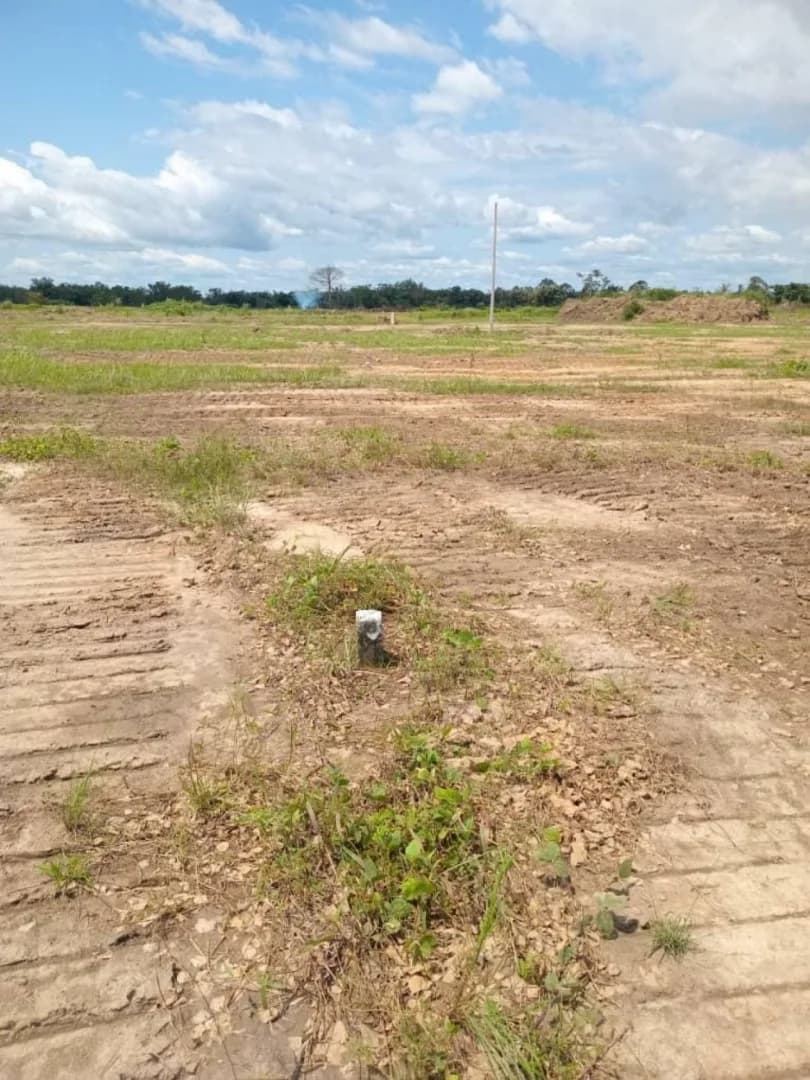
A chartered surveyor registered with the Order of Chartered Surveyors of Ivory Coast (OGECI) records the exact GPS coordinates of each boundary marker, confirms the actual area against the cadastre, and draws up an official boundary survey report (procès-verbal de bornage).
Boundary disputes are, along with multiple sales, one of the most frequent sources of litigation in Ivorian land matters. Skipping the boundary survey means exposing yourself to a costly rectification procedure a few years down the line.
The Single National Geodetic Reference System (RGCI-2019)
Since Decree No. 2019-220 of March 13, 2019, all chartered surveyors work on a single national geodetic reference system. No more disagreements between two surveyors each using their own coordinate system. If a recent boundary survey produces coordinates that do not match those on an official plan, that is a signal: an error, an approximation, or fraud. Insist on RGCI-2019 consistency in the boundary survey report.
Step 6: Run the "Land Reputation" Investigation
A classic case. The file is impeccable on paper: a valid ACD, boundary survey done, notary ready, and everything grinds to a halt at the last minute because a family claims customary rights that were never extinguished. The papers are good, but the local community disputes the original transfer.
Question the village chief and, in rural areas, the Village Rural Land Management Committee (CVGFR). Talk to the immediate neighbours, who almost always know who really owns the parcel next door. Stop by the town hall to spot any ongoing dispute.
A locally contested plot, even with a valid ACD, remains a risky plot.
Stellionat, a Fraud Defined by Law
The Urban Planning Code (Law 2020-624, article 3) defines stellionat as "the fraudulent manoeuvre that consists in selling a property one no longer owns, or mortgaging it a second time without the knowledge of the previous creditor, or presenting it as free of mortgage when it is encumbered by one". The perpetrator of this fraud faces imprisonment of one to five years and a fine of 300,000 to 3,000,000 FCFA (article 278 of the same law), nullity of the deed, and damages.
It is one of the land scams with the heaviest consequences in Ivory Coast. Three typical signs.
- The seller refuses to provide an État Foncier less than 15 days old, because they know a subsequent transfer would show up on it.
- The seller insists on closing the transaction "fast" and without going through your notary.
- Several old "promises of sale" for the same parcel are circulating among people close to the seller.
Your defence: demand a dated État Foncier, cross-check it against the IDUFCI on the SIGFU, use a notary of your own choosing and never the seller's, and above all talk to the immediate neighbours.
Phase 4: Sign and Pay in the Right Order
Step 7: The Mandatory Visit to the Notary
In Ivory Coast, private deeds, meaning contracts drafted and signed between the parties without a notary's involvement, have been formally prohibited in urban land transactions since Ordinance No. 2013-481 of July 2, 2013, a principle carried over into the Urban Planning Code (Law No. 2020-624). A "paper signed in someone's living room" therefore has strictly no legal value for transferring ownership of land.
The notary is not a prudent option. It is a legal obligation, and any transaction that bypasses it is null and void.
Choose your own notary, and do not blindly accept the one the seller imposes. Your notary authenticates the documents, drafts the deed of sale, and handles publication with the Land Registry.
Step 8: Secure Payment and KYC Compliance
Cash payment is legal, but dangerous and tightly regulated. It requires impeccable documentation, a reservation contract and official receipts, and KYC (Know Your Customer) applies under Law No. 2016-992 against money laundering: proof of identity and of the origin of the funds.
A bank transfer, by contrast, offers full traceability. Never transfer money to an intermediary's personal account. The transfer goes to the account designated by the notary, or to the seller's account as identified by their notary.
The notarial escrow account is the method Capital Foncier recommends. The funds remain blocked in an account held by the notary until the final deed is signed and the verifications are completed. If the transaction falls through, the funds return to the buyer.
Phase 5: After Signing, the Work Continues
Step 9: Oversee the Transfer and Registration
After the deed of sale is signed before the notary, three formalities follow automatically through the administrative chain (SIGFU). You do not have to trigger them yourself, but you must track their progress.
- Registration of the deed at the Land and Mortgage Registry (DGI).
- Payment of the duties on the transaction. Note: the registration duty exemption for first-time buyers only applies to homes in approved real estate programmes. For a land purchase, duties remain payable at the DGI's standard rates.
- Recording of the land title in your name in the Land Register. The transfer is materialised by the Certificate of Land Ownership Transfer (CMPF), issued by the Registrar, for a cost of around 15,000 FCFA and a timeline of around 15 working days.
The CMPF is your official proof that the transfer is recorded in the Land Register. It is the "bankable" document: banks accept it as collateral documentation for a mortgage. Ask your notary for a certified copy, and check in parallel that the parcel's IDUFCI is properly linked to your name on the SIGFU.
Step 10: Occupy and Protect the Land
A plot that is bought and left abandoned for two years is an open invitation to squatting and third-party claims. Three concrete actions: put up a fence, a low wall, or trees to visibly mark your occupation; pay the annual property tax to the DGI; and entrust surveillance to a trusted person, family or a professional caretaking service.
A 2026 reminder: the property wealth tax on bare urban land has been 1% since the 2025 Tax Annex, and land newly acquired from 2025 onwards benefits from a 2-year exemption. Paying this tax every year, even for a modest amount, leaves a public trace of your occupation. It is also a real deterrent to squatting.
To Go Further
Glossary
- ACD, Definitive Concession Order
- Land Title (Titre Foncier)
- CMPF, Certificate of Transfer
- ADU, Right-of-Use Attestation
- Attestation Domaniale
- État Foncier · État Domanial
- IDUFCI · SIGFU
- Stellionat · Private Deed (Sous Seing Privé)
Read Next
- ACD vs Land Title: The Ministry's Official Position
- The 5 Official Terms of Ivorian Land Law
- Why Private Deeds Have Been Prohibited Since 2013
- Challenging a Fraudulent ACD Before the Council of State
Official Resources
- servicepublic.gouv.ci, official procedures
- construction.gouv.ci, Ministry of Construction (MCLU)
- sigfu.gouv.ci, Integrated Urban Land Management System
- idufci.construction.gouv.ci, Unique Land Identifier
- dgi.gouv.ci, Land Registry
- afor.ci, Rural Land Agency
- MCLU call centre: 13 78 (Monday to Friday, 8 a.m. to 6 p.m.)
Official sources cited:
- Ordinance No. 2013-481 of July 2, 2013 (land reform, repealed and incorporated by article 302 of Law No. 2020-624; cited as the historical origin)
- Law No. 2020-624 of August 14, 2020, Urban Planning and Urban Land Domain Code
- Law No. 2024-351 of June 6, 2024 (amending law)
- Law No. 98-750 of December 23, 1998, amended by Law 2019-868 (rural land)
- Organic Law No. 2020-968 of December 17, 2020 (Council of State), which repealed Law No. 2018-978 of December 27, 2018
- Law No. 2019-576 of June 26, 2019 (Construction and Housing Code)
- Law No. 2016-992 (anti-money laundering)
- Decree No. 2019-220 of March 13, 2019 (new national geodetic reference system, RGCI-2019)
- Decree No. 2019-221 of March 13, 2019 (IDUFCI)
- Decree No. 2021-783 of December 8, 2021 (procedure for forfeiture of rights)
- Decree No. 2021-784 of December 8, 2021 (subdivision plans: establishes mass titling, art. 31)
- Decree No. 2021-785 of December 8, 2021 (ACD issuance procedure)
- Decree No. 2021-862 (SIGFU)
- Ordinance No. 2025-85 of February 12, 2025 (SIFOR-CI)
- 2024, 2025, and 2026 tax annexes (Finance Law No. 2025-987 of December 19, 2025)
- Ministry of Construction, BÂTIR N°000 (October to December 2019), 11-step ACD procedure, pp. 17 and 19
Preparing a purchase, or have doubts about a file in progress? Our advisers review the documents and guide you towards a secure structure for your transaction.