Chargement...
Chargement...
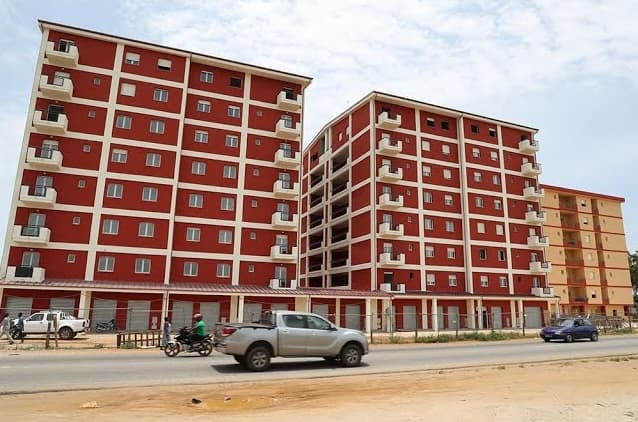
Ruling No. 311 of the Council of State (2021), appeals dismissed in 2022 and again in 2025, and a demolition order revoked in late July 2026: what the public record of the Italia Construction case in Modeste (Grand-Bassam) establishes, what it does not, and the eight due-diligence reflexes it imposes on every buyer.
Need a land expert?
Speak with an advisor for free. Response within 2 hours.
This article is based exclusively on public sources: the case-law database of the Council of State of Côte d'Ivoire, legal notices published on Abidjan.net, official communications from the Ivorian government, and the Ivorian press (KOACI, Abidjan.net, AIP, Pouvoirs-Magazine, Le Perroquet Libéré, among others). Some of the reported elements come from a single press investigation whose website is now inaccessible: these elements are systematically presented in the conditional tense and attributed to their source. No accessible court decision establishes any criminal offence against the companies or individuals mentioned, all of whom enjoy the presumption of innocence. Any party cited may exercise a right of reply by writing to akadio@capital-foncier.com.
On 28 July 2021, the presidential chamber of the Council of State of Côte d'Ivoire dismissed the appeal filed by Italia Construction against a 2017 definitive concession decree covering a 26,000 m² plot in the village of Modeste (Grand-Bassam municipality). On this plot, the developer — presented at the time by the State as its partner for around 3,000 housing units — had reportedly already built. This ruling No. 311, listed in the Council of State's case-law database, did not stand alone: two further appeals by the developer were dismissed, in 2022 (ruling No. 77, inadmissibility) and then on 23 July 2025 (ruling No. 455, dismissal), definitively closing the administrative front of what the press has called "the Italia Construction affair" (sometimes spelled "Ital Construction"). And on 27 July 2026, the press review of the Ivorian Press Agency (AIP), relaying the weekly Le Canard déchaîné, reported that a court decision had ordered the demolition of buildings constructed by the company — information that went viral the next day on social media, but whose jurisdiction, references and terms have yet to be published. Around these facts revolve considerable grey areas: a chain of titles allegedly overlapping on the same site, a customary rights buy-out reportedly carried out twice, a chieftaincy conflict more than twenty years old between Modeste and Moossou, and buyers whose fate is documented nowhere. For any buyer or investor, this case is a textbook example: it illustrates, better than any argument, why prior documentary verification (land status, topographic extract, exact identification of the seller) is not a formality but the survival condition of any land project.
| Indicator | Value | Source |
|---|---|---|
| Area of the plot at the heart of the administrative dispute | 26,000 m² (Land Title No. 7121, Grand-Bassam land registry district) | KOACI, 7 September 2021 |
| Date of the contested definitive concession decree | 21 December 2017 (decree No. 17-01665/MCLAU/DGUF/DDU/COD-AEI/KEV) | KOACI, 7 September 2021 |
| First Council of State verdict | Dismissal of Italia Construction's appeal, 28 July 2021 (ruling No. 311) | Council of State case-law database (Comoé Database) |
| Subsequent appeals by the developer | Ruling No. 77 of 30 March 2022 (inadmissibility); ruling No. 455 of 23 July 2025 (dismissal) | Council of State case-law database (Comoé Database) |
| Duration of the administrative front (2017 decree → ruling No. 455) | 7 years and 7 months | Calculation based on official dates |
| Reported demolition order | Late July 2026 — unpublished decision (jurisdiction and terms unknown) | AIP, press review of 27 July 2026, relaying Le Canard déchaîné |
| Age of the underlying customary conflict (Modeste/Moossou) | 20 to 24 years according to sources | AIP, KOACI, Ivorian press |
| Amounts reportedly invested by some buyers | 50 to 80 million FCFA per property (press allegation, unverified) | Le Perroquet Libéré (indexed extracts) |
The village of Modeste extends on either side of the Abidjan-Grand-Bassam axis, between Mockey-ville and the Port-Bouët boundary — one of the most coveted corridors of Greater Abidjan. An N'zima village whose administrative recognition dates back to 1930, Modeste has for twenty years combined all the ingredients of Ivorian land tension: a strategic position at the exit of the economic capital, a national housing programme that has mobilised significant tracts of land there, and a customary authority conflict with the Abouré royalty of Moossou over who can sign village certificates and collect the buy-out of customary rights.
As early as March 2012, the people of Modeste blocked the expressway to denounce the "sell-off" of their lands. In August 2013, emissaries from the King of Moossou demonstrated in front of the Ministry of Construction against the handover of a customary rights buy-out cheque to the chief of Modeste. The administration publicly replied that unregistered land belongs to the State and that Moossou had produced no title. The press of the time reported 81 hectares intended for the presidential housing programme on Modeste's territory and a 60 million FCFA advance cheque paid to the village chief by the Land Management Agency (AGEF). At the time, the buy-out of customary rights was governed by decree No. 2013-224 of 22 March 2013, amended by decree No. 2014-25 of 22 January 2014, with a scale ranging from 600 to 2,000 FCFA/m² depending on location.
It is against this already inflammable backdrop that a property developer with an unusual profile arrives.
| Actor | Role in the case | What is documented |
|---|---|---|
| Italia Construction SARL | Property developer of the Modeste site (Cité Corail) | Ivorian-law company registered in Grand-Bassam in March 2016 (RCCM CI-GRDBSM-2016-B-3589, capital 10 million FCFA), managed by Mame Mar Ndoye, with individual Italian partners. The press presents it as linked to an Italian group; the legal notices show only individual partners. |
| The Ivorian State | Publicised partner of the developer, then victorious opposing party in the litigation | Official communication of September 2021: partnership "established in 2016" for 3,000 housing units. The same Ministry of Construction issued the 2017 decree challenged by Italia Construction, and won before the Council of State. |
| Tiahmo Rauf | Beneficiary of the 2017 definitive concession decree | Presented by the press as early as 2011 as president of the American African Arab Group (AAAG), then in 2021 as an American economic operator. According to a press investigation that has remained the only one of its kind, the ministry allegedly awarded his group, as early as 2012, a plot of more than 25 hectares in Modeste. |
| A third titled owner | Holder, according to the Perroquet Libéré investigation, of Land Titles No. 5204 and 5924 that the construction site allegedly annexed from 2018 | Not named in accessible public sources. His rights were reportedly consolidated by a definitive concession in 2016; he reportedly declined an amicable settlement proposed in late 2019 by the ministry's Inspectorate General and sued the developer before the Grand-Bassam court. |
| The chieftaincy of Modeste | Customary authority signing village certificates | Chief recognised by the administration; in judicial conflict with the Moossou royalty since the 2000s. |
| The Moossou royalty | Competing customary authority | Contests Modeste's legitimacy to transfer the lands; convicted in absentia in 2016 of forgery and use of forgery, a conviction set aside by an opposition two days later — the press reports in 2026 that the King was ultimately unsuccessful on appeal and then before the Court of Cassation. |
| The buyers | Subscribers of villas and apartments on the site | A spokesperson for a buyers' mutual mentioned in 2021 an agreement signed with the developer "since 2017". Their current situation is documented nowhere. |
This section relies essentially on the investigation by Le Perroquet Libéré, an Ivorian investigative weekly whose website is now offline — its content is now only accessible through extracts preserved in search engine indexes. It must therefore be read entirely in the conditional tense.
According to this investigation, the Ministry of Construction allegedly allocated, by letter dated 1 June 2012, a 256,612 m² plot in Modeste to the American African Arab Group, holder of Land Title No. 3640 of the Bassam district; this parent plot was then reportedly subdivided into lots with definitive concession decrees. Two years later, on 22 May 2014, the chief of Modeste village reportedly issued a customary certificate covering approximately 10 hectares to a family holding customary rights, which allegedly transferred these rights to Italia Construction through a buy-out agreement signed on 21 September 2016 — under the supervision, the investigation specifies, of the Ministry of Construction itself, for a value reportedly assessed at 1.6 billion FCFA. However, a competing version circulates: a certificate was also allegedly issued for the same lands by the Moossou royalty in April 2017 — in a customary authority conflict which the courts have since decided in favour of Modeste. Both accounts coexist in the public record without any accessible document to settle between them.
If this chronology is accurate, it already contains the anomaly that will trigger everything: the same area allegedly was the subject of a State allocation to a private group as early as 2012, of a customary rights buy-out paid by the State from 2013 for the housing programme, and then of a second buy-out — this time private — for the benefit of Italia Construction in 2016. Under standard land law logic, these acts are mutually exclusive: one does not buy out customary rights on land already bought out, and one does not customarily transfer land already allocated by the State.
The documented breaking point comes on 21 December 2017: decree No. 17-01665/MCLAU/DGUF/DDU/COD-AEI/KEV grants the definitive concession of a 26,000 m² plot, covered by Land Title No. 7121 of the Grand-Bassam land registry district, to Tiahmo Rauf, apparently in a personal capacity, whereas the 2012 allocation had reportedly benefited his group. This plot allegedly overlaps the site on which Italia Construction had built: a topographic extract from 27 September 2018 would show the developer's site encroaching on three distinct land titles (No. 3640, 7121 and 5204). Moreover, a 2.6-hectare plot exceeds the one-hectare threshold below which a prefect can sign by delegation: the act therefore automatically fell within ministerial-level authority.
Here is the procedural timeline reconstructed from public sources. Dates marked with an asterisk come from the single Perroquet Libéré investigation and remain to be confirmed against the original documents.
| Date | Event | Status of the information |
|---|---|---|
| 21 December 2017 | Definitive concession decree for the 26,000 m² plot (Land Title No. 7121) in favour of Tiahmo Rauf | Reported by the press (KOACI), corroborated by the existence of the litigation |
| 12 June 2018* | Administrative appeal by Italia Construction against the decree — unanswered | Single source |
| 27 September 2018* | Topographic extract said to show the overlap of Land Titles No. 3640, 7121 and 5204 | Single source |
| 12 December 2018* | Filing before the administrative chamber of an application for annulment on grounds of abuse of power | Single source |
| Unknown date | Eviction summons of Italia Construction by Tiahmo Rauf before the Grand-Bassam court section | Single source — outcome never documented |
| 17 December 2020 | Organic law No. 2020-968: the Council of State replaces the administrative chamber of the Supreme Court | Official text |
| 28 July 2021 | Ruling No. 311 of the presidential chamber of the Council of State: dismissal of Italia Construction's application | Adjudicated fact — listed in the official Council of State case-law database |
| 13 September 2021* | Notification of the ruling | Single source |
| 16 September 2021 | Official visit by the Secretary of State for Social Housing to Italia Construction's building sites, hailed as that of a "serious partner" | Government communication |
| 30 March 2022 | Ruling No. 77 of the Council of State: new appeal by Italia Construction against the ministry declared inadmissible (exact subject of the appeal not public) | Adjudicated fact — official case-law database |
| 23 July 2025 | Ruling No. 455 of the Council of State: dismissal of Italia Construction's appeal against ruling No. 77 itself — the administrative front closes definitively | Adjudicated fact — official case-law database |
| 27 July 2026 | The AIP press review, relaying Le Canard déchaîné, reports that the courts have ordered the demolition of buildings constructed by Italia Construction in a land dispute in Grand-Bassam | Institutional press — underlying decision not published |
| 28 July 2026 | A viral video (more than 80,000 views in a few hours) asserts demolition at the developer's expense and the return of the plot to a titled owner | Social media — details not corroborated |
Three lessons of temporality emerge from this table.
First lesson: administrative time. Three years and seven months elapsed between the contested decree and the first Council of State verdict, including approximately two years and seven months of court proceedings. Throughout this period, construction, sales and handovers continued on the site. An administrative land dispute in itself suspends nothing: accomplished facts accumulate while the law makes its way.
Second lesson: customary time. The authority conflict between Modeste and Moossou, the backdrop to all transfers on this territory, has lasted twenty to twenty-four years according to sources, with continuous judicial proceedings since at least 2016 and a Court of Cassation ruling that the Modeste chieftaincy invokes without its full reference being published. As recently as February 2026, the people of Modeste were marching on the Abidjan-Grand-Bassam axis against "land dispossession". Buying in a territory whose customary legitimacy is contested means inheriting a dispute that may be older than the project itself.
Third lesson: enforcement time. Ruling No. 311 validated the concession granted to Tiahmo Rauf as early as July 2021. Yet the developer continued his appeals (dismissed in 2022, then definitively in 2025) and, above all, his handovers: 1,405 keys handed over in February 2025 during an official ceremony on the Modeste site, a modern market donated to the village in October 2025 — three months after ruling No. 455 that closed the administrative avenue. If the demolition order reported in late July 2026 is confirmed, it will have taken nearly nine years, counted from the 2017 decree, for an enforceable outcome merely to be announced. Winning a land case is one thing; enforcing it is manifestly another.
This is the most important point in the entire file, and the one most often distorted. The Council of State's case-law database lists ruling No. 311 of 28 July 2021, "Société Italia Construction v/ Minister of Construction, Housing, Sanitation and Urban Planning", with a clear outcome: dismissal.
This dismissal establishes one thing only: Italia Construction's appeal against the 2017 decree did not succeed. The definitive concession granted to Tiahmo Rauf emerges reinforced. Since the full text of the decision is not published online, it is unknown even whether the dismissal was on the merits or for procedural reasons — the administrative appeal, if it was indeed lodged nearly six months after the decree, may have exceeded the two-month time limit that usually restricts prior administrative appeals, which would open the hypothesis of simple forfeiture. Without the text of the ruling, no decision can be made.
On the other hand, what the ruling does not do deserves to be said with equal clarity: it condemns no one. It establishes neither fraud, nor unauthorised construction, nor sale of another's property — the labels "scandal" or "scam" that are circulating come from press headlines, mainly from the Perroquet Libéré investigation, and have not been enshrined in any accessible court decision. The same applies to the two subsequent rulings: the 2022 inadmissibility and the 2025 dismissal reject the developer's appeals, they impose no sanction. No criminal complaint from subscribers, no arrest warrant and no prosecution targeting the company or its manager could be documented in the public sources consulted.
Two confusions that the press has sometimes maintained should be avoided. The "actively sought swindler" referred to in some articles on Modeste land is an entirely different individual, subject to a 2016 wanted notice for illicit sales of village lands, with no established link to Italia Construction. And the request for a general audit of the Ministry of Construction made in March 2025 by MP-journalist Assalé Tiémoko concerns, in the verified articles, the Bessikoi subdivision scandal in Djorogobité 2 (Abidjan), involving falsification of secured stickers and fraud on definitive concession decrees, with no mention of Italia Construction or Modeste.
On 27 July 2026, the daily press review of the Ivorian Press Agency (AIP), relaying the weekly Le Canard déchaîné, reported that a "land dispute in Grand-Bassam" had led the courts to order the demolition of buildings constructed by Italia Construction. The next day, a video posted on Facebook by an influencer followed by several hundred thousand subscribers exceeded 80,000 views in a few hours: it asserts that the developer will have to raze his buildings at his own expense and return the plot to its titled owner, after approximately nine years of proceedings.
Our verifications, carried out on the Council of State's case-law database and on the press, allow us to sort what is established from what remains to be confirmed.
What is verified. The Council of State's official database confirms two decisions after 2021 that media coverage had never reported: ruling No. 77 of 30 March 2022, which declares inadmissible a new appeal by Italia Construction against the Ministry of Construction, and ruling No. 455 of 23 July 2025, which dismisses the appeal filed by the company against ruling No. 77 itself. In other words, the developer has exhausted the administrative avenue, and definitively lost it in the summer of 2025 — seven years and seven months after the decree that originated the dispute. The AIP relay of 27 July 2026 also establishes that a demolition order was indeed reported by the Ivorian written press: this is a publication fact, coming from a public agency.
What is not verified. The demolition decision itself is published nowhere: neither its jurisdiction (a demolition order at the builder's expense would more likely fall within the judicial courts — Grand-Bassam court, court of appeal — whose decisions are hardly ever posted online), nor its exact date, nor its scope, nor its terms. The Council of State's database contains no July 2026 decision mentioning the case. The name of the "titled owner" put forward by the viral video does not match any documented party in public sources: the identified holders remain Tiahmo Rauf (Land Title No. 7121) and, according to the Perroquet Libéré investigation, the AAAG (Land Title No. 3640) as well as a third owner, never publicly named, whose titles (Land Titles No. 5204 and 5924, consolidated by a 2016 definitive concession) were allegedly annexed by the construction site from 2018 and who reportedly declined an amicable settlement proposed in late 2019 by the ministry's Inspectorate General before suing the developer before the Grand-Bassam court. As for the 20 million FCFA offer that was reportedly refused according to the video, no source corroborates it — it should be noted that in Modeste itself, a separate 2020 case (a commercial building demolished by the ministry after the refusal of a 5 million FCFA cheque) offers a precedent from which the viral narrative may have drawn.
Necessary caution. As long as the decision is not published or confirmed by a detailed official source, the demolition order must be treated as reported information: plausible, consistent with the file's trajectory — three administrative defeats for the developer, and a demolition basis that title holders were already invoking according to the press (articles 553 et seq. of the Civil Code, which govern the fate of buildings erected on another's land) — but unverifiable in its details: buildings concerned, deadlines, fate of occupants and buyers. The local climate adds to the confusion: Modeste is the scene of several parallel disputes (eviction of the SIAC company ordered in March 2025 in the "Cité Lagunaire" file, march of the population against "land dispossession" in February 2026, third-party appeals brought up to the Council of State in 2025), which viral narratives readily aggregate into a single story.
Three documented contradictions run through this file and have never been publicly resolved.
A developer celebrated three days after losing. The ruling adverse to Italia Construction was reportedly notified on 13 September 2021. On 16 September 2021, the Secretary of State for Social Housing visited the developer's building sites and publicly described him as a "serious partner", without any official source mentioning the litigation. The litigious State had just won against the developer whom the building State was celebrating. The two sequences coexist in the public archives without any document connecting them.
"Social" housing that may not actually be so. The 2021 official communication spoke of "economic and standing" housing — a nuance that the press largely erased by speaking of "social housing". In February 2025, the day after a handover of 1,405 keys from the Presidential Housing Programme organised on the Modeste site, one media outlet stated that Italia Construction was not part of this programme: its properties sell for between 30 and 50 million FCFA, outside the social range. Two articles published three days apart thus give frontally incompatible versions of the site's belonging to the public programme, without any accessible official list of approved operators to settle the matter. For a subscriber, the question is not trivial: buying in a State programme and buying from a private developer are two operations with very different protections.
Two "partnership" dates that do not refer to the same thing. The State refers to a partnership "established in 2016"; the spokesperson for a buyers' mutual spoke of an agreement signed "since 2017". These would actually be two separate agreements — one between the State and the developer, the other between the developer and subscribers — that no public document allows consultation. The existence, content and exact legal scope of the State-developer agreement remain, ten years later, unverifiable online.
The following elements are hypotheses of interpretation, built on the sources cited above. None constitutes a fact established by a court.
Building before securing the title. If the genealogy reported by the press investigation is accurate, Italia Construction started construction on the basis of a customary certificate and a private buy-out agreement — without having a definitive concession decree published in its name on the site concerned. Yet, under Ivorian urban law derived from ordinance No. 2013-481, only the definitive concession decree published in the Land Register effects the transfer of ownership. A customary buy-out, even conducted before the authorities, does not confer ownership: it extinguishes customary rights, nothing more. Building dozens of housing units on this basis alone amounts to building on a promise.
Failing to detect — or to address — the title conflict upstream. The topographic extract of September 2018 reportedly revealed the overlap of three land titles on the construction site. This type of anomaly is precisely what a land status requested from the Land and Mortgage Conservation Office (CPFH) and a contradictory topographic survey, carried out before any investment, are intended to reveal. If the overlap existed from the outset, a complete documentary verification carried out in 2016 could have revealed it before the first shov
Découvrez les terrains que Capital Foncier a vérifiés : titre publié, statut du lotissement contrôlé, et état domanial croisé.
Élargissez votre lecture avec d'autres facettes du foncier ivoirien.

The official platform construction.gouv.ci/mclulotissement makes it possible to verify whether a subdivision is approved, cancelled, or suspended — free of charge, in 5 minutes. Visual guide with the 7 form fields, the 3 statuses, and the pitfalls to avoid.
Lire l'article
Five bilateral tax treaties, one notable absence (USA-CI), four mandatory forms (2047, 2044, T1135, 8938): navigating the cross-border taxation of land investment in Ivory Coast from the diaspora. Educational guide, not personalized tax advice.
Lire l'article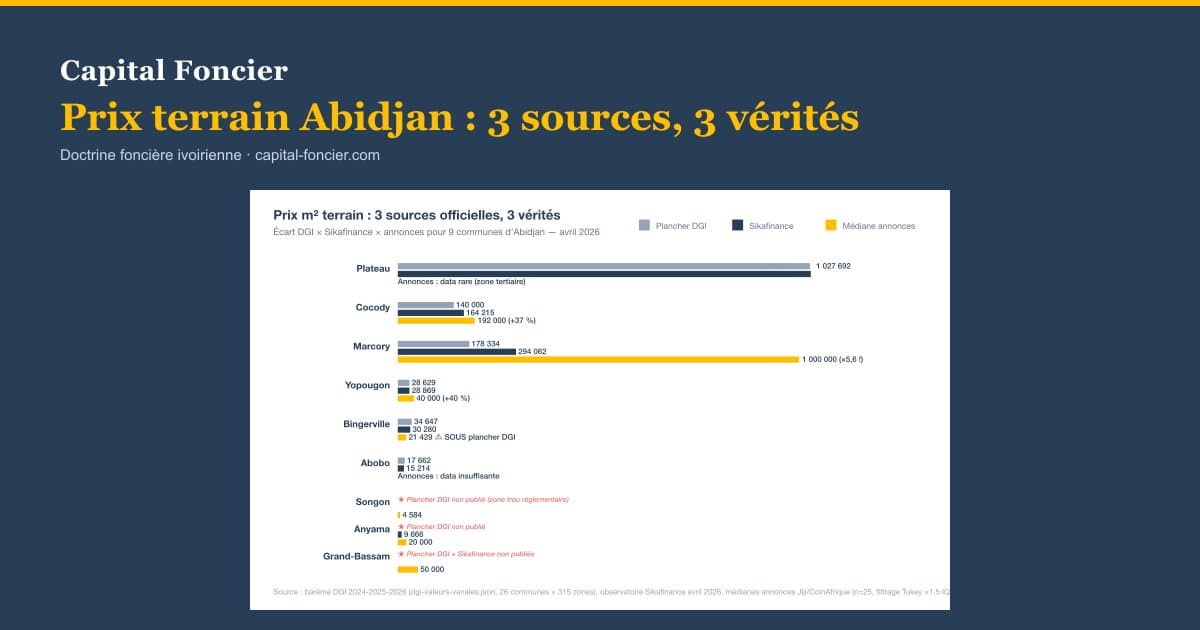
For the same plot in Marcory Zone 4, the DGI (Tax Authority) benchmark states 178,334 FCFA/m², the Sikafinance observatory reports 294,062 FCFA/m², and listings reach up to 1,000,000 FCFA/m². Who's right? All three. Breaking down the price gaps that can make or break a land investment.
Lire l'article