The 6 types of urban planning opinions in Ivory Coast: 20,150 applications decoded (2020-2023)
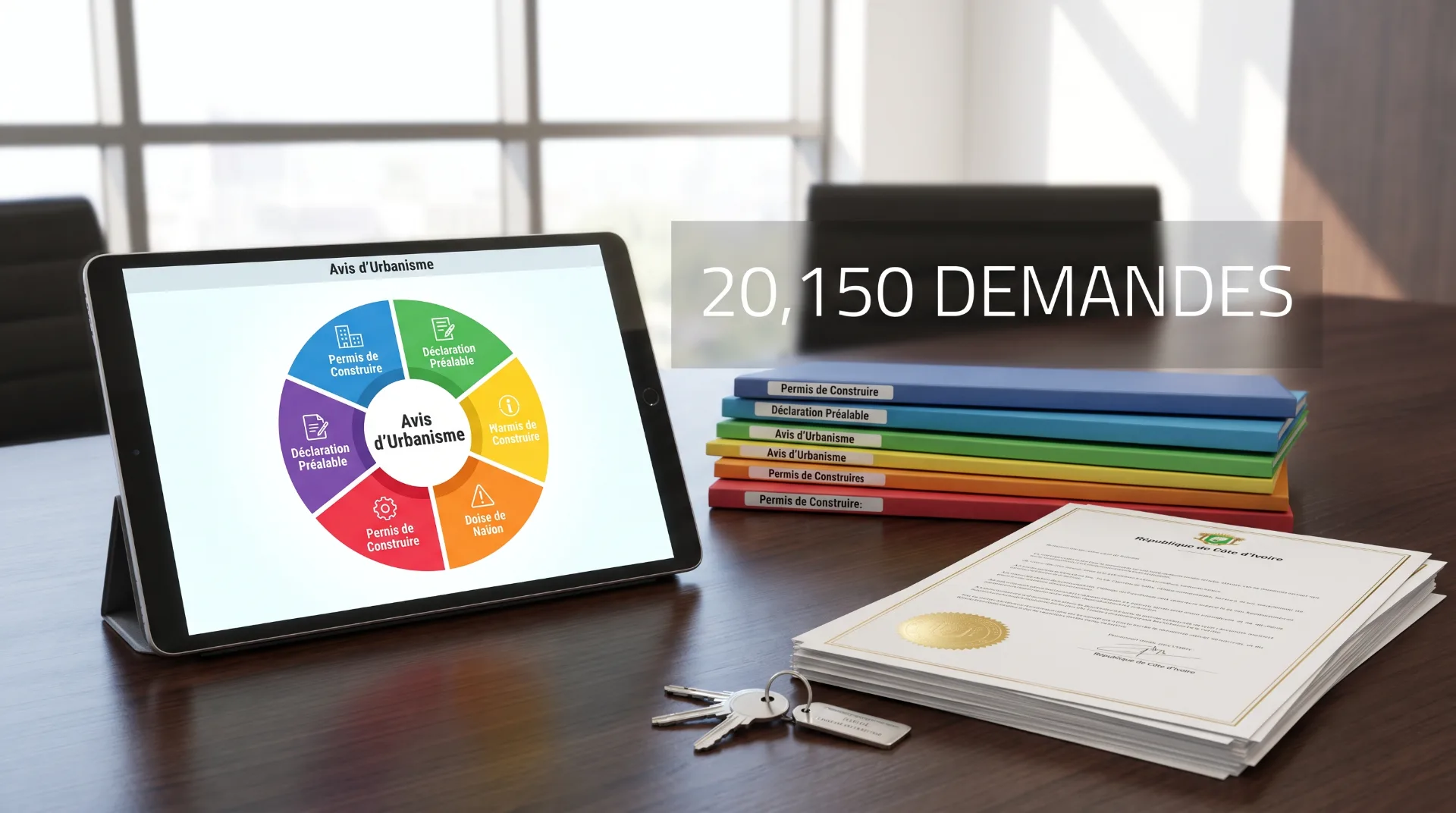
Between 2020 and 2023, the MCLU's DUDU received 20,150 applications for urban planning opinions. What each category means for a land project, and the real issuance rates.
Need a land expert?
Speak with an advisor for free. Response within 2 hours.
Key quotes
The sentences below can be quoted on their own. Every figure is tied to its dated official source.
- "Between 2020 and 2023, the Urban Planning and Urban Development Directorate (Direction de l'Urbanisme et du Développement Urbain, DUDU) of the Ministry of Construction, Housing and Urban Planning (MCLU) received 20,150 applications for urban planning opinions and issued 19,945 opinions." (MCLU statistical yearbook 2018-2023, Table 11.)
- "Urban planning easement opinions account for 17,890 opinions issued, or 90% of total volume." (MCLU yearbook, Table 11.)
- "Applications for declassification and modification show the lowest issuance rate, at 51.3%, against 94.4% for waivers." (MCLU yearbook, Table 11.)
In brief
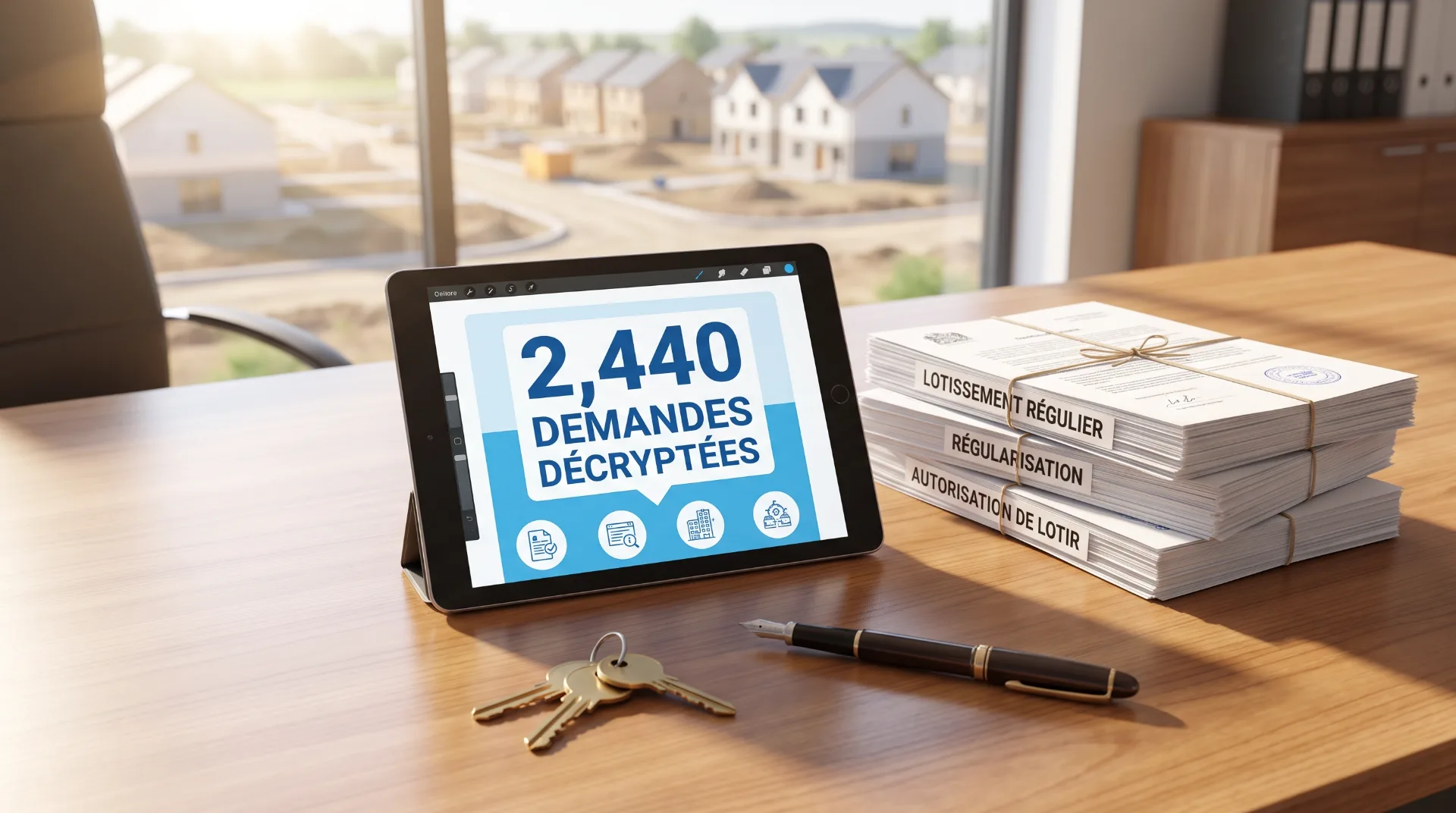
The MCLU's DUDU reviews six main categories of urban planning opinion (avis d'urbanisme), to which the subdivision permit (autorisation de lotir) is added as the rarest line in Table 11. Between 2020 and 2023 it received 20,150 applications and issued 19,945 opinions, a 99% response rate. Three categories concentrate the volume: urban planning easement opinions (17,890 opinions, 90% of the total), applications for a regular subdivision (1,095 opinions) and applications for declassification or modification (538 opinions). Each category matches a precise step, or a precise land situation. Understanding them means anticipating the administrative path of a project.
Key figures: applications for urban planning opinions 2020-2023
| Type of opinion | Applications | Opinions issued | Rate |
|---|---|---|---|
| Urban planning easement opinion | 17,890 | 17,890 | 100% |
| Application for a regular subdivision | 1,394 | 1,095 | 78.5% |
| Application for declassification and modification | 1,048 | 538 | 51.3% |
| Application for a subdivision under regularization | 996 | 812 | 81.5% |
| Application for a waiver | 658 | 621 | 94.4% |
| Application for a declaration of public interest | 51 | 48 | 94.1% |
| Application for a subdivision permit | 50 | 30 | 60.0% |
| Total 2020-2023 | 20,150 | 19,945 | 99.0% |
Source: MCLU statistical yearbook 2018-2023, Table 11.
Preparing a land project and unsure which urban planning opinion applies to you? A Capital Foncier adviser will locate your file and answer you within two hours. Run my land diagnostic.
1. The urban planning easement opinion, the pivotal document (90% of volume)
The urban planning easement opinion (avis de servitude d'urbanisme) is by far the most requested, with 17,890 opinions issued in four years. It is the document that sets out the easements applicable to an urban plot: building line, setback from the road, permitted footprint, maximum height, intended use of the zone, distance to utility networks, and easements for public infrastructure.
It serves to spell out the building rules applicable to a plot, to condition the issuance of the building permit, and to keep a project consistent with the master urban plan (Plan d'Urbanisme Directeur, PUD) or the urban planning master scheme (Schéma Directeur d'Urbanisme, SDU) in force.
When should it be requested? Ahead of any construction project, often when the preliminary sale agreement is signed, or just after.
The response rate reaches 100%. In concrete terms, the administration answers every compliant application, and a complete file goes through without particular friction.
2. The application for a regular subdivision, 1,394 applications in four years
The application for a regular subdivision (lotissement régulier) covers the creation of a new subdivision, compliant with the urban planning rules in force and with the applicable planning documents. It presupposes a base plot whose legal situation is clear and compatible with the PUD zoning.
It allows a plot to be divided into several lots intended for sale or for construction, an urban fabric to be created with its internal roads, common areas and utilities, and the administrative authorization required before any marketing to be obtained.
Of 1,394 applications filed, 1,095 opinions were issued. That 78.5% issuance rate reflects how selective the review is. Roughly one file in five is suspended or refused as it stands, usually because documents are missing or because adjustments are called for.
Before buying a lot, the benchmark to look for is the approved subdivision (lotissement approuvé), that is, the one that has received a favourable opinion from the DUDU. A subdivision that is not approved, or still going through the procedure, leaves the buyer in an intermediate situation that does not fully protect them.
3. The application for declassification and modification, 1,048 applications
This category covers projects that aim to change the administrative status of a plot or of an area, typically:
- Moving a plot out of an agricultural or natural zone and into a buildable zone.
- Changing the footprint of an already approved subdivision.
- Reclassifying a plot recorded within a public domain.
The issuance rate falls to 51.3%, the lowest of all the opinions reviewed by the DUDU, which says a great deal about how selective the procedure is. A declassification (déclassement) is not decided lightly: it opens or closes entire possibilities for a plot.
A declassification obtained changes the intended use of a plot, and therefore potentially its value. The reverse matters just as much: a plot whose declassification is refused keeps its original intended use, which can limit a construction project.
4. The application for a subdivision under regularization, 996 applications
These are applications concerning existing subdivisions that were never formally approved by the administration, or whose approval was suspended. Regularization consists in bringing the file into compliance with the rules in force.
It makes a pre-existing subdivision legally secure, it makes formal sale deeds on the lots possible, and it opens the way to the issuance of the ACD (Arrêté de Concession Définitive, Definitive Concession Decree) on the plots concerned.
996 applications filed in four years: the stock of subdivisions awaiting regularization remains substantial, and it is one of the historic friction points of Ivorian urban land. For a buyer, a lot located in a subdivision under regularization is not disqualified for that reason alone, but it does call for a specific check. Where does the file stand? Who is carrying the procedure? What timelines can reasonably be expected?
Important. A subdivision under regularization is not a doomed irregular subdivision, it is a subdivision working towards compliance. Even so, the absence of formal approval is information to have in hand before any preliminary sale agreement.
5. The application for a waiver, 658 applications
A waiver (dérogation) is an exceptional authorization granted to a project that, as it stands, does not comply with an urban planning rule: height, footprint, setback, intended use, density. It rests on a technical, planning or public interest justification.
The issuance rate reaches 94.4%. That high level mainly indicates that the files submitted are generally well argued, and that they concern situations where the waiver is technically justified.
The most frequent cases:
- Moderate excess over the maximum height authorized in a zone.
- Modification of an easement to take a topographical constraint into account.
- Adaptation of a subdivision's rules to a particular development programme.
For a buyer, a plot that needs a waiver for the intended project is not blocked, but it depends on one further administrative decision. That can be planned for, with the corresponding allowance for time.
6. The application for a declaration of public interest, 51 applications
The declaration of public interest (déclaration d'utilité publique, DUP) is the procedure that allows the State or a local authority to acquire a property for a project of general interest: infrastructure, public facilities, urban development. It can lead to expropriation, with compensation in accordance with the rules in force.
Volume remains low, with 51 applications in four years, of which 48 opinions were issued. It is an exceptional procedure, reserved for major projects.
For a buyer, a DUP under way in an area close to the target plot is information worth having. It often signals a development project that will affect the area, one way or the other depending on its nature.
7. The application for a subdivision permit, 50 applications
The subdivision permit (autorisation de lotir) is the administrative act that precedes the creation of a new subdivision. It differs from the application for a regular subdivision: it covers the start of the procedure, whereas the application for a regular subdivision finalizes its approval.
Issuance rate: 60.0%. With 50 applications in four years, this is the least requested category.
A subdivision permit is not a building permit. It authorizes dividing the land and servicing it, not building on it. The individual building permit is still required for each building.
What the map of urban planning opinions means for an investor
Three readings for a diaspora investor.
- 90% of the DUDU's activity concerns the urban planning easement opinion. A serious buyer consults that opinion before any commitment. It is a habit to acquire, on the same footing as the état domanial (state land status report) and the état foncier (land registry status report).
- A subdivision under regularization is not a blockage, it is a signal. It calls for a check of the file with the administration, before any preliminary sale agreement.
- Waivers are obtained in 94.4% of cases, but that presupposes a file argued by an urban planning practice or by an experienced architect.
What this means for an individual buyer
Four reflexes for a resident who is buying.
- The easement opinion is indispensable. It is the official source that states what you may build on a plot.
- The approved subdivision is the standard to aim for. A regular subdivision that has received a favourable opinion from the DUDU offers a far sounder legal framework than a subdivision that has not been formally approved.
- An announced declassification calls for prudence. If an owner speaks to you of a future declassification to justify the price, remember that only 51.3% of applications are granted. No value appreciation projection can rest on a declassification that has not yet been obtained.
- A waiver is applied for beforehand, not afterwards. If your project depends on one, obtain it before you pay.
What Capital Foncier takes from this
Our reading comes down to three observations.
The DUDU handles more than 5,000 files a year, with a very high response rate. The administration works, provided it is presented with compliant files.
The urban planning easement is the pivotal document of the whole path. Many buyers are unaware of it or neglect it, and that is a mistake.
Every urban planning opinion has a period of validity. An old opinion may no longer reflect the current reality of a plot, so always ask for a recent document.
Further reading
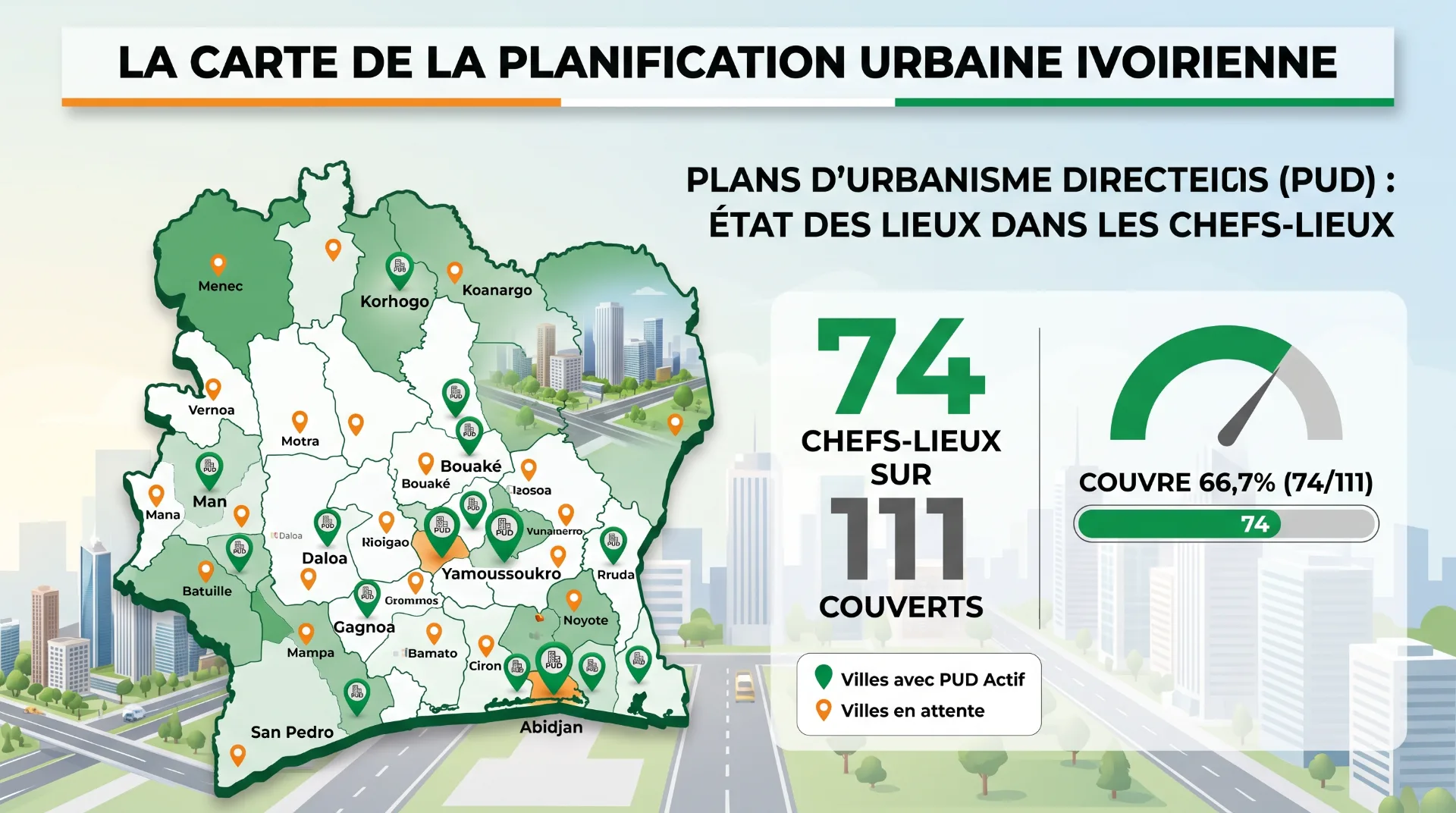
- Master urban plans: 74 of 111 regional capitals covered
- Housing deficit: 827,753 units to build
- The ACD procedure: steps and documents
- Due diligence guide: verifying a subdivision
Securing your land project
Do you want to check whether a plot calls for a specific urban planning opinion, a waiver or a regularization? A Capital Foncier adviser reviews your file and calls you back within two hours.
Run my land diagnostic: two minutes to describe your situation, and an adviser gets back to you.
Sources
- MCLU statistical yearbook 2018-2023, Table 11 (Direction de l'Urbanisme et du Développement Urbain, DUDU)
- Law No. 2020-624 of 14 August 2020 establishing the Urban Planning and Urban Land Code
- Ordinance No. 2013-481 of 2 July 2013 on the management of urban land
- Decree No. 2013-482 setting out the implementing provisions
About this article
Article written by the Capital Foncier team from the MCLU statistical yearbook 2018-2023. Initial publication: 6 May 2026. This article is educational in purpose. It constitutes neither legal advice nor individualized investment advice.
The Capital Foncier team, Abidjan, Ivory Coast
"Our mission is to secure every square metre bought by our investors, so that investing stays a pleasure."
?Frequently asked questions
How long does it take to obtain an urban planning easement opinion?+
Official timelines are set by the legal texts. In practice, the timelines actually experienced vary with the volume of files under review, the complexity of the plot and the quality of the file submitted. A complete file, filed in an area covered by an up-to-date PUD, moves faster than an incomplete file in a complex area.
Is there a fee for the easement opinion?+
Yes. The cost varies with the type of opinion and with the status of the applicant. Up-to-date information is available from the MCLU or on the government portals.
Is a negative easement opinion final?+
No, an unfavourable opinion is never the last word. It can be challenged through administrative channels (a request for reconsideration, then an appeal to the supervising authority) and then through the courts (the administrative judge). In practice, the most effective strategy often consists in adjusting the project so as to obtain a favourable opinion from the outset.
Can you build in a subdivision that has not been approved?+
In principle, no. Building in a subdivision that has not been approved exposes you to administrative penalties and to legal exposure. The recommended path consists in checking the status of the subdivision before any commitment, then in favouring subdivisions that are duly approved or on the way to regularization.
What distinguishes a waiver from an ordinary authorization?+
An ordinary authorization is obtained because the project complies with the general rules. A waiver is an exceptional authorization, granted despite a departure from the rule, justified by technical, planning or public interest considerations. It is reviewed case by case.