Declassification and public interest declaration: 1,099 cases in four years, what it changes for a buyer

Between 2020 and 2023, the DUDU processed 1,048 declassification requests and 51 declarations of public interest. What these two procedures change for a buyer.
Need a land expert?
Speak with an advisor for free. Response within 2 hours.
Key quotes
The sentences below can be quoted on their own. Every figure is tied to its dated official source.
- "Between 2020 and 2023, the Directorate of Urban Planning and Urban Development (Direction de l'Urbanisme et du Développement Urbain, DUDU) of the Ministry of Construction, Housing and Urban Planning (Ministère de la Construction, du Logement et de l'Urbanisme, MCLU) received 1,048 requests for declassification and modification and 51 declarations of public interest (déclaration d'utilité publique, DUP)." Source: MCLU statistical yearbook 2018-2023, Table 11.
- "The issuance rate for favorable opinions on declassification stands at 51.3%, the lowest of all urban planning opinions." Source: MCLU yearbook, Table 11.
- "In 2023, declassification requests jumped to 747 (against 132 in 2022) with an issuance rate falling to 32%, a sign of stricter review." Source: MCLU yearbook, Table 11.
In brief
The MCLU statistical yearbook 2018-2023 documents two urban planning procedures that can change the legal situation of a plot. The first is declassification and modification (déclassement et modification): 1,048 requests in four years, 538 favorable opinions. The second is the declaration of public interest (DUP): 51 requests, 48 favorable opinions. Declassification changes the official designated use of an area or of a lot. The DUP prepares an acquisition by the public authorities for a project of general interest. With an issuance rate of 51.3% for declassification, the lowest among the DUDU's opinions, both procedures are selective. For a buyer, knowing that they exist and how they work avoids acquiring a plot whose designated use could change, or that could be targeted by a public project.
Key figures: declassification and DUP, 2020-2023
| Procedure | Requests | Opinions issued | Rate |
|---|---|---|---|
| Declassification and modification | 1,048 | 538 | 51.3% |
| Declaration of public interest (DUP) | 51 | 48 | 94.1% |
| Total | 1,099 | 586 | 53.3% |
Source: MCLU statistical yearbook 2018-2023, Table 11 (DUDU).
Annual trend in declassification requests
| Year | Declassification requests | Opinions issued |
|---|---|---|
| 2020 | 108 | 108 |
| 2021 | 61 | 61 |
| 2022 | 132 | 132 |
| 2023 | 747 | 237 |
Source: MCLU yearbook, Table 11. 2023 accounts for the bulk of the requests and the issuance rate there falls to 32%.
Do you suspect that a plot could be affected by a declassification project or by a DUP? A Capital Foncier adviser runs the administrative verification for you. Start my diagnostic.
Declassification: when the official designated use of a plot changes
Declassification is the procedure through which a plot, or an entire area, has its official designated use amended in the planning documents. The typical cases:
- A plot recorded in an agricultural or natural zone is declassified into a buildable zone (residential, commercial, industrial).
- A plot belonging to the public domain is declassified into the private domain of the State, which opens the possibility of a transfer.
- A modification of the layout plan of an approved subdivision adjusts the footprint, the easements, or the designated use of certain lots.
What the figures say: with 1,048 requests in four years, the procedure is used regularly. Its issuance rate, 51.3%, is the lowest among the DUDU's opinions. In other words, roughly one request in two is refused or deferred. And 2023 alone accounts for 747 requests out of 1,048, with an issuance rate falling to 32%. That concentration suggests an accelerated effort to bring planning documents into line, reviewed more severely.
For the buyer, the stakes are concrete. A declassification actually obtained raises the potential value of the plot: an agricultural plot declassified into a buildable zone becomes residential land. A declassification that is merely promised, on the other hand, is a risk. The 49% refusal rate is a reminder that a verbal commitment from a seller or an intermediary about a future declassification has no enforceable legal value. Finally, a modification of a subdivision footprint can affect your lot: if a subdivision is going through a modification procedure, you need to check what is planned for the lot being offered to you.
No buyer should pay the "buildable" price for land whose declassification has not been formally obtained. The price gap between an agricultural zone and a buildable zone must reflect administrative certainty, not simply a commercial ambition.
The DUP: when the State or a local authority decides to acquire
The declaration of public interest (DUP) is the procedure through which the State, a local authority, or an authorized public body declares that a project serves the general interest. It opens the possibility of an amicable or a forced acquisition (expropriation) of the assets concerned, against compensation.
Typical cases:
- Construction of public infrastructure (a road, a bridge, a utility facility).
- Creation of a collective facility (a school, a hospital, a market, a station).
- A large-scale urban development program (a new planned district).
- A project of environmental interest (creation of a reserve, protection of a sensitive area).
What the figures say: 51 requests in four years is a low volume, and it points to an exceptional procedure. The issuance rate of 94.1% indicates that the files submitted are generally well prepared, since they are carried by public authorities or by authorized bodies. A DUP on your plot is therefore not frequent, but areas close to the large conurbations and to infrastructure projects mechanically concentrate more risk.
If a DUP concerns a plot already acquired, compensation is owed to the owner; the rules rest on the market value of the asset, on terms framed by the applicable texts. A DUP under way on a neighboring area is not neutral either: it can transform the dynamics of a district, positively (a new pole of attractiveness) as much as negatively (a long worksite, temporary nuisances, a change of designated use). And buying in an area where a DUP is contemplated calls for a specific check. What is the perimeter of the DUP? Is your plot included? What timelines and what compensation are provided for?
How to detect a declassification or DUP risk before buying
Four checks to run.
- Ask for an up-to-date état domanial (official state-land status report). It is the reference document for the current official designated use of a plot and for any procedure under way in the area.
- Consult the applicable Plan d'Urbanisme Directeur (PUD, Master Urban Plan) or Schéma Directeur d'Urbanisme (SDU, Urban Development Master Scheme). A declassification or a large-scale public project leaves traces in the planning documents. Ask for the version applicable to the area.
- Enquire with the DUDU services. Large DUPs are the subject of public communications, and subdivision modification or declassification projects are traced at administrative level.
- Check with the town hall (mairie) or the prefecture concerned. Local authorities are often the first to know about the development projects that could give rise to a declassification or to a DUP.
Warning signals in the seller's pitch
A few wordings that should prompt further checks.
- "The area is going to be declassified, the price will go up." If a declassification had been obtained, it would appear in the official documents. A declassification "to come" is a projection, not a fact.
- "There is a highway project next door, it is an opportunity." That may be true; it may also signal a future DUP that will affect the plot. To be verified.
- "The town hall will lift the easement next year." Lifting an easement goes through an administrative procedure. It is not decided by the seller, nor by an oral promise.
- "The subdivision is being modified to give you more surface area." A subdivision modification is an official procedure with a significant refusal rate. No commitment before the review is completed.
What the diaspora can take from this
For an investor at a distance:
- A declassification obtained is an asset; a declassification promised is a risk. Never pay the post-declassification price before the favorable opinion has been officially issued.
- A DUP is rare but not impossible. For a plot close to a public project area (infrastructure, urban planning), a systematic check is justified.
- Administrative information is accessible. An adviser or a specialist firm can verify these items remotely.
What the individual buyer can take from this
For a resident who is buying:
- The 49% refusal rate on declassifications speaks for itself. The procedure is selective, and no commercial projection should rest on a hypothetical declassification.
- A DUP is not necessarily bad news. If it concerns a useful public facility (a school, a health center, a road network), it can improve the area in the medium term.
- Vigilance is exercised upstream of signature. Once the notarized deed is signed, the room for maneuver narrows.
What Capital Foncier takes from this
Declassification is a controlled procedure, not a simple formality: one request in two is refused or deferred. The DUP, for its part, is rare but structuring, and its effects on a perimeter can be major. In both cases, prior verification remains the main tool. An informed buyer does not sign blind.
Going further
- The 6 types of urban planning opinion in Ivory Coast
- Regular subdivision versus regularization: 2,440 requests decoded
- État domanial, état foncier, tax status certificate: the 3 official documents
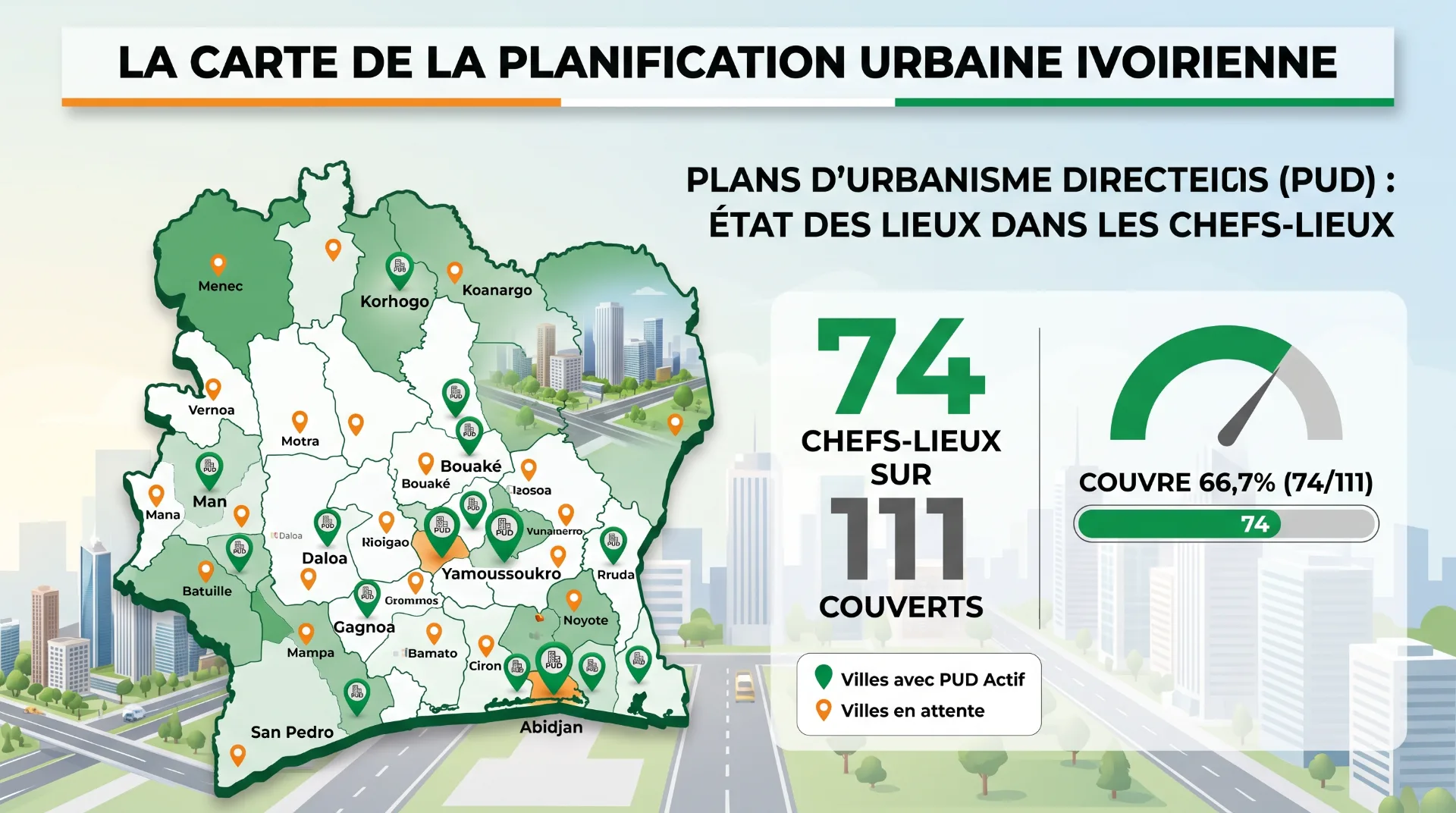
- Master Urban Plans: 74 departmental capitals out of 111 covered
Securing your land project
Do you want to check that a plot is not affected by a declassification project or by a DUP? A Capital Foncier adviser runs the administrative verification for you and calls you back within two hours.
Start my land diagnostic: two minutes to describe your project, and an adviser's feedback on the administrative situation of the plot.
Sources
- MCLU statistical yearbook 2018-2023, Table 11: Directorate of Urban Planning and Urban Development (DUDU)
- Law No. 2020-624 of 14 August 2020 establishing the Urban Planning and Urban Land Code
- Ordinance No. 2013-481 of 2 July 2013 on the management of the urban land domain
- Code de l'expropriation pour cause d'utilité publique (Code of expropriation in the public interest)
- Notation: the MCLU yearbook publishes its rates with a decimal comma and separates thousands with a space. This English version uses the decimal point, and the comma as a thousands separator, so the figures read the same as in the source.
About this article
Article written by the Capital Foncier team from the MCLU statistical yearbook 2018-2023. Initial publication: 13 May 2026. This article is educational in purpose. It is neither legal advice nor individualized investment advice.
The Capital Foncier team, Abidjan, Ivory Coast
"Our mission is to secure every square metre purchased by our investors."
?Frequently asked questions
Can a declassification happen without the owner being informed?+
A declassification initiated by the public authorities is the subject of notifications and of official publications. In practice, the owners concerned may be informed through various channels (the administration, the local authority). If in doubt, check directly with the DUDU services.
How much is paid out in the event of expropriation following a DUP?+
Compensation rests on the market value of the asset, on terms framed by the texts in force. Negotiation is in principle amicable; failing that, the court can be seized. An expropriated owner has administrative and judicial remedies available.
Can a declassification that affects your lot be challenged?+
Yes. Declassification decisions taken in the context of a subdivision or of an area can be challenged through a prior administrative appeal and then through litigation, in accordance with the texts applicable to administrative acts in Ivory Coast (Côte d'Ivoire).
Does a favorable declassification automatically increase value?+
Potentially, but not automatically. Value also depends on servicing, on access, on the local market, and on the legal status of the plot. A declassification is a favorable condition, not a sufficient factor.
Is the DUP the same thing as expropriation?+
No, these are two stages. The DUP declares the general interest and opens the possibility of acquiring the assets needed for the project. Expropriation, where it proves necessary, is the contentious procedure that follows if amicable negotiation fails.
How can I find out whether a DUP is contemplated in my area?+
By consulting the official publications, by enquiring with the town hall or the prefecture, and by checking a recent état domanial for the plot. Large-scale DUPs are generally preceded by public communications and by preliminary studies.