ACD, Land Title and CMPF: Three Documents, Three Legal Functions in Ivory Coast

ACD, Titre Foncier (Land Title) and CMPF: what each document proves, who issues it, what it costs, and at which point of the Ivorian urban land process it comes in.
Need a land expert?
Speak with an advisor for free. Response within 2 hours.
"The land has its papers", but which ones exactly?
It's a phrase you hear often, whether you're a diaspora investor or a resident in Abidjan. A property owner tells you that their land "has its papers." An intermediary shows you an official document. What remains is knowing which one: a Definitive Concession Decree (ACD / Arrêté de Concession Définitive), a Land Title (TF / Titre Foncier), or a Property Title Mutation Certificate (CMPF / Certificat de Mutation de Propriété Foncière)?
This confusion is normal. Ivorian land law distinguishes several documents that seem to play the same role. In reality, each one corresponds to a precise step of the journey, and confusing one with another can have serious consequences for your investment.
1. The ADU: the starting point since July 1, 2024
The Customary Land Use Certificate (ADU / Attestation de Droit d'Usage Coutumier) has been in effect since July 1, 2024 and replaces the old village attestation, which had no recognized legal value. Since January 1, 2025, it is issued free of charge. According to the Ministry of Construction (National ADU Campaign, 2025), the ADU is today the only document recognized by the State to attest to a customary right on land from a subdivision.
The ADU is issued by the MCLU (Ministry of Construction, Housing and Urban Planning) via the Single Land & Housing Window (GUFH / Guichet Unique du Foncier et de l'Habitat). It attests that an applicant effectively occupies a plot, but it does not confer ownership. Its role is strictly preparatory: it does not replace the ACD.
Two changes came in 2025. The circular note no. 0174/MCLU-CAB of April 1, 2025 extends the securing of customary information to subdivisions approved before the mass titling reform. And since March 31, 2025, any ACD application must be preceded by a request for a land position statement from the Single Land Window in your locality.
The ADU therefore proves a recognized occupation, not ownership.
2. The ACD: the act that confers ownership
Official definition
According to servicepublic.gouv.ci, the Definitive Concession Decree is "the sole and unique act that confers ownership of urban land". It is an administrative act signed by the Minister of Construction, Housing and Urban Planning (MCLU), based on Ordinance no. 2013-481 of July 2, 2013 and its implementing decree no. 2013-482.
Since January 2024, the ministerial signature has been electronic, through the SIGNE platform deployed by the MCLU. According to the Ministry (BÂTIR No. 008, Jan-Mar 2024), this reform raises the pace of signatures from about 1,000 to 2,000-2,500 ACDs per month.
Procedure and costs
Applications are filed at the Single Land & Housing Window. Phone: 27 20 21 74 78. The general MCLU call center answers on 1378, Monday to Friday, from 8am to 4:30pm.
| Profile | Official cost |
|---|---|
| Individual | 100,000 FCFA/lot + 1,000 FCFA/file + 50,000 FCFA |
| Company | 450,000 FCFA/lot + 1,000 FCFA/file |
| Association/NGO | 150,000 FCFA/lot + 1,000 FCFA/file |
Source: servicepublic.gouv.ci
On timelines, the texts of the Ivorian administration published in BÂTIR magazine No. 004 (Jan-Mar 2022) set the issuance of an ACD on a plot from an approved subdivision at 180 calendar days at the MCLU, excluding processing by the tax authorities. In practice, that timeline can run significantly longer, for reasons that are not always easy to explain: backlog, additional investigations, stays for oppositions, documents to complete, and back-and-forth between services.
The file comes in two parts. The technical part gathers the tracing, 21 A3 photocopies, the coordinate table, the surveyor's report, and the georeferencing. The administrative part gathers the form, the cadastral sheet, the ADU, the photos, and the national ID.
On volumes, the Ministry (BÂTIR No. 008, 2024) reports 17,000 ACDs issued in 2020, with a target of 24,000 to 30,000 per year thanks to SIGNE. The South-Comoé Regional Directorate alone issued 5,760 ACDs in 2024 (MCLU Newsletter, August 2025).
3. The Land Title: when the ACD is entered in the register
The ACD and the Land Title: two distinct steps in the same continuum
The ACD and the Land Title are not synonymous. The ACD is a unilateral administrative act by which the State definitively grants an urban plot. The Land Title is the real property right that arises from registration in the Land Register by the Land Property Conservation office, a service attached to the General Tax Directorate (dgi.gouv.ci).
The Land Title is created during the ACD procedure by the Land Property and Mortgage Conservation office (CPFH / Conservation de la Propriété Foncière et des Hypothèques, attached to the Ministry of Budget), at official step 3, before ministerial signature (step 5). Step 7 is publication in the Land Register, the step that makes the right enforceable against all. According to the texts, notification to the ministry must occur 24 hours after registration in the Land Register (Decree no. 2013-482, art. 4). In practice, the timeline between ACD signature and publication in the Land Register is often longer, for reasons that are not always easy to explain. This is not a transformation of the ACD into a Land Title: the ACD published in the Land Register is the Land Title published.
In summary, the ACD is the administrative act by which the State definitively grants the plot, challengeable before the administrative judge for abuse of power. The Land Title is the real property right registered in the Land Register, unchallengeable and imprescriptible under the Torrens system. The two are inseparable.
Legal properties of the Land Title
The Land Title is unchallengeable and imprescriptible. Created under the legal conditions, it can no longer be contested before any court. It is the strongest protection in Ivorian land law.
The IDUFCI: the unique identifier for each plot
Since Decree no. 2019-221 of March 13, 2019, each plot is assigned a Unique Ivorian Land Identifier (IDUFCI / Identifiant Unique du Foncier de Côte d'Ivoire). Think of it as the chassis number of a vehicle: it lets you verify the identity of the property independently of what the seller says.
According to the Ministry (BÂTIR No. 008, Jan-Mar 2024), the 322,462 km² of Ivorian territory are now recorded to the nearest square meter in the unique identifier, classified forests, military zones, residential areas, plantations, and industrial establishments included. Being recorded in the IDUFCI is not the same as being registered in the Land Register: the first identifies the plot, the second establishes the title.
Official platform: idufci.construction.gouv.ci
4. The CMPF: for the secondary market
When does it intervene?
The CMPF is not a starting point, it is a transfer act. It intervenes when you buy land that already has an ACD and a Land Title, that is, on the secondary market.
The CMPF formalizes the change of owner in the Land Conservation registers. Without it, the sale remains legally incomplete with respect to third parties. Its legal basis is found in article 223 of Law no. 2020-624 of August 14, 2020, which institutes the Code of Urban Planning and Urban Land.
Procedure, cost and timeline
| Element | Detail |
|---|---|
| Authority | Land Conservation, DGI ([dgi.gouv.ci](https://www.dgi.gouv.ci)) |
| Cost | 15,000 FCFA |
| Official timeline | 15 business days, in practice often longer |
| Documents | Application, notarized deed of sale, and national ID |
Source: servicepublic.gouv.ci
The CMPF is a bankable document, that is, accepted by banks as collateral for real estate credit.
5. The Rural Land Certificate: a distinct regime
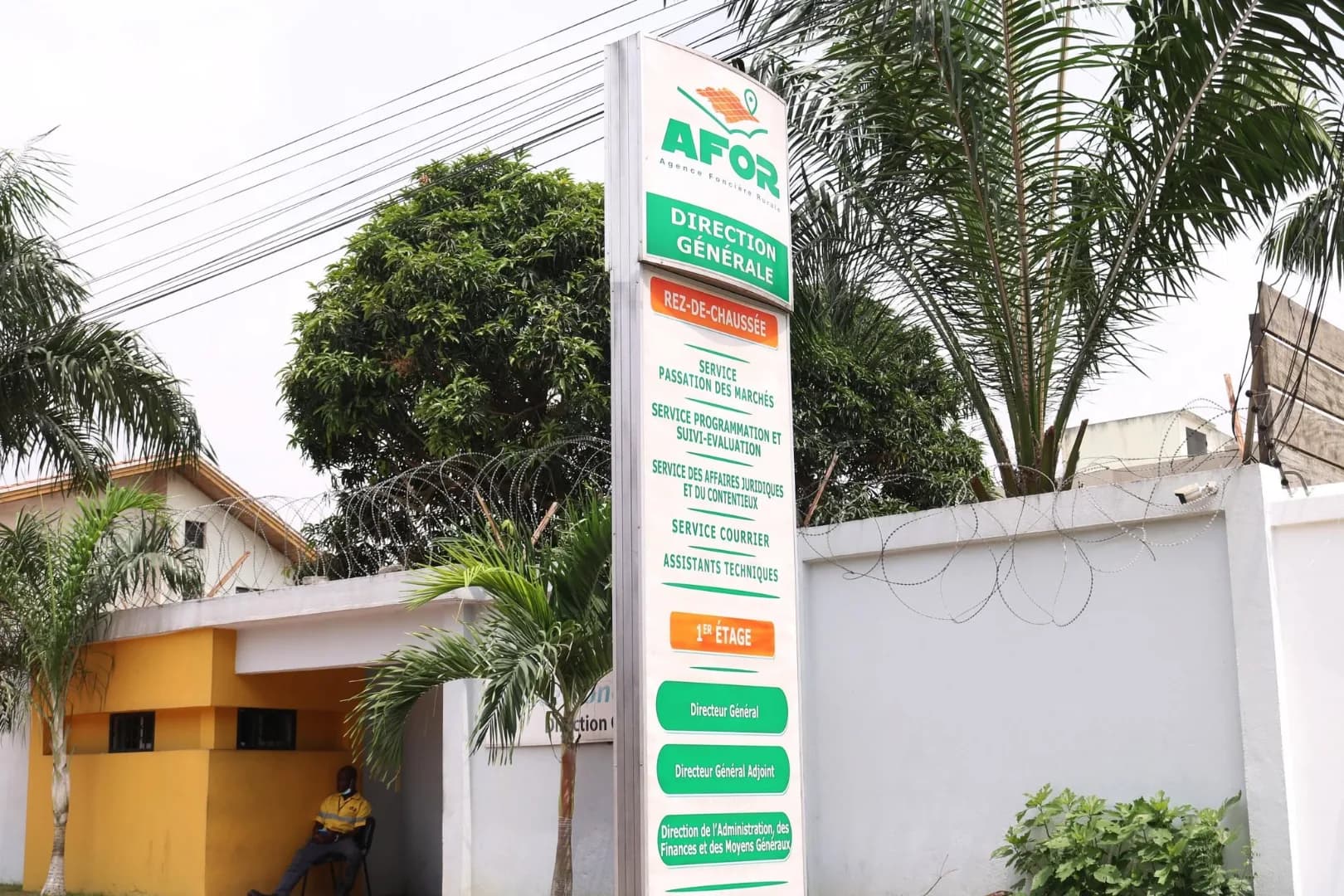
The Rural Land Certificate is an entirely different document from the ACD. It falls under the rural land regime, governed by Law no. 98-750, and it is issued by the AFOR (Rural Land Agency).
Worth remembering: if the owner of a plot in an urban zone presents you with a Rural Land Certificate, there is a major inconsistency to clarify before any discussion about price. The two regimes are not interchangeable.
6. Summary table: the six key documents
| Document | Authority | Zone | Cost | What it proves |
|---|---|---|---|---|
| ADU | MCLU / GUFH | Urban | Free | Recognized occupation, not ownership |
| Domain status | MCLU | Urban | 5,000 FCFA | Absence of domain allocation |
| ACD | MCLU | Urban | 100,000 FCFA (indiv.) | Ownership of urban land |
| Land Title | Land Conservation (DGI) | Urban | Included | Official registration, unchallengeable |
| CMPF | Land Conservation (DGI) | Urban | 15,000 FCFA | Transfer of ownership (secondary market) |
| Rural Land Certificate | AFOR | Rural | 10,000 FCFA (file) | Recognized customary rights |
7. Domain status or land status: which document to request?
| Domain status | Land status | |
|---|---|---|
| When? | Before Land Title creation | After Land Title creation |
| Where? | MCLU ([construction.gouv.ci](https://www.construction.gouv.ci)) | Land Conservation ([dgi.gouv.ci](https://www.dgi.gouv.ci)) |
| Cost | 5,000 FCFA | 3,000 FCFA |
| What it proves | The applicant recognized in SIGFU | The definitive owner and the absence of charges |
The rule is simple. No Land Title yet: ask the MCLU for a domain status. Existing Land Title: ask the DGI for a land status.
8. The three most common mistakes
First mistake: treating the ACD and the Land Title as two hierarchical levels. The ACD integrates the creation of the Land Title by the CPFH from step 3 of the procedure. These are not two titles of different levels, but the same act at two stages. Publication in the Land Register closes the process: as long as it is not done, the right is not enforceable against third parties. Systematically ask for the Land Title number and have it verified at the DGI.
Second mistake: believing that the village attestation is sufficient. Since July 1, 2024, it has been replaced by the ADU, the only document recognized by the State to attest to a customary right on a subdivision. Land with only a simple village attestation is at the very beginning of the process, and several steps still separate you from secure ownership.
Third mistake: verifying at the wrong window. Verification of an ACD is done at the MCLU. Verification of a Land Title is done at the DGI. These are two separate registers. An investor who knocks on the wrong door will not get a result, and might wrongly conclude that "the land has no papers."
Official sources:
- servicepublic.gouv.ci: ACD and CMPF fact sheets
- construction.gouv.ci: Ministry of Construction, Housing and Urban Planning
- dgi.gouv.ci: General Tax Directorate, Land Conservation
- idufci.construction.gouv.ci: IDUFCI platform
- afor.ci: Rural Land Agency
- Ordinance no. 2013-481 of 07/02/2013: rules of urban land
- Decree no. 2013-482 of 07/02/2013: 39 implementing articles
- Law no. 2020-624 of 08/14/2020: Code of Urban Planning and Urban Land
- Decree no. 2019-221 of 03/13/2019: creation of the IDUFCI
- Circular note no. 0174/MCLU-CAB of 04/01/2025: securing of customary information
- BÂTIR Magazine No. 004 (Jan-Mar 2022) and No. 008 (Jan-Mar 2024), Ministry of Construction
- MCLU Newsletter No. 028 (August 2025): National ADU Campaign
- Law no. 98-750: rural land
To learn more:
?Frequently asked questions
Is an ACD sufficient to buy with peace of mind?+
A valid ACD is legally sound. The Land Title is created by the Land Property and Mortgage Conservation office from step 3 of the procedure, even before ministerial signature. Publication in the Land Register (step 7) makes the right enforceable against all, and that is the step to verify during the transaction. As long as the ACD is not published in the Land Register, it remains valid but not yet enforceable against third parties. This is not a hierarchy ACD → Land Title, but a timeline internal to the procedure.
Can a Land Title be canceled?+
The Land Title is imprescriptible and unchallengeable once published in the Land Register (Urban Planning Code (Law No. 2020-624)). Corrections for material error exist. But under normal conditions, the ACD published in the Land Register, which materializes the Land Title, offers the strongest protection. Here again, these are not two hierarchical acts but the same act at two stages.
What does the CMPF add compared to a notarized deed?+
The notarized deed records the transaction. The CMPF formalizes its effects in the public registers (article 223 of Law 2020-624). Without the CMPF, you are the owner between you and the seller, but not with respect to third parties. The two are complementary.
What is the role of the IDUFCI?+
The Unique Land Identifier (Decree no. 2019-221) is assigned to each urban plot and is today deployed over the 322,462 km² of territory, to the nearest 1 m². It lets you find the documentary history of a plot on idufci.construction.gouv.ci, independently of what the seller says.
Are the timelines announced by the administration respected?+
The timelines displayed (180 days for the ACD, 15 days for the CMPF) are those set out in the official texts of the Ivorian administration. In practice, they can be much longer, for reasons that are not always easy to explain. Anticipating and checking progress regularly remains the recommended approach.