Chargement...
Chargement...
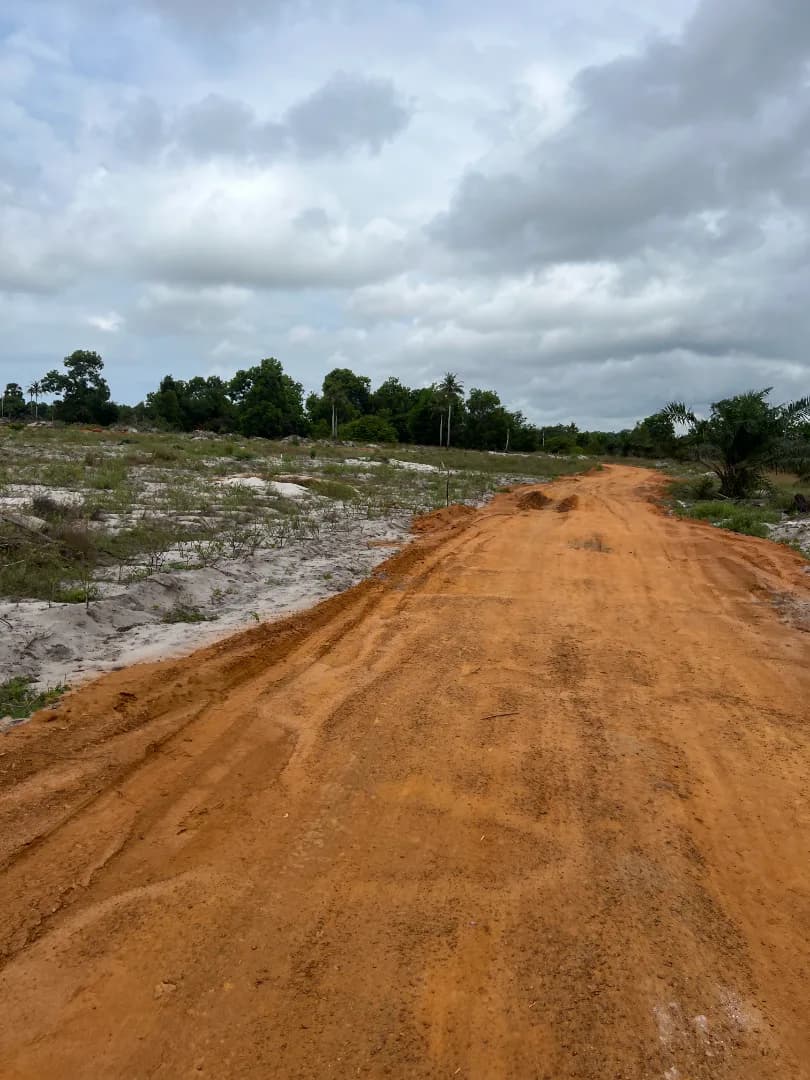
Understanding the essential process of clearing customary rights for urban development in Ivory Coast.
Need a land expert?
Speak with an advisor for free. Response within 2 hours.
In Ivory Coast, the majority of urban plots were originally customary lands belonging to village communities. Before a subdivision can be created and an ACD (Definitive Concession Decree) can be issued, the State must first purge customary rights — that is, compensate the communities holding these rights so that the land officially enters the State's urban land domain.
If this step has not been properly carried out, the plot remains legally contestable. And indigenous families can claim their rights — even years after the sale.
Understanding this mechanism is fundamental for any investor.
The purging of customary rights is the procedure by which the State compensates village communities holding traditional rights to a plot, in order to integrate it into the urban land domain. It is governed by:
According to the Ministry of Construction (BÂTIR nos Villes No. 0001, 2018), only the State is authorized to purge customary rights, for its own account or for that of territorial authorities. Private individuals can only proceed with purging through an agreement entered into with and on behalf of the State.
The purging order is the document that certifies that customary rights have been legally extinguished on the plot. Without this order, the subdivision cannot be approved.
Source: afor.ci — Decree No. 2019-266
Decree No. 2013-224 of March 22, 2013 amended by Decree No. 2014-25 of January 22, 2014 sets the official geographic purging rate. Amounts vary by zone:
| Geographic Zone | Official Rate (FCFA/m²) |
|---|---|
| Autonomous District of Abidjan | 2,000 |
| Autonomous District of Yamoussoukro | 1,500 |
| Regional Capital | 1,000 |
| Departmental Capital | 750 |
| Sub-prefecture Capital | 600 |
Source: Decree No. 2013-224 amended, cited in the official MCLU magazine "BÂTIR nos Villes" No. 0001 (January-February 2018).
Compensation related to crops is taken into account and settled separately, based on the assessment and rate established by the Ministry responsible for Agriculture.
Official purging timelines: the law provides regulatory timelines for each step (identification, verification, negotiation, ministerial order). In practice, these timelines can be much longer for various reasons that are not always clear (disputes, refusal by certain families, incomplete files, back-and-forth between departments).
The traditional method: the State pays a sum of money to the families holding rights, calculated on the basis of the official rate. Since the guidelines adopted by Minister Isaac De (BÂTIR nos Villes No. 0001, 2018), payments are now made by the Public Treasury directly to each holder's bank account (Bank Identification Number previously transmitted), and no longer through a third party. This safeguard aims to ensure that money actually reaches the beneficiaries.
The new MCLU guidelines now allow customary rights holders to receive real estate or developed plots as partial compensation for the resources owed under the purging. The objective is to convert agricultural rents into real estate rents — offering communities lasting patrimonial value rather than a one-time sum.
| Method | Advantages | Limitations |
|---|---|---|
| Cash via Public Treasury | Direct, traceable payment | Amount sometimes deemed insufficient, no lasting patrimony |
| In kind (developed lots — payment by delivery) | Lasting patrimony, integration into the city | Complex logistics, longer timelines |
Attached to the Cabinet of the Minister of Construction, the Service for Land Research for Major State Projects (SRFGPE) is responsible for:
Source: Magazine BÂTIR nos Villes No. 0001 (January-February 2018), interview with the Minister of Construction and M. Anikpo Yed Melei (then Head of the SRFGPE).
A land reserve is a plot that the State constitutes for public interest needs: roads, schools, health centers, green spaces, high-voltage lines, public infrastructure. These plots are non-buildable for private individuals.
For major infrastructure projects, the State has the SRFGPE (see previous section) within the MCLU. This service:
Source: construction.gouv.ci — MCLU
A plot located on a projected public footprint (future road, public utility zone) is a risky plot. Even if a seller offers it to you with a property document, construction may be prevented or demolished if the plot is within a land reserve.
How to verify: order a domain statement (5,000 FCFA from the MCLU) — it reveals whether the plot is subject to a public easement or is in a reserved zone.
Source: servicepublic.gouv.ci
If the purge has not been properly carried out — or if certain families have not been consulted — claims can emerge years later. These disputes are frequent in the expansion zones of Greater Abidjan (Songon, Bingerville, Anyama) where urbanization advances faster than purging procedures.
A subdivision whose purge is contested may see its approval order called into question. If the subdivision is annulled, the ACDs issued on its lots become void.
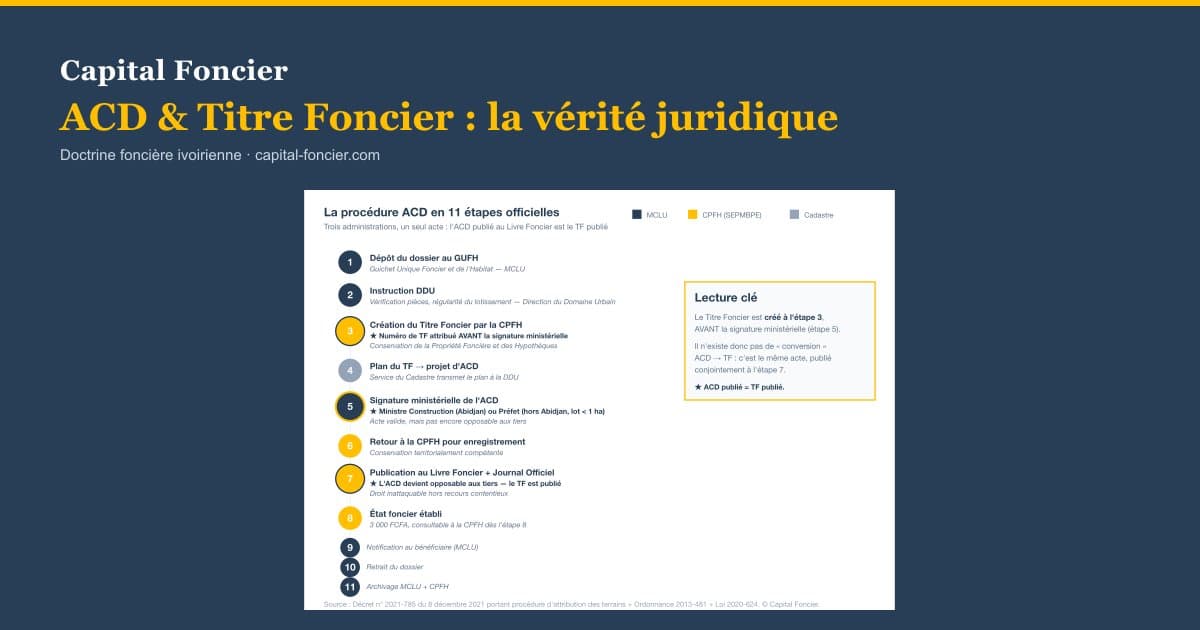
On a plot whose customary rights have not been purged, the ACD procedure cannot be completed. The file will be rejected at the GUFH (Single Land and Housing Window — Tel: 27 20 21 74 78).
Official Sources:
To Learn More:
It is the procedure by which the State compensates village communities to extinguish their traditional rights to a plot, in order to integrate it into the urban land domain. It is governed by Decree No. 2013-224 (amended by Decree 2014-25), Law No. 98-750, Decree No. 2019-266, and Ordinance No. 2013-481.
According to Decree No. 2013-224 amended, the geographic rate is 2,000 FCFA/m² in the Abidjan District, 1,500 FCFA/m² in Yamoussoukro, 1,000 FCFA/m² in a Regional Capital, 750 FCFA/m² in a Departmental Capital, and 600 FCFA/m² in a Sub-prefecture Capital. Crop compensation is calculated separately based on the Ministry of Agriculture's rate.
Découvrez les terrains que Capital Foncier a vérifiés : titre publié, statut du lotissement contrôlé, et état domanial croisé.
No. Only the State is authorized to purge, for its own account or for that of territorial authorities. Private individuals can only proceed with purging within the framework of an agreement entered into with and on behalf of the State.
Request the purging order from the seller or developer. Also verify the subdivision approval order at the MCLU — a subdivision can only be approved if the purge has been carried out. A domain statement (5,000 FCFA) confirms the status in the SIGFU.
The buyer is exposed to claims by indigenous families, to the annulment of the subdivision, and to the inability to obtain an ACD. The risk of total loss of investment is real.
Yes. Since 2018, the MCLU has introduced three innovations: targeting of true beneficiaries through the Village Chief and the President of the Land Management Committee, strengthened payment security through direct Public Treasury transfer, and the possibility of compensation in kind (developed lots — payment by delivery) rather than cash only.
Yes. Since Decree No. 2019-266, the CVGFR participates in the verification of customary rights. A CVGFR constituted without including at least one woman is irregular (AFOR FAQ).
The texts set regulatory timelines for each step (identification, verification, negotiation, ministerial order). In practice, timelines can be much longer for various reasons that are not always clear. Anticipating and getting professional support is the recommended approach.
Élargissez votre lecture avec d'autres facettes du foncier ivoirien.

Birth certificate extract, title deed, tax clearance, inheritance judgment: the real list of documents an Ivorian notary firm requires for a real estate sale, explained item by item — and what it means for a diaspora buyer.
Lire l'article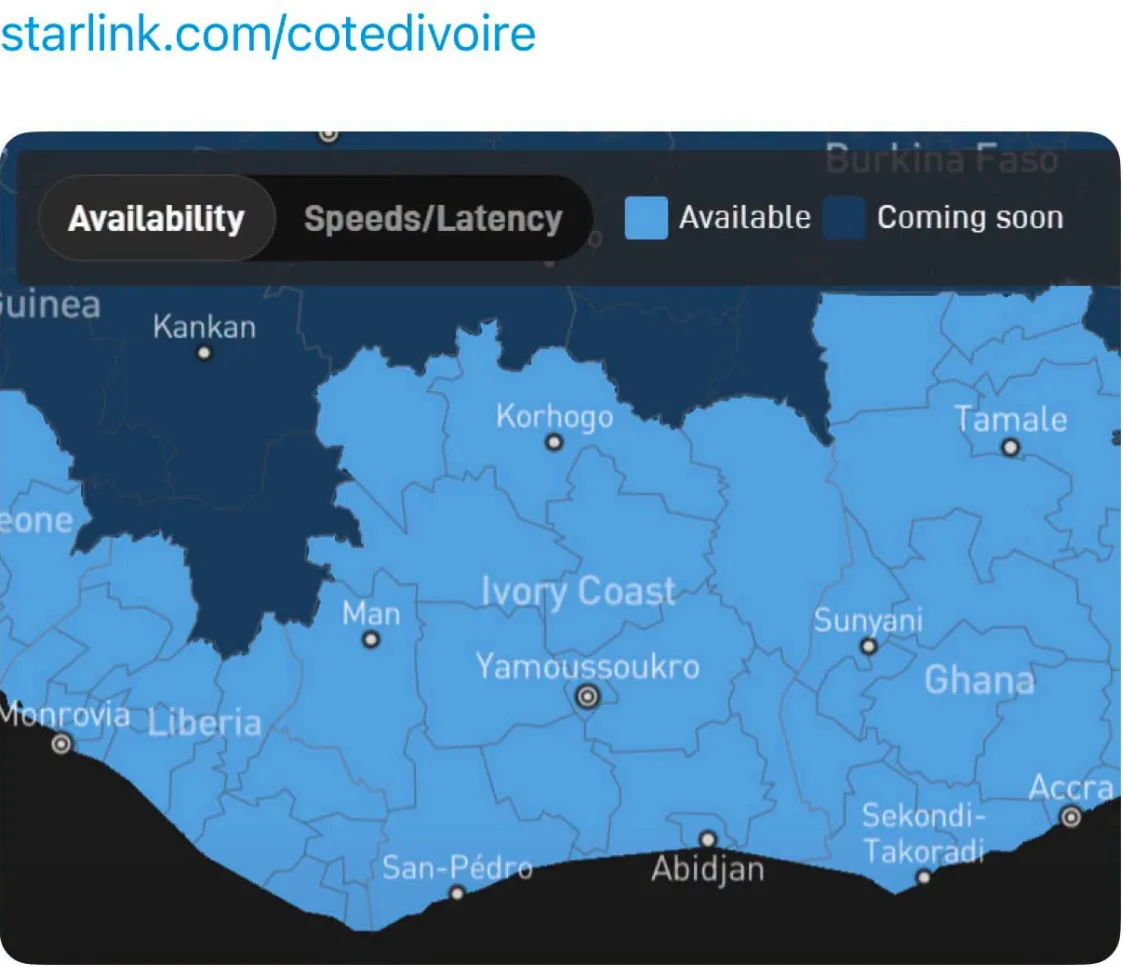
Starlink is now available for order in Côte d'Ivoire. Kit and subscription pricing, coverage map, and an honest comparison with CanalBox, Orange, and Moov fiber. How connectivity is changing land value.
Lire l'article
A real notarial invoice from Songon Audoin (500 m² at 15,000 FCFA/m²): 1,462,275 FCFA in fees for 7,500,000 FCFA of land, or 19.5%. A line-by-line breakdown, with every amount cross-checked against official regulations, and what this levy reveals about the development of unserviced areas.
Lire l'article