Chargement...
Chargement...

The Definitive Concession Decree (ACD) can be challenged. Discover the available remedies and the procedure to follow.
Need a land expert?
Speak with an advisor for free. Response within 2 hours.
The Definitive Concession Decree (ACD) is the sole instrument that confers ownership of urban land in the state domain, under the Ordinance No. 2013-481 of July 2, 2013 governing the urban land domain of the State and territorial authorities. It is a powerful act — but it is not infallible.
An ACD issued in violation of the law, by an incompetent authority, or in disregard of a third party's rights can be contested and annulled. The Law No. 2018-978 of December 27, 2018 established a clear framework for these appeals, in two stages: first administrative, then contentious.
This guide details the procedure, deadlines, admissible grounds, and strategies to adopt.
Before any judicial action, the law requires a mandatory administrative appeal. This step is not optional — a contentious appeal filed without exhausting the administrative remedy will be declared inadmissible.
| Type | To Whom? | When? |
|---|---|---|
| Gracious Appeal | To the authority that issued the decision (the Minister of Construction or the Prefect) | Within 2 months following notification of the ACD |
| Hierarchical Appeal | To the superior authority (the Minister if the ACD was issued by the Prefect) | Within 2 months following notification |
The appeal request must be substantiated — meaning it must clearly set out:
If the administration does not respond within 4 months, this silence is considered an implicit rejection (Article 12 of Law No. 2018-978). This implicit rejection opens the door to contentious appeal.
Source: Law No. 2018-978 of December 27, 2018 — servicepublic.gouv.ci
If the administrative appeal is rejected (explicitly or implicitly), the applicant may petition the Council of State through an appeal for excess of authority.
The administrative judge examines the contested ACD from four angles:
| Ground for Annulment | Explanation | Example |
|---|---|---|
| Incompetence | The authority that signed the ACD lacked the power to do so | A Sub-prefect signs an ACD when only the Minister is competent |
| Procedural Defect | Regulatory steps were not followed | Absence of publication, absence of commodo inquiry, failure to consult the CVGFR |
| Violation of Law | The ACD contravenes an applicable text | ACD issued on land in a non-buildable zone or in public domain |
| Abuse of Authority | The ACD was issued for motives unrelated to the public interest | Favoritism, proven corruption |
If the Council of State annuls the ACD, the decision has a retroactive effect: the ACD is deemed never to have existed. The land reverts to the public domain or to the rights of the legitimate applicant.
| Stage | Deadline |
|---|---|
| Administrative appeal (gracious or hierarchical) | 2 months after notification of the ACD |
| Administration's response | 4 months (silence = rejection) |
| Contentious appeal (Council of State) | 2 months after rejection (explicit or implicit) |
Caution: these deadlines are strict. An appeal filed outside the deadline will be declared inadmissible, regardless of the strength of your arguments.
The Land Title (TF) is, by nature, unassailable and imprescriptible (Ordinance No. 2013-481, Article 3). This means that once the ACD is registered at the Land Registry and the Land Title is created, it can no longer be contested through ordinary means.
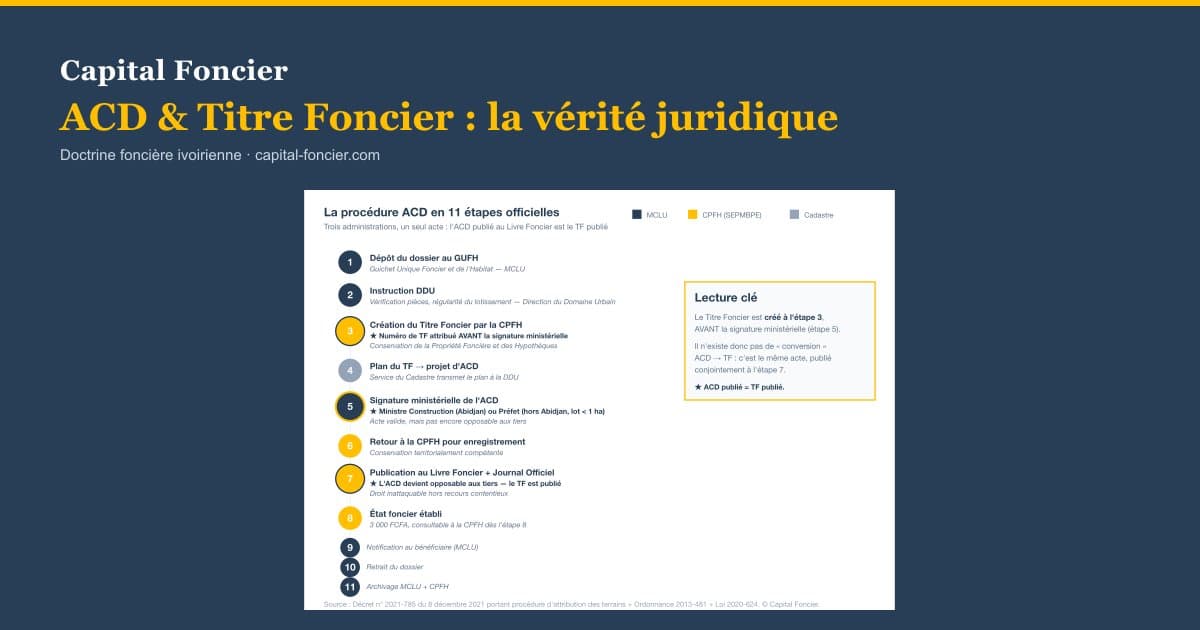
Official timeline: according to Ivorian administrative texts, 180 calendar days at the MCLU for an ACD on an approved subdivision (BÂTIR No. 004, 2022), excluding tax processing. In practice, the total time experienced is often 6 to 12 months or more, for various reasons that are not always clear. Note: the Land Title is created by the Land Registry during the ACD procedure (official step 3), not after — the ACD published in the Land Register is the published Land Title.
However, in exceptional cases — proven fraud during the registration procedure — a rectification appeal may be considered. These cases are rare and require solid evidence.
Practical consequence: if you wish to contest an ACD, act before it is registered at the Land Registry and converted into a Land Title. Once the Land Title is created, avenues of appeal become considerably narrower.
If you hold an ADU or a Rural Land Certificate on the land, and an ACD has been issued to a third party without your consent:
If the ACD procedure did not follow the required steps (no publication, no contradictory boundary marking):
If the same land has been allocated to two different persons:
| Stage | Lawyer Necessary? |
|---|---|
| Administrative appeal | No — the applicant may act alone |
| Contentious appeal (Council of State) | Strongly recommended — a lawyer specializing in administrative and land law |
Lawyer costs vary depending on case complexity. For a contentious appeal, expect between 500,000 and 2,000,000 FCFA in fees (indicative estimate). This is an investment to weigh against the value of the land at stake.
Sources:
To Learn More:
The appeal deadline is 2 months after notification. After this deadline, the administrative appeal is time-barred. However, if you were never notified of the ACD (which happens in fraud cases), the deadline may be recalculated from the date you became aware of the ACD.
Yes. Annulment of an ACD for procedural defect does not prevent the administration from restarting the procedure correctly and issuing a new ACD — this time in compliance with the law.
SIGFU (Decree No. 2019-221) blocks concurrent registrations, which reduces multiple sales. But it does not automatically verify the legality of the ACD procedure — that is the role of the GUFH and administrative oversight.
Découvrez les terrains que Capital Foncier a vérifiés : titre publié, statut du lotissement contrôlé, et état domanial croisé.
The situation is complex. Annulment of the ACD may result in loss of ownership rights, but constructions made in good faith may be subject to compensation. Each case is unique — consult a lawyer.
The Ombudsman can facilitate an amicable settlement between parties, but has no power to annul an ACD. For annulment, only administrative and contentious remedies are effective.
Élargissez votre lecture avec d'autres facettes du foncier ivoirien.

Birth certificate extract, title deed, tax clearance, inheritance judgment: the real list of documents an Ivorian notary firm requires for a real estate sale, explained item by item — and what it means for a diaspora buyer.
Lire l'article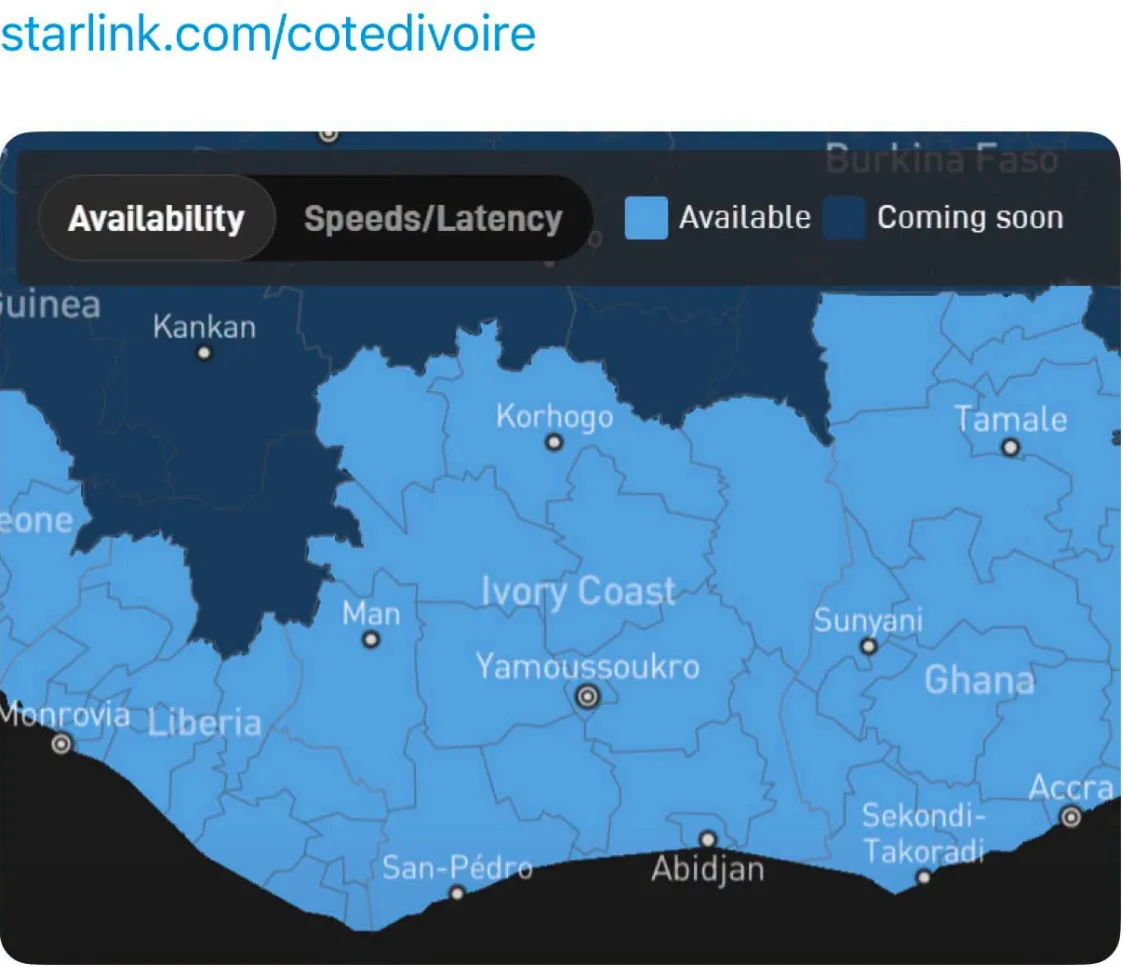
Starlink is now available for order in Côte d'Ivoire. Kit and subscription pricing, coverage map, and an honest comparison with CanalBox, Orange, and Moov fiber. How connectivity is changing land value.
Lire l'article
A real notarial invoice from Songon Audoin (500 m² at 15,000 FCFA/m²): 1,462,275 FCFA in fees for 7,500,000 FCFA of land, or 19.5%. A line-by-line breakdown, with every amount cross-checked against official regulations, and what this levy reveals about the development of unserviced areas.
Lire l'article