Housing deficit in Ivory Coast: 827,753 units to build, what the official MCLU figures reveal
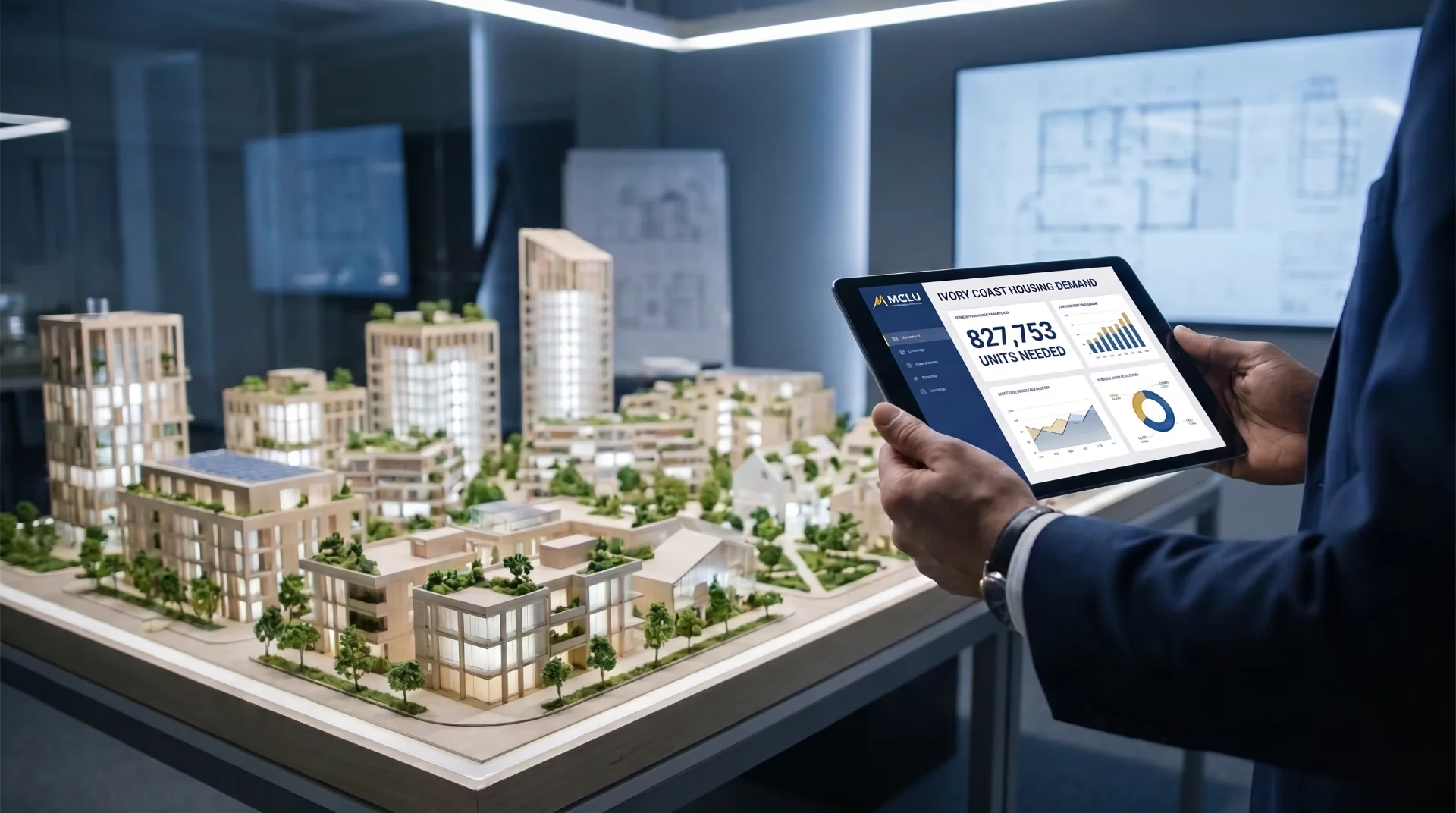
In 2023 the MCLU puts the housing deficit at 827,753 units and the requirement at 13,181.5 billion FCFA, of which only 1.3 % is land. A reading of the official figures for the investor.
Need a land expert?
Speak with an advisor for free. Response within 2 hours.
Key quotes
The sentences below can be quoted on their own. Every figure is tied to its dated official source.
- "In 2023, the Ministry of Construction, Housing and Urban Planning (Ministère de la Construction, du Logement et de l'Urbanisme, MCLU) puts the housing deficit in Ivory Coast at 827,753 units." (MCLU statistical yearbook 2018-2023, published in July 2024.)
- "Closing that deficit would require 13,181.5 billion FCFA, of which 166.9 billion for land (1.3 %), 1,668.8 billion for site servicing (12.7 %), and 11,345.8 billion for materials (86.1 %)." (MCLU yearbook, Table 64.)
- "Housing credit granted in Ivory Coast rose from 182.2 to 505.3 billion FCFA between 2020 and 2022, an increase of 177 %." (MCLU yearbook, general socioeconomic section.)
In brief
The Ministry of Construction, Housing and Urban Planning (MCLU) puts the housing deficit at 827,753 units in 2023. Closing it would mean mobilising some 13,181.5 billion FCFA: 166.9 billion for land, 1,668.8 billion for site servicing (roads and utility networks, known in French as voirie et réseaux divers or VRD), and 11,345.8 billion for building materials.
For anyone preparing a purchase, land accounts for only 1.3 % of the total cost of a new home. Demand, on the other hand, remains massive and documented. And housing credit, up from 182.2 to 505.3 billion FCFA between 2020 and 2022, shows that the local funding circuit has restarted.
Key figures on the housing deficit in 2023
| Indicator | Value | Source |
|---|---|---|
| Housing deficit in 2023 | 827,753 units | MCLU yearbook 2018-2023, housing sector analysis |
| Resources to be mobilised (minimum) | 13,181.5 billion FCFA | MCLU yearbook, authors' calculation |
| Land as a share of the requirement | 166.9 billion FCFA (1.3 %) | MCLU yearbook, sector analysis |
| Site servicing as a share (primary VRD) | 1,668.8 billion FCFA (12.7 %) | MCLU yearbook |
| Building materials as a share | 11,345.8 billion FCFA (86.1 %) | MCLU yearbook, Table 64 |
| Households in Ivory Coast (2021 RGPH) | 5,616,487 | 2021 RGPH, cited in the MCLU yearbook |
| National urbanisation rate | 52.5 % | 2021 RGPH |
| Housing credit (2022) | 505.3 billion FCFA | MCLU yearbook, macro-financial marker |
Are you preparing a purchase in Ivory Coast and wondering what these figures change for your project? The land project diagnosis takes 2 minutes, and an adviser calls you back within 2 hours. Run my project diagnosis.
An official deficit of 827,753 homes: where does the figure come from?
The figure comes from the MCLU statistical yearbook covering the 2018-2023 period, published in July 2024. It draws on the 2021 General Population and Housing Census (Recensement Général de la Population et de l'Habitat, RGPH) and on the ministry's own sector analysis work.
Three points help in reading it.
- Ivory Coast has 5,616,487 households according to the 2021 RGPH. That is the reference statistical unit for measuring housing demand.
- The urbanisation rate is 52.5 % nationally, with wide gaps between territories: Abidjan reaches 97 % while several northern regions remain mostly rural.
- The deficit is not limited to the absence of a roof. It also counts households living in precarious conditions, homes that need rebuilding, and the pressure created by urban population growth.
The MCLU presents this deficit as a conservative estimate: it is the minimum to be produced to bring supply back in line with expressed demand. The figure rises as soon as quality standards and the renewal of the existing stock are added, but the yearbook publishes no upper bound.
13,181 billion FCFA: breaking down the funding requirement
This is one of the most striking figures in the yearbook. To build 827,753 homes, the ministry estimates the minimum requirement at 13,181.5 billion FCFA, spread over three main lines.
| Item | Amount (FCFA) | Share |
|---|---|---|
| Land | 166.9 billion | 1.3 % |
| Primary VRD (site servicing) | 1,668.8 billion | 12.7 % |
| Building materials | 11,345.8 billion | 86.1 % |
| Total | 13,181.5 billion | 100 % |
Source: MCLU statistical yearbook 2018-2023, housing sector analysis, Table 64 for the materials detail.
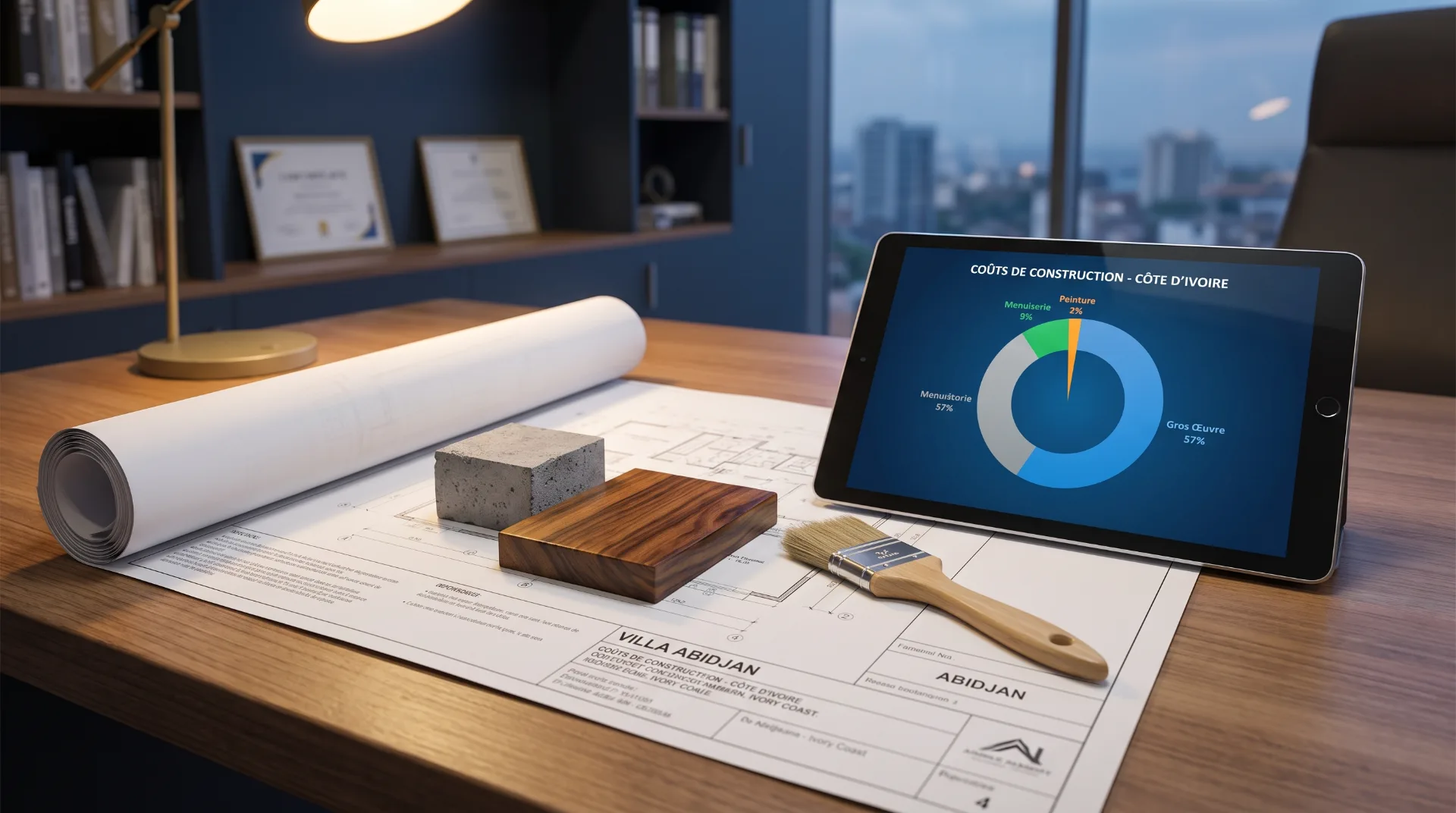
The materials line (11,345.8 billion FCFA) reads item by item.
- Structural works, known in French as gros œuvre: 6,434.9 billion FCFA (57 % of the materials line)
- Hard floor and wall coverings: 1,648.7 billion FCFA (15 %)
- Joinery: 1,022.7 billion FCFA (9 %)
- Suspended ceilings, roof framing, and roofing: 994.5 billion FCFA (9 %)
- Electrical works: 601.9 billion FCFA (5 %)
- Plumbing: 356.2 billion FCFA (3 %)
- Paint: 176.4 billion FCFA (2 %)
- Waterproofing: 110.5 billion FCFA (1 %)
Source: MCLU yearbook, Table 64.
What the weight of land reveals: 166.9 billion out of 13,181
This is probably the most counter-intuitive data point in the yearbook for a buyer. In the cost structure of a new home seen at national scale, land accounts for 1.3 %. Most of the final price comes from materials (86 %) and site servicing (13 %).
Three readings follow.
First, land investment is not speculation on the scarcity of soil. At macro level, soil is not the scarce factor. What is scarce is the plot that is serviced, well located, and secure in its legal status.
Second, site servicing changes what a plot is worth. The 1,668.8 billion FCFA to be invested in primary VRD (roads, water, electricity, and sanitation) is 10 times the land line. A serviced plot, or one located in an area scheduled for servicing, does not carry the same risk profile as an unserviced plot in open countryside.
Finally, the central question for an investor is not "how much does the land cost" but "where is this plot headed": approved subdivision (lotissement approuvé)? ACD (Arrêté de Concession Définitive, Definitive Concession Decree) under way? Servicing scheduled? Area planned in a Master Urban Development Plan (Plan d'Urbanisme Directeur, PUD)?
Worth knowing. Of the 111 departmental capitals in Ivory Coast, 74 have a Master Urban Development Plan being drafted or revised, that is 67 %. Greater Abidjan, Greater Yamoussoukro, and Bouaké have an Urban Master Plan (Schéma Directeur d'Urbanisme). This planning layer is public information, and over a ten-year horizon it is what weighs most heavily on what becomes of a plot. Source: MCLU yearbook, Urban Planning and Urban Development Directorate (Direction de l'Urbanisme et du Développement Urbain, DUDU).
Urbanisation and the deficit: why Abidjan concentrates the pressure
Urban concentration explains a large share of the pressure on the housing market.
- Abidjan shows an urbanisation rate of 97 % according to the 2021 RGPH. Almost all of Greater Abidjan lives in an urban setting, with particularly strong demand for plain rental housing (location simple).
- Nationally, 35.6 % of households are plain tenants, against 51.8 % who own their home and 7.4 % housed free of charge. In urban areas, plain renting climbs to 57 %, against only 7.3 % in rural areas.
- The urban and rural contrast is stark: 78.8 % of rural households own their home, against 31.5 % in urban areas.
Source: MCLU yearbook, Table 2, housing occupancy status (2021 RGPH).
This asymmetry is structural. Housing pressure plays out first in the large conurbations, Abidjan above all. It also makes the move into ownership harder in the city, which feeds continuous demand for urban and peri-urban land.
Housing credit: a 177 % rise in two years
The yearbook reports another indicator that helps in reading the market: the trend in housing credit granted in Ivory Coast (Côte d'Ivoire). After a marked decline between 2017 and 2019, the recovery is clear from 2020 onwards.
| Year | Housing credit (billion FCFA) |
|---|---|
| 2020 | 182.2 |
| 2021 | ~340 (yearbook estimate) |
| 2022 | 505.3 |
Source: MCLU yearbook, general socioeconomic section.
Between 2020 and 2022, housing credit rose by 177 %. That rebound points the same way as the momentum of the construction and public works sector (Bâtiment et Travaux Publics, BTP), which accounted for 4 to 5.5 % of gross domestic product (GDP) over the 2015-2020 period.
This macroeconomic framing does not predict the future value of any particular plot. The credit recovery says nothing about a rental return or a value appreciation on a specific lot. It says only that the local funding circuit has restarted, which is a necessary condition for projects to reach the market, not a sufficient one.
What these figures mean for the diaspora investor
If you are an Ivorian investor based in France, Canada, the United States, or elsewhere, the yearbook offers three markers.
Structural demand is documented: 827,753 missing homes, 5.6 million households, 52.5 % urbanisation, and an urban ownership rate that remains a minority (31.5 %). This numerical backdrop is not a promise. It is a macroeconomic context to factor into your own analysis.
The cost of land is only a starting point. At national scale, land represents 1.3 % of the cost of closing the deficit. For an individual project, the real decision variable is therefore not the price per square metre alone, but the administrative and technical trajectory of the plot: approved subdivision, ACD, servicing, PUD, and customary rights purged.
Documentary verification remains decisive. With 20,150 urban planning opinion requests processed by the DUDU between 2020 and 2023, the administration is digitising its circuits and making them more reliable. For a remote buyer, two documents are unavoidable before any commitment: a recent état domanial (the administrative status of the plot at the MCLU) and an état foncier (the statement of real rights encumbering the title, issued by the CPFH, the Land Registry and Mortgages Office, for 3,000 FCFA).
Important. No national statistic predicts the value of any particular plot. The MCLU yearbook figures describe a market, not an individual return. A land investment carries legal, administrative, and technical risks, and those are assessed plot by plot, documents in hand.
What these figures mean for a resident buyer in Ivory Coast
For a buyer living in Ivory Coast who is preparing the purchase of a first plot, the yearbook points to four habits.
Prioritise planned areas. A plot located in an approved subdivision, in an area covered by a PUD or an Urban Master Plan, does not carry the same risk profile as a plot acquired through a village attestation (attestation villageoise) with no administrative formalisation. Since 1 July 2024 that attestation has been replaced by the ADU (Attestation de Droit d'Usage coutumier), issued by the GUFH; in practice, files based on an attestation from an older subdivision are still being processed.
Budget for the whole journey, not just the purchase price. The MCLU figures are a reminder that site servicing accounts for 13 % of the average cost and materials 86 %. If the project involves building, the land share of the final budget is a minority one. Better to pay more for clean land than to save on the purchase and lose several years in litigation.
Rely on the official tools. SIGFU for urban land (Decree No. 2019-221), and SIFOR, the rural land information system created by Ordinance 2025-85, aim to secure and speed up administrative circuits. Asking for consistency between a title offered for sale and the official registers is now a normal step.
Keep a written record of every step: adversarial boundary survey (bornage contradictoire), état domanial, état foncier, preliminary sale agreement, and notarised deed. Ivorian land rewards documentary patience.
What Capital Foncier reads in these figures
Our editorial reading comes down to three points.
The deficit of 827,753 homes is not a call to buy fast. It is an indicator of long-term structural need.
Land at 1.3 % of total cost is a reminder that price alone protects nothing. What protects is the full chain: a clean title, an approved subdivision, scheduled servicing, a notarised deed, and publication in the Land Book (Livre Foncier).
The recovery in housing credit (+177 % in two years) is a market signal. It says nothing at all about an individual project. We do not promise returns. We support documentary verification and the securing of a land project.
Going further
- ACD procedure in Ivory Coast: steps and required documents
- ACD, Land Title, and CMPF: three documents, three legal functions: the CMPF can only be issued on an existing Land Title. This Property Title Mutation Certificate (Certificat de Mutation de Propriété Foncière) evidences the registration of a transfer of ownership made by notarised deed.
- Due diligence guide: how to verify a subdivision in Ivory Coast
- Land FAQ: the 20 most frequent questions
Securing your land project
Are you preparing a purchase in Ivory Coast from abroad or from Abidjan? Before any signature, run a diagnosis of your project. We check documentary consistency, we tell you which controls to carry out, and we reply within 2 hours by WhatsApp or telephone. The diagnosis is provided at no cost.
Run my project diagnosis. Reply within 2 hours.
Sources
- Statistical yearbook of the Ministry of Construction, Housing and Urban Planning (MCLU), 2018-2023 edition, published in July 2024
- 2021 General Population and Housing Census (RGPH), National Statistics Institute (Institut National de la Statistique, INS)
- Housing sector analysis, MCLU yearbook 2018-2023, Table 64 (financial estimate of the materials needed for 827,753 homes)
- Housing occupancy status, MCLU yearbook, Table 2
- MCLU budget and programme, MCLU yearbook, Tables 6 and 7
- Urban Planning and Urban Development Directorate (DUDU), MCLU yearbook, Tables 11 and 13
- Ordinance No. 2013-481 of 2 July 2013 on the management of urban land
- Law No. 2020-624 of 14 August 2020 establishing the Urban Planning and Urban Land Code
- Reading the source figures: the MCLU publishes in French notation, where a space separates thousands and a comma marks the decimal, while this article uses English notation. In the yearbook the same figures read 827 753 units, a total of 13 181,5 milliards FCFA, lines of 166,9 then 1 668,8 then 11 345,8 milliards FCFA, shares of 1,3 %, 12,7 %, and 86,1 %, a materials detail of 6 434,9 then 1 648,7 then 1 022,7 then 994,5 then 601,9 then 356,2 then 176,4 then 110,5 milliards FCFA, 5 616 487 ménages or 5,6 millions, an urbanisation rate of 52,5 %, occupancy shares of 35,6 %, 51,8 %, 7,3 %, 78,8 %, and 31,5 %, housing credit of 182,2 then 505,3 milliards FCFA, and a construction sector at 4 to 5,5 % of GDP
About this article
Article written by the Capital Foncier team from the official MCLU statistical yearbook 2018-2023. First published: 1 May 2026. Last updated: 1 May 2026. This article has an educational purpose. It constitutes neither legal advice nor individualised investment advice. All the data cited comes from public, dated sources. Investment or acquisition decisions must rest on documentary verification carried out plot by plot.
The Capital Foncier team, Abidjan, Ivory Coast
"Our mission is to secure every square metre purchased by our investors."
?Frequently asked questions
Is the figure of 827,753 missing homes official?+
Yes. It comes from the 2018-2023 statistical yearbook of the Ministry of Construction, Housing and Urban Planning (MCLU), published in July 2024. It is to date the most recent public reference on the housing deficit in Ivory Coast.
Why does land weigh only 1.3 % of the total requirement?+
Because the yearbook breaks down the production cost of a new home at national scale. Out of 13,181 billion FCFA to be mobilised, 11,345 billion concerns materials and 1,668 billion site servicing (VRD). Land, at 166.9 billion, represents only a small share of it. That does not make it secondary: it simply means the final value of a home is driven mainly by the construction and servicing lines.
Do these figures prove that land values will rise?+
No. A documented housing deficit indicates structural demand. Does it tell you what your lot will be worth in five years? No. Every plot has its own trajectory: legal status, coverage by a Master Urban Development Plan, servicing projects, zoning, and easements. No individual value appreciation projection can be deduced from a national average.
How do I check that a plot is in a planned area?+
Three useful markers. First, Urban Master Plans exist for Greater Abidjan, Greater Yamoussoukro, and Bouaké. Second, 74 of the 111 departmental capitals have a Master Urban Development Plan being drafted or revised. Third, the état domanial issued by the MCLU states the official zoning of a plot. In case of doubt, an adviser carries out the check on your behalf.
Does the recovery in housing credit make investing easier for the diaspora?+
Housing credit granted in Ivory Coast tripled between 2020 and 2022 (from 182 to 505 billion FCFA). That is a positive signal on local liquidity. For a diaspora investor paying from own funds or going through a foreign institution, the direct effect is more limited, but local banks are becoming an option again for blended structures. In every case, the instalment plan (facilité de paiement) remains a matter to examine project by project.