What Housing Really Costs: Structural Work 57%, Joinery 9%, Painting 2%, the Official Breakdown
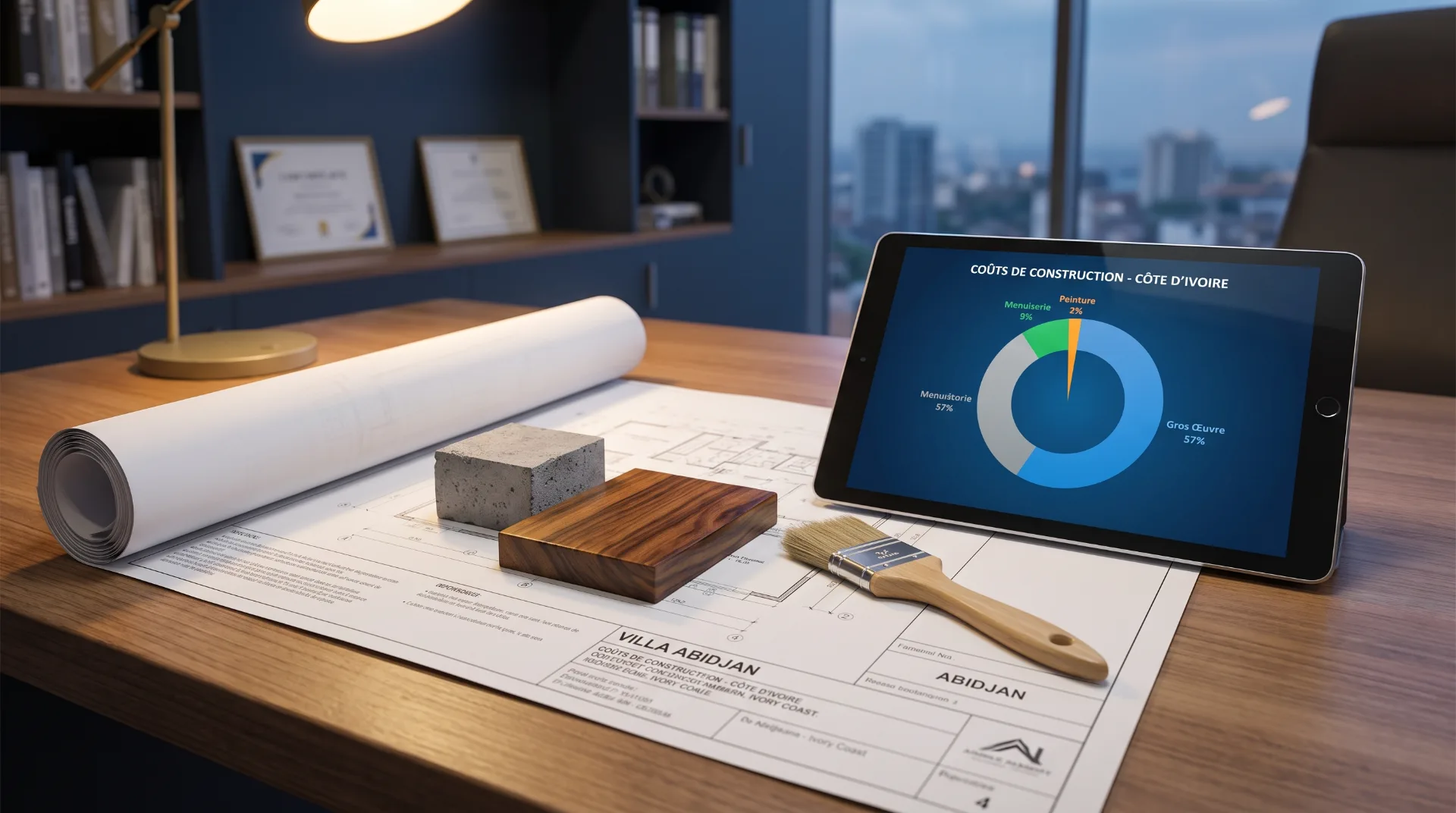
The 2018-2023 yearbook from the MCLU (Ministère de la Construction, du Logement et de l'Urbanisme, the Ministry of Construction, Housing and Urban Planning) publishes the official breakdown of the cost of materials needed to close the deficit of 827,753 housing units. Structural work 57%, wall and floor coverings 15%, joinery 9%: a valuable framework for anyone preparing a construction project.
Need a land expert?
Speak with an advisor for free. Response within 2 hours.
Key quotes
The sentences below can be quoted independently. Every figure comes from the statistical yearbook of the Ministry of Construction, Housing and Urban Planning (MCLU), a dated official source.
- "Of the 11,345.8 billion FCFA in materials needed to build 827,753 housing units in Ivory Coast (Côte d'Ivoire), structural work accounts for 56.7%, hard floor and wall coverings 14.5% and joinery 9%." (MCLU statistical yearbook 2018-2023, Table 64.)
- "The average cost of materials is estimated at around 13.7 million FCFA per housing unit, excluding land, servicing and labour." (Calculation based on the MCLU 2018-2023 yearbook.)
- "Waterproofing and paint combined account for less than 3% of the materials cost, yet they determine the final quality and durability of the building." (MCLU yearbook, Table 64.)
In brief
The MCLU 2018-2023 statistical yearbook publishes a data set rarely found elsewhere: the line-by-line breakdown of the cost of materials needed to produce a new housing unit in Ivory Coast. Of the 11,345.8 billion FCFA estimated to build 827,753 housing units (materials only, excluding land and servicing), the breakdown is as follows: structural work (gros œuvre) 56.7%, hard floor and wall coverings 14.5%, joinery 9.0%, suspended ceilings and roofing 8.8%, electrical work 5.3%, plumbing 3.1%, paint 1.6%, waterproofing 1.0%. Per unit, that puts the average cost of materials at 13.7 million FCFA per housing unit, with no labour or margins included.
Key figures: materials breakdown (11,345.8 billion FCFA for 827,753 housing units)
| Line item | Total amount (FCFA) | Share |
|---|---|---|
| Structural work | 6,434,879,273,588 | 56.7% |
| Hard floor and wall coverings | 1,648,704,370,154 | 14.5% |
| Joinery | 1,022,710,077,160 | 9.0% |
| Suspended ceilings, roof framing, roofing | 994,528,668,922 | 8.8% |
| Electrical work | 601,905,913,643 | 5.3% |
| Plumbing | 356,231,129,914 | 3.1% |
| Paint | 176,355,754,359 | 1.6% |
| Waterproofing | 110,506,887,944 | 1.0% |
| Total materials | 11,345,822,075,685 | 100% |
Source: MCLU statistical yearbook 2018-2023, Table 64, financial estimate of the materials needed for 827,753 housing units.
Average materials cost per housing unit
| Indicator | Value |
|---|---|
| Total materials for 827,753 housing units | 11,345.8 billion FCFA |
| Average materials cost per housing unit | ≈ 13.7 million FCFA |
Calculation based on yearbook data.
Planning a build and want to estimate your materials budget? A Capital Foncier advisor can connect you with qualified professionals. Get my assessment.
Structural work: 57% of the materials cost
Structural work alone accounts for more than half the cost of materials for a new housing unit, according to the MCLU yearbook. It covers everything that carries the building: the foundations (footings, raft slabs, tie beams), the base structure (walls below or above ground up to the level of the ground floor slab), the frame (columns, beams, floors, slabs), the masonry (load-bearing and non-load-bearing walls, in brick, concrete block or cellular concrete), and the rough roof structure, meaning the structural roofing elements before the final roof covering goes on.
This weight is no accident. Structural work concentrates most of the weight and volume of materials on a building site: cement, rebar, sand, gravel, concrete blocks. These materials track world prices, cement and steel in particular. Finally, a sizing error becomes very expensive to correct once the structure is up, which demands budgetary caution from the outset.
Order of magnitude: on a standard build, structural work can represent between 50% and 65% of the materials budget. The MCLU yearbook's 57% falls within that range.
Hard floor and wall coverings, 15% of the cost: the "almost finished" stage
Hard coverings group together the durable finishes for floors and walls: tiling (floors, bathroom walls, kitchen), ceramic wall tiles in wet rooms, and natural stone such as marble or granite for high-end finishes.
At 14.5% of the materials budget, this is no minor item. Above all, it is the line where quality choices open up the widest gap between a standard home and a high-end one. The same square metre of tiling can cost 5,000 FCFA or 30,000 FCFA depending on the range chosen.
Joinery, 9%: heavier than it looks
Joinery accounts for 9% of the materials budget, or 1,023 billion FCFA for 827,753 housing units. It covers interior and exterior doors, windows and glazed openings, built-in wardrobes, and security elements such as reinforced doors and grilles.
It is a line item that initial budget projections often underestimate. For a three-bedroom house, expect around ten doors, some fifteen glazed openings and several built-in wardrobes. Each of these elements comes in sharply contrasting price ranges.
The other line items: roofing, electrical, plumbing, paint, waterproofing
Suspended ceilings, roof framing, roofing: 8.8%
This item covers the roof frame, tiles or metal sheeting, upper insulation and interior suspended ceilings. It climbs quickly if the project calls for high ceilings or premium roofing (terracotta tiles, zinc).
Electrical work: 5.3%
Wiring, distribution board, sockets, switches, light fittings, protection (circuit breakers, surge protection). The budget varies widely depending on the number of rooms, any home automation, and the level of security targeted.
Plumbing: 3.1%
Piping, taps and fittings, sanitaryware (washbasins, toilets, showers), water heaters, drainage. A fairly stable item as long as the project sticks to conventional standards.
Paint: 1.6%
Renders, primers, interior and exterior paint. A small share of the budget, but decisive for the final result. High-end paints can double the amount.
Waterproofing: 1.0%
Sealing of flat roofs, below-ground walls and wet areas. A small item, but a critical one: poor waterproofing costs dearly in repairs and secondary damage.
What these figures mean for an individual project
These figures describe a national average, calculated over the 827,753 housing units the MCLU costs out to close the housing deficit. An individual project can deviate from them significantly, for at least four reasons.
- The construction standard. A standard house and a high-end villa do not have the same breakdown: coverings, joinery and paint weigh more heavily in the latter.
- The housing type. An apartment in a multi-unit building, a detached house and a single-storey villa do not have the same cost structure.
- Location. Logistics costs, materials transport and site access add to certain line items depending on the area.
- Technical choices. Construction method (concrete blocks, bricks, cast-in-place concrete), roofing (sheet metal or tile), insulation (basic or reinforced): all variables that shift the weight of each line item.
The MCLU table should therefore be read as a reference grid, not a personal estimate. It helps you anticipate the broad cost blocks, calibrate a provisional budget, and spot a commercial proposal that strays far from the norms.
13.7 million FCFA per housing unit: what does this figure really mean?
Straight division, 11,345.8 billion FCFA over 827,753 housing units, gives an average materials cost of 13.7 million FCFA per housing unit.
This figure does not represent the total cost of a home. It excludes:
- land (166.9 billion FCFA out of the 13,181.5 billion total needed to close the deficit);
- servicing, meaning primary roads and utility networks: water, electricity, sanitation, access roads (1,668.8 billion FCFA);
- labour, not costed in this table;
- margins, taxes and professional fees (architect, surveyor, engineering firm);
- equipment (sanitary appliances, kitchen, air conditioning if planned).
A realistic budget for a new home in Ivory Coast adds up:
- land acquisition;
- servicing, if the plot is not already serviced;
- materials (≈ 13.7 million FCFA as the MCLU benchmark for a standard home, to be adjusted to the project);
- labour, often 30 to 50% of the materials cost depending on how the work is contracted;
- design and permit fees;
- contingencies and provisions.
For the diaspora: how to use this grid
Three practical uses.
- Pre-qualify an estimate. When a contractor or builder presents a budget, check whether the broad cost blocks are consistent with the MCLU grid: structural work weighing in at 30% or 75% of the materials line is a signal worth investigating.
- Prioritise trade-offs. If the budget is under pressure, the grid shows where the big money sits (structural work, coverings) and where adjustments remain marginal (paint, waterproofing).
- Compare offers. Two proposals for the same project can have very different breakdowns. The one closest to the MCLU averages is often the most realistic; marked deviations deserve an explanation.
For those who build: a few practical benchmarks
- Never cut corners on waterproofing. It is 1% of the materials budget, but potentially 100% of future problems if done badly.
- Budget structural work on the high side. It is the heaviest line item and the most sensitive to fluctuations in cement and steel prices.
- Anticipate the "small" items that add up at the finishing stage. Paint, locks and ironmongery, lighting: each line is modest, but together they can exceed 10-15% of the total budget.
- Build in a contingency margin. A 10 to 15% reserve is prudent. Building sites always reveal adjustments missing from the initial estimate.
Capital Foncier's takeaways
Structural work accounts for more than half the materials budget: that is where control of the build is won or lost. The finishing items, meanwhile, are more strategic than they appear, since hard coverings (15%), joinery (9%) and paint (1.6%) together make up 26% of materials, nearly a quarter of the budget. Finally, land represents only 1.3% of the total cost of closing the deficit: buying well is only the beginning, most of the spending comes afterwards, and that is where the trade-offs make the difference.
Further reading
- Housing deficit: 827,753 units to build
- Construction sector's share of Ivorian GDP 2015-2020
- Housing credit: the 2020-2022 rebound (+177%)
- Urban Master Plans: 74 of 111 district capitals covered
Securing your land project
Have you secured your plot and are you starting the construction phase? A Capital Foncier advisor can point you towards the relevant professionals.
Get my free assessment. Two minutes is all it takes to describe your project.
Sources
- MCLU statistical yearbook 2018-2023, Table 64, financial estimate of the materials needed for 827,753 housing units
- MCLU yearbook 2018-2023, housing sector analysis
- National Institute of Statistics (INS)
About this article
Article written by the Capital Foncier team based on the MCLU 2018-2023 statistical yearbook. First published: May 17, 2026. This article is intended for educational purposes. It constitutes neither legal advice nor individualised investment advice. The cost estimates cited must be refined with professional quotes for any actual project.
The Capital Foncier team (Abidjan, Ivory Coast)
"Our mission is to secure every square metre purchased by our investors."
?Frequently asked questions
Do these figures include labour?+
No. The MCLU yearbook breaks down materials only. Labour (masons, joiners, plumbers, electricians, painters) typically adds 30 to 50% on top of the materials cost, depending on how the site is organised: general contractor, piecework crews or self-build.
Does the average of 13.7 million FCFA per housing unit apply to my project?+
Not necessarily. It is an average calculated over 827,753 housing units, in the context of closing a documented deficit. An individual project can deviate upwards (villa, high-end standard) or downwards (small social housing unit). This figure serves as a benchmark, not a precise forecast.
How do materials prices evolve in Ivory Coast?+
They track the international market (cement and steel in particular), exchange rates for imported materials, and local conditions. Chambers of commerce, trade associations and the business press publish updated indices. For an ongoing project, having the same requirements priced by several materials merchants remains the basic reflex.
Which line items offer the most room for negotiation?+
Hard coverings (floor and wall tiles) and joinery offer the widest price range, depending on quality, origin (local or imported) and finish level. Paint also shows significant variation. Structural work, by contrast, is negotiated more on labour and site management than on basic materials such as cement and rebar.
Is structural timber available locally?+
Yes. Ivory Coast has an organised timber industry. The choice between local and imported species affects both price and durability. An architect or engineering firm can guide this choice according to the project and budget.