Checklist: The 10 Documents to Verify Before Signing a Land Purchase

Never sign a deed of sale without checking these 10 essential documents. This checklist protects you against 95% of land fraud schemes in Ivory Coast (Côte d'Ivoire).
Need a land expert?
Speak with an advisor for free. Response within 2 hours.
Introduction
A deed of sale is signed once. The documents, however, are checked beforehand, while you can still walk away without losing anything.
This list covers the 10 documents that appear in almost every Ivorian land file. Print it, take it with you to the site and then to the notary, and check off each item as you go.
Document 1: The ACD or the Land Title
The ACD (Arrêté de Concession Définitive, the definitive concession order) or the Land Title (Titre Foncier, TF) establishes that the seller is indeed the owner. Without this document, the rest of the file proves very little.
Official timeframe: according to the Ivorian administration's own texts, 180 calendar days at the Ministry of Construction, Housing and Urban Planning (MCLU) for an ACD on an approved subdivision (BÂTIR N°004, 2022), excluding processing at the tax authorities. In practice, the total time experienced is often longer. Note: the land title is created by the Land and Mortgage Registry (Conservation de la Propriété Foncière et des Hypothèques, CPFH) during the ACD procedure, at official step 3, not afterwards. The ACD published in the Land Register is the published land title.
What to check:
- the original, never a photocopy;
- the seller's name, identical to the one shown on the document;
- the cadastral references, legible and complete;
- the validity of the document.
Where to verify it: at the CPFH, a department of the General Tax Directorate (Direction Générale des Impôts, DGI), for the jurisdiction the land falls under.
Document 2: The approved subdivision plan
This document certifies that the plot belongs to an approved subdivision. Outside an approved subdivision, a plot has no recognised planning status.
What to check:
- the approval order, signed by the Minister;
- your plot, identified on the plan and not merely pointed at;
- the absence of any cancellation or suspension of the subdivision.
Where to verify it: at the MCLU, which keeps the database of approved subdivisions dating back to 1960.
Document 3: The certificate of ownership
Issued by the registrar, it confirms the real property rights recorded on the plot. At the same time, request a recent land registry extract (3,000 FCFA), which shows the current titleholder and any pending entries.
What to check:
- a date less than three months old;
- the absence of any registered mortgage or encumbrance;
- a titleholder who matches the seller.
Document 4: The non-litigation attestation
It confirms that no court proceedings concern the land. This is the document most often missing from rushed files.
What to check:
- issuance by the court of the relevant jurisdiction;
- a date less than three months old;
- an explicit statement that no proceedings are pending.
Document 5: The location plan
It places the plot in its surroundings: streets, neighbours, landmarks visible from the road.
What to check:
- a clearly identified plot;
- boundaries that match what you saw on site;
- GPS coordinates consistent with the rest of the file.
Document 6: The boundary survey report
Drawn up by a chartered surveyor, it physically fixes the boundaries of the land. This is the document that settles matters the day a neighbour disputes a fence.
What to check:
- an adversarial boundary survey, signed by the neighbours;
- a surveyor registered with the Ivory Coast (Côte d'Ivoire) Order of Chartered Surveyors (Ordre des Géomètres-Experts de Côte d'Ivoire, OGECI);
- surface areas identical to those stated in the deed of sale;
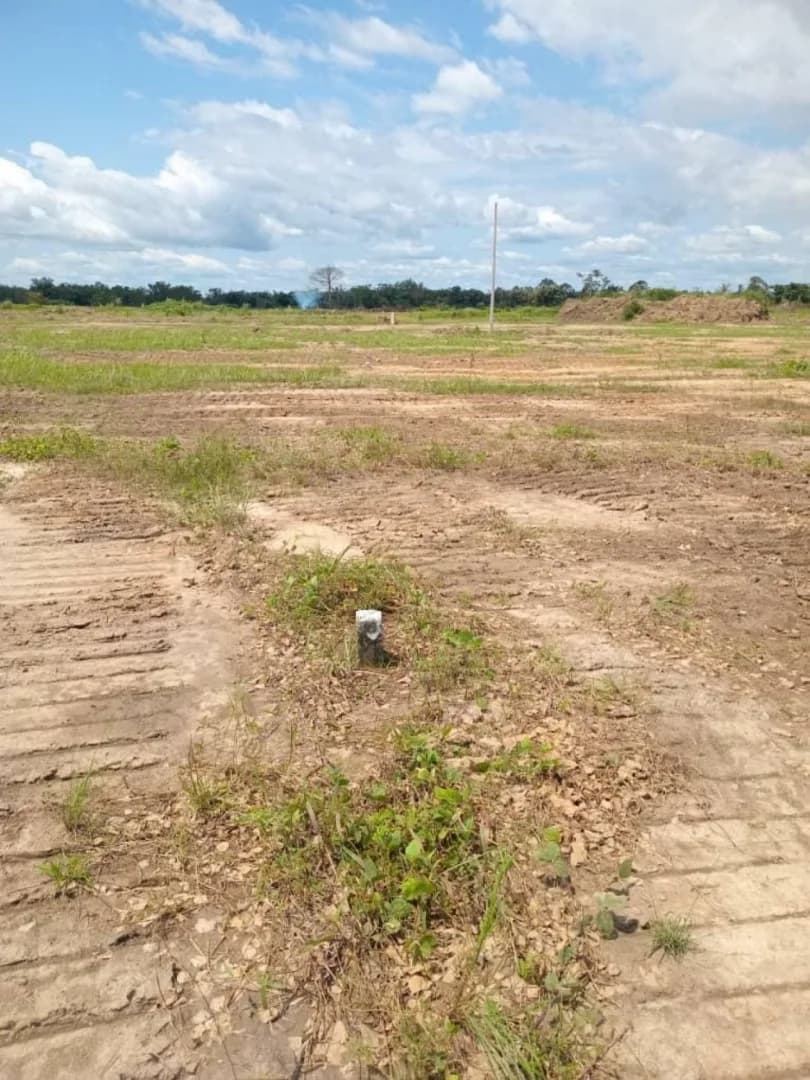
- boundary markers actually planted in the ground, which you will go and see for yourself.
Document 7: The seller's identity document
National identity card (CNI) or passport. A routine check, often skipped because it feels awkward to ask for.
What to check:
- a document that is currently valid;
- a photo that matches the person in front of you;
- a name identical to the one on the land documents;
- if a power of attorney is used, a notarised power of attorney, read in full.
Document 8: The state land status report
The state land status report (état domanial, 5,000 FCFA) sets out the plot's position with regard to state land: attachment, easements, classification as a reserved or protected zone. Building rules, for their part, are found in the approved subdivision and the detailed urban plan.
What to check:
- land that is buildable, not classified as a reserved or protected zone;
- height, footprint and setback rules compatible with your project;
- the absence of any easement that would constrain the building's placement.
Document 9: The tax compliance attestation
It establishes that the seller is up to date on obligations relating to the land. An unpaid arrear always resurfaces eventually, and rarely on the seller's side.
What to check:
- the property tax (impôt sur le patrimoine foncier, IPF) paid for the current year;
- the absence of arrears attached to the plot;
- amounts consistent with the declared value of the land.
Document 10: The utilities certificate
It certifies that the land is connected, or connectable, to the networks. A poorly served plot is expensive to equip, and that cost never appears in the advertised price.
What to check:
- an existing or planned road access;
- a water network nearby (SODECI);
- an electricity network nearby (CIE);
- drainage that works, including in the rainy season.
Summary checklist
| # | Document | Checked |
|---|---|---|
| 1 | ACD or Land Title | ☐ |
| 2 | Approved subdivision plan | ☐ |
| 3 | Certificate of ownership | ☐ |
| 4 | Non-litigation attestation | ☐ |
| 5 | Location plan | ☐ |
| 6 | Boundary survey report | ☐ |
| 7 | Seller's identity document | ☐ |
| 8 | State land status report | ☐ |
| 9 | Tax compliance attestation | ☐ |
| 10 | Utilities certificate | ☐ |
Capital Foncier's advice
At Capital Foncier, these 10 documents are gathered and checked for every plot before it goes on sale. Our four-level verification protocol follows this list and extends it with checks carried out on site.
Conclusion
No list replaces a notary, and this one is no exception. Its purpose is to spot, before signing, the documents that are missing, those that contradict each other, and those you are promised for later. Do not sign before you have checked off all 10 points. If even one is missing, postpone the transaction and have the file reviewed by a professional.
Contact Capital Foncier for secure, expert support.
Official sources:
- servicepublic.gouv.ci: ACD (100,000 FCFA per individual plot), CMPF (15,000 FCFA), state land status report (5,000 FCFA), land registry extract (3,000 FCFA)
- construction.gouv.ci: MCLU, GUFH (Tel: 27 20 21 74 78), subdivision database since 1960
- idufci.construction.gouv.ci: IDUFCI (Decree No. 2019-221) and SIGFU, the Integrated Urban Land Management System (Decree No. 2021-862)
- dgi.gouv.ci: Land Registry, IPF
- Ordinance No. 2013-481: urban land domain
Further reading:
?Frequently asked questions
Who must provide these documents, the seller or the buyer?+
It is the seller's responsibility to produce them. The buyer has the right to examine them and to request certified copies. A seller who refuses to hand over a document is telling you something important about their file.
Does my notary check all these documents automatically?+
The notary checks the main legal documents, in particular the title and the certificate of ownership. Utilities and the boundary survey do not always fall within their remit. Check those two points yourself, or have them checked.