ACD and Land Title in Ivory Coast: The Legal Truth That 9 Out of 10 Websites Get Wrong

The ACD is not a title "beneath" the Land Title. The Land Title is created during the ACD procedure by the Land Registry and Mortgages Office (CPFH). Legal analysis, 11 official steps, and 5 errors that competing blogs continue to spread.
Need a land expert?
Speak with an advisor for free. Reply within 24 business hours.
Key quotes
Each excerpt below can be quoted on its own. Each one is attached to its dated official source.
- "The transfer of ownership over urban land belonging to the State domain is carried out by a Definitive Concession Decree, which must be mandatorily published in the Land Registry." (Ordinance No. 2013-481 of 2 July 2013, Article 8.)
- "The Cadastre Service transmits the Land Title plan to the Urban Domain Directorate, which drafts the ACD (Definitive Concession Decree) and submits it for the Minister's signature." (Decree No. 2021-785 of 8 December 2021, ACD procedure, step 4.)
- "The Definitive Concession Decree is the sole act that confers ownership over urban land in Ivory Coast." (servicepublic.gouv.ci, official ACD procedure.)
In brief
The ACD (Definitive Concession Decree) and the Land Title (TF) are not two legally distinct titles, one of which would be "inferior" to the other. The TF is created during the ACD procedure, at step 3 of the official process, by the Conservation of Land Property and Mortgages (CPFH, Conservation de la Propriété Foncière et des Hypothèques), an administration separate from the Ministry of Construction. The ACD published in the Land Registry is the published TF: a single act, two administrative stages. Four texts currently in force support this reading (Ordinance 2013-481, Decree 2013-482, Decree 2021-785, Law 2020-624). Yet most blogs and sellers keep ranking the two acts hierarchically, when they do not present them as two different commercial products. This article sets out the correct doctrine, cites the texts, takes apart the common errors, and follows the procedure step by step.
Key figures
| Indicator | Value | Source |
|---|---|---|
| Legal texts founding the doctrine | 4 (Ord. 2013-481, Decree 2013-482, Decree 2021-785, Law 2020-624) | Official Journal of the Republic of Ivory Coast |
| Official steps of the ACD procedure | 11 (public list from MCLU) | Decree 2021-785 |
| Step at which the CPFH creates the Land Title | Step 3 | Decree 2021-785 |
| Step at which the TF is published in the Land Registry | Step 7 | Urban Planning Code (Law No. 2020-624) |
| Administrations involved in the procedure | 3 distinct entities: MCLU, CPFH (attached to SEPMBPE), Cadastre | Urban Planning Code 2020-624 |
Do you have an ACD or a TF and want to check its publication in the Land Registry? A Capital Foncier advisor will review the document within 2 hours. Get my diagnostic.
The question every investor asks: "Should I go for the ACD or the TF?"
This is the first question we get from the diaspora, and it is a poorly framed one.
Real estate blogs, sales agencies, and some law firms set up the same opposition: "the ACD is an administrative title, the TF is a land title; the TF is superior." Some sellers go further and build two separate commercial offers out of it, "land with ACD" against "land with TF", at two different prices, as if these were two products.
The presentation is commercially convenient and legally wrong. It comes from a shortcut inherited from the period before 2013, when several precarious acts coexisted (attribution letter, permit to inhabit, provisional concession decree). Ordinance No. 2013-481 of 2 July 2013 cleaned that up, and Decree No. 2021-785 of 8 December 2021 clarified the procedure. Since then, the ACD is the sole ownership act on urban land. The Land Title is not a "higher title": it is a component of the ACD procedure itself.
The legal answer in one sentence
The ACD published in the Land Registry is the published Land Title.
Same act, two administrative stages. Here is why.
What the texts actually say
1. Ordinance No. 2013-481 of 2 July 2013: the ACD is an ownership act
The foundational text of the current urban doctrine states:
"Any occupation of urban land must be justified by the possession of a definitive concession title issued by the Minister in charge of Construction and Urban Planning."
"The transfer of ownership over urban land belonging to the State domain is carried out by a Definitive Concession Decree, which must be mandatorily published in the Land Registry."
Source: Ordinance 2013-481, Articles 7 and 8.
Two things follow. The ACD is the urban ownership title, and its publication in the Land Registry is mandatory for the transfer to take effect.
2. The same text specifies the role of the CPFH
"The certified true copy of the Definitive Concession Decree is kept at the territorially competent Conservation of Land Property and Mortgages."
Source: Ordinance 2013-481.
In other words, the ACD does not live at the MCLU alone. It is also archived at the CPFH, the office that maintains the Land Registry. Both administrations work on the same act.
3. Decree No. 2021-785 of 8 December 2021: the TF is created during the ACD
The most precise text on the procedure is Decree 2021-785. At step 4 of the official procedure:
"The Cadastre Service transmits the Land Title plan to the Urban Domain Directorate, which drafts the ACD and submits it for the signature of the Minister in charge of Construction and Urban Planning."
Source: Decree 2021-785, ACD procedure.
Read that sentence closely. The Land Title plan exists before the ministerial signature of the ACD, so the TF is not what arrives later. It is being created by the Conservation while the Minister signs the ACD. Once the ACD is signed, the file goes back to the CPFH for joint publication in the Land Registry.
4. Decree 2021-785: step 4 confirms the CPFH's dual role
"The Urban Domain Directorate transmits the ACD to the territorially competent Conservation of Land Property and Mortgages, which publishes it in the Land Registry and issues a land status certificate."
Source: Decree 2021-785.
Here again, the CPFH does not step in afterwards to produce a second title. It publishes the ACD in the Land Registry, and that publication is at the same time the materialization of the Land Title. The land status certificate it issues next is the document asked for at every verification (3,000 FCFA, a few days of processing).
5. Law No. 2020-624 of 14 August 2020: the Urban Planning Code locks in the doctrine
The Urban Planning and Urban Land Domain Code, in force since 2020, states:
"The ACD may only be issued for land that is fully or partially serviced and holds a Land Title number."
Source: Law 2020-624.
That sentence alone settles the question. A TF number pre-exists the signature of an individual ACD, so it cannot come afterwards: it is already there. The overall subdivision has a parent TF, and each lot resulting from the subdivision receives its own TF number, created by the CPFH before the Minister signs the corresponding ACD.
6. Law 2020-624, Article 223: the CMPF concerns an existing TF
The Certificate of Land Ownership Transfer (CMPF, Certificat de Mutation de Propriété Foncière) clarifies the doctrine in turn:
"The Certificate of Land Ownership Transfer is issued by the Conservator of Land Property and Mortgages following the recording of a transfer on a Land Title."
Source: Law 2020-624, Article 223.
The CMPF is not a tool for "converting an ACD into a TF". It is issued on a TF that already exists, at the moment of a transfer (sale, inheritance, gift). The "ACD to TF conversion step" that some blogs describe has no legal existence.
7. Law No. 2024-351 of 6 June 2024: the updated doctrine
The 2024 law amends the Urban Planning Code on certain points, notably the ministerial electronic signature through the SIGNE platform, without touching the overall architecture. Creation of the TF by the CPFH remains part of the ACD procedure. The non-hierarchy holds in current positive law.
The 11 official steps of the ACD procedure
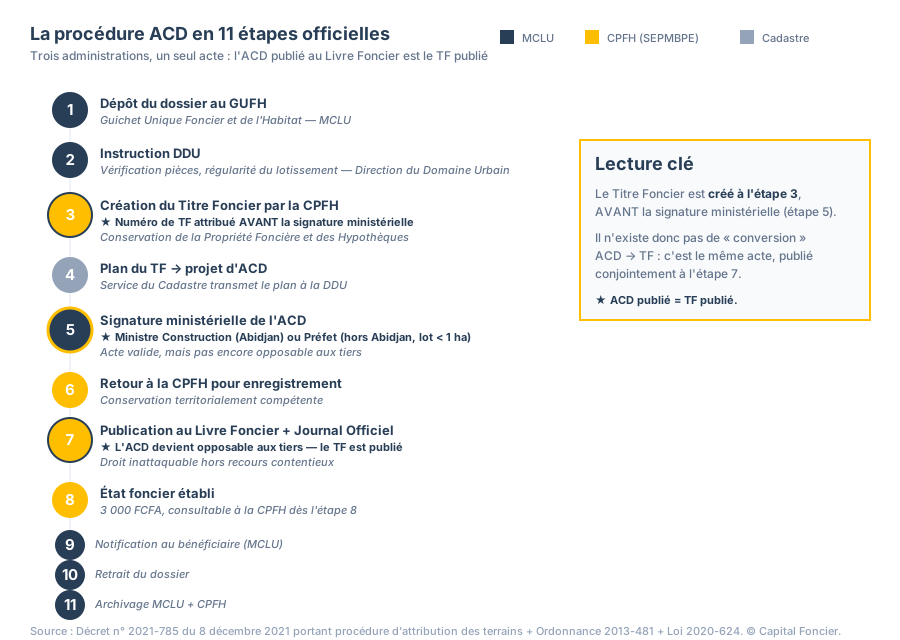
Here is the procedure published by the MCLU (Decree 2021-785), with the exact moment the TF appears.
- File submission at the One-Stop Land and Housing Desk (GUFH).
- Instruction by the Urban Domain Directorate (DDU): verification of documents, regularity of the subdivision, status of the lot.
- Transmission to the Cadastre and the CPFH, with creation of the Land Title in the Conservation's register and assignment of a unique TF number.
- Return of the TF plan to the DDU, then preparation of the draft ACD.
- Ministerial signature: the Minister in charge of Construction signs the ACD, or the Prefect outside Abidjan depending on the case.
- Return to the CPFH for registration.
- Publication in the Land Registry and the Official Journal: the ACD becomes enforceable against third parties, the TF is published.
- Issuance of the land status certificate by the CPFH, a document available on request for 3,000 FCFA.
- Notification to the beneficiary.
- Collection of the file by the owner or their agent.
- Archiving at the MCLU and the CPFH.
Source: Decree 2021-785, official procedure published by the MCLU.
The point to remember: between step 5 (ministerial signature) and step 7 (publication), the ACD is valid but not yet enforceable against third parties. That is the only nuance to know about enforceability, and it establishes no hierarchy between the ACD and the TF.
Who does what: three administrations, three distinct roles
One major source of confusion is that sellers often speak of "the ministry" as a single block. Three distinct institutions take part.
| Institution | Reports to | Role in the ACD procedure |
|---|---|---|
| MCLU (Ministry of Construction, Housing and Urban Planning) | Autonomous | File instruction, ministerial signature of the ACD |
| Cadastre | MCLU | Parcel plans, topographic verification |
| CPFH (Conservation of Land Property and Mortgages) | SEPMBPE / MCBPE, not the MCLU | Creation of the TF, publication in the Land Registry, land status certificate |
The CPFH reports to the State Secretariat to the Prime Minister in charge of the Budget and State Portfolio (SEPMBPE/MCBPE), not to the MCLU. The distinction matters. An ACD does not come out of the Ministry of Construction alone: it results from cooperation between two ministries.
Legal security: what publication changes
| Deed | Legal security | Available remedy |
|---|---|---|
| Unpublished ACD | Moderate | Application to set aside before the Council of State (Organic Law No. 2020-968, 2 + 2 month time limit) |
| ACD published in the Land Register = registered land title | Unassailable and imprescriptible (Torrens system) | Claim against the State for damages where fraud is established |
An ACD can be annulled by the administrative court in three cases: fraud in obtaining it, a double allocation on the same plot (the later ACD then falls), or an ACD covering a plot of the public domain, which is inalienable by nature.
Once published in the Land Register, the title enjoys Torrens indefeasibility, a principle drawn from the Australian Torrens System and adopted in Ivorian law since 1932. Where fraud is established, only a claim for damages against the State remains open. The title itself stays valid.
The five common errors of blogs and sellers
We take five formulations regularly published online and set them against the texts. We are not attacking competitors here. The point is to help the reader recognize legally false shortcuts.
Error 1: "The ACD triggers the process of creating the land title"
This wording appears on several commercial sites, often on pages that sell lots. It suggests that the TF is created after the ACD. The texts say the opposite: the TF is created at step 3, before the ministerial signature of step 5. The wording is legally false.
Error 2: "The Land Registry Conservation is the final step to obtain the ACD"
Some law firms present the CPFH as a last step. It intervenes twice: at step 3 to create the TF, then at step 7 to publish the ACD in the Land Registry after signature. The CPFH is the doctrine's double anchor point rather than the end of the road.
Error 3: "To gain full ownership, you must convert your ACD into a TF"
A commercial formulation that invites ACD owners to pay for a conversion. That conversion does not exist. The ACD published in the Land Registry is already the published TF, and there is no transformation to finance. If someone offers to "convert your ACD into a TF" for a fee, the service being sold is either a transfer, whose official price is regulated, or a fictitious procedure.
Error 4: "The TF is superior to the ACD"
A false hierarchy, used to justify a commercial price gap. In the texts, ACD and TF point to the same act taken at two moments. A lot sold "with unpublished ACD" and the same lot sold "with published TF" are not two different qualities: it is the same asset, at two different stages of the procedure. The price gap belongs to commercial pricing, not to a legal hierarchy.
Error 5: "Since 2013, the TF no longer exists in urban areas"
The mirror formulation, legally false in turn. Some blogs have tried to simplify by writing that Ordinance 2013-481 had "replaced" the TF with the ACD. That is inaccurate, and the urban TF has not been abolished: it is integrated into the ACD procedure, created by the CPFH, published in the Land Registry. What changes with the stage is the terminology, not the substance.
What this means for a diaspora investor
If you live in France, Canada, the United States, Belgium, or Switzerland and you are preparing an acquisition in Ivory Coast (Côte d'Ivoire), three concrete reflexes.
- Ask for the ACD published in the Land Registry, not just the signed ACD. Publication in the Land Registry (step 7) makes the right enforceable against third parties and unassailable, save for an action against the procedure. An ACD signed but not yet published stays valid; it simply deserves a check on where the file stands at the CPFH.
- Ask for the associated Land Title number. That number exists from step 3 onwards. A seller who answers that "the ACD does not have a TF number yet" is signaling either a subdivision still going through the procedure or incomplete information. In both cases, clarify the point before signing anything.
- Ask the CPFH for a recent land status certificate. Official cost: 3,000 FCFA. Recommended age: less than 15 days. Cross-checked with the published ACD, this document is the consistency checkpoint that any serious buyer asks for, including from abroad, through a notary or an authorized advisor.
- Check the Unique Land Identifier (IDUFCI) on the SIGFU, the integrated urban land management system (sigfu.gouv.ci). If the ACD you are shown appears neither in the land record nor under an IDUFCI, put the transaction on hold: a genuine, published ACD leaves a trace in all three systems.
What to do if you were told the opposite
If a seller has presented the ACD and the TF as two different products, or if a blog has led you to believe that a conversion is needed, three questions settle it.
- What is the Land Title number of the parcel?
- On what date was the ACD published in the Land Registry?
- Can you provide a land status certificate issued less than 15 days ago?
A serious seller answers all three without difficulty. A seller who gets tangled up, or who offers to "move the procedure along" for an extra fee, deserves an outside check by a registered notary, a specialized firm, or a trusted third party.
Capital Foncier's role: to verify, not to issue
Capital Foncier is neither a land authority nor a notary. We verify the consistency of the documents handed over by sellers: the ACD and its TF number, publication in the Land Registry, the land status certificate at the CPFH, the match with the PUD (Urban Master Plan). Our internal deliverable, the Land Compliance Certificate (CCF), attests to the documentary verification we have carried out. It does not stand in for official acts; it audits them.
For diaspora members who cannot travel on site at every step, this documentary audit is often the missing link between a seller who says "everything is in order" and the legal certainty needed to sign.
What Capital Foncier takes from this doctrine
The ACD and the TF are not ranked hierarchically, and that reading rests on four texts currently in force. The Conservation of Land Property and Mortgages is the institution to question, not the MCLU alone, and it reports to the SEPMBPE/MCBPE. The real benchmark remains publication in the Land Registry, at step 7, because that is what makes the right enforceable against third parties. An ACD signed but not published is not an inferior act: it is an act in the course of being finalized.
Further reading
- The 11 official steps of the ACD procedure: documents to provide
- Difference between ACD, Land Title and CMPF: the guide
- Domain status, land status, tax certificate: the 3 official documents
- Challenging a fraudulent ACD: administrative appeal and Council of State
Secure your land investment project
Do you have an ACD or a TF on your radar and want to check its publication in the Land Registry? A Capital Foncier advisor will run the documentary audit on your behalf and call you back within 2 hours.
Request my land diagnostic: two minutes to describe your project.
Sources
- Ordinance No. 2013-481 of 2 July 2013 setting the rules for acquiring ownership of urban land (FAOLEX)
- Decree No. 2013-482 of 2 July 2013 on the implementation of Ordinance 2013-481
- Decree No. 2021-785 of 8 December 2021 on the land attribution procedure (lexterra.ci)
- Law No. 2020-624 of 14 August 2020 establishing the Urban Planning and Urban Land Domain Code, Official Journal of the Republic of Ivory Coast
- Law No. 2024-351 of 6 June 2024 amending Law 2020-624
- servicepublic.gouv.ci, official ACD procedure
- construction.gouv.ci, Urban Domain Directorate (DDU)
About this article
Written by Alain Kadio, founder of Capital Foncier SARL (Abidjan), from the legal texts currently in force (Ordinance 2013-481, Decrees 2013-482 and 2021-785, Law 2020-624, Law 2024-351) and Capital Foncier's internal canonical doctrine V2. Review: Capital Foncier legal team.
Initial publication: 30 April 2026. Last verification of texts: 24 April 2026.
This article has an educational purpose. It constitutes neither legal advice nor personalized investment advice. Acquisition decisions must rest on parcel-by-parcel documentary verification. Contact: akadio@capital-foncier.com.
The Capital Foncier team, Abidjan, Ivory Coast
"Our mission is to secure every square metre purchased by our investors."
?Frequently asked questions
Is the ACD a definitive ownership title?+
Yes. Under the Urban Planning Code (Law No. 2020-624), which repealed Ordinance No. 2013-481, the ACD is the act that effects the transfer of ownership over urban land in the State's private domain. There is no higher act in urban areas.
When is the Land Title created during the ACD procedure?+
At step 3 of the official procedure published by the MCLU (Decree 2021-785). The Conservation of Land Property and Mortgages (CPFH) creates the TF and assigns its unique number before the Minister signs the ACD, at step 5.
Has the ACD replaced the Land Title since 2013?+
No. The urban Land Title continues to exist and is integrated into the ACD procedure. The ACD published in the Land Registry is materially the published TF: same act, two administrative stages.
How long between the signing of the ACD and its publication in the Land Registry?+
The texts set no precise deadline between signature and publication. In practice, the observed delay runs from a few weeks to several months depending on the Conservation office concerned and the volume of pending files. This is to be verified case by case.
Who signs the ACD in Abidjan and elsewhere?+
In Abidjan, the ACD is signed by the Minister in charge of Construction and Urban Planning. Outside Abidjan, it may be signed by the territorially competent Prefect for residential lots resulting from an approved subdivision of less than one hectare, in accordance with Decree 2021-785.
Is an ACD not published in the Land Registry enforceable against third parties?+
No. A signed ACD is valid, but it becomes enforceable against third parties only after its publication in the Land Registry, at step 7. Before that publication the right exists, but a third party may still, under certain conditions, contest the procedure. After publication, the right is unassailable save for litigation over a serious irregularity.
How can I verify that an ACD is properly published in the Land Registry?+
By requesting a land status certificate from the territorially competent CPFH. The document is issued at the official rate of 3,000 FCFA and should be less than 15 days old at the time you use it for a transaction. It indicates whether the ACD has been registered and published.