Buying Land Near an Announced Bridge: Five Key Checks
Bridge or road announced: five checks to make before paying more for land (right-of-way, DUP, state land status, subdivision, timeline). The case of Abidjan's sixth bridge.
Need a land expert?
Speak with an advisor for free. Response within 2 hours.
Key quotes
The sentences below can be quoted independently. Each statement is tied to a source text or a dated reference.
- "The price premium requested for a plot 'next to the future bridge' pays for a probability, not a fact: as long as the contract has not been signed and the right-of-way published, the infrastructure remains a hypothesis." Source: Capital Foncier analysis, Abidjan sixth bridge case, August 2026.
- "Under article 238 of Law No. 2020-624 of 14 August 2020, expropriation for reasons of public utility is a forced transfer of property rights over a real estate asset, in exchange for fair and prior compensation." Source: Urban Planning and Urban Land Code.
- "Between 2020 and 2023, the Directorate of Urban Planning and Urban Development (DUDU) of the Ministry of Construction, Housing and Urban Planning (MCLU) processed 51 public utility declaration files and issued 48 favorable opinions." Source: MCLU 2018-2023 statistical yearbook, Table 11.
In brief
An announced bridge, highway or interchange near a plot pushes listed prices up well before the first shovel hits the ground. The seller knows this, and the argument comes up often during viewings: "with the bridge, it'll be worth double." Sometimes access does genuinely improve; often, the argument is premature. And the plot that sits on the alignment could be acquired by the public authorities at the end of an expropriation procedure, rather than resold by you.
This guide sets out five checks, in the order in which we run them, using the Abidjan sixth bridge case (Abatta, Koumassi, Port-Bouët) as a common thread. A land status report (état domanial) costs 5,000 FCFA; the timeframe for a written response from the administration, however, is beyond your control. These checks cost a fraction of the premium the seller is asking in the name of the bridge.
What the "infrastructure premium" really pays for
When a plot sells at a higher price because an infrastructure project has been announced, you are paying for three things at once: the probability that the project will happen, the probability that it will happen at that location, and the probability that it will improve access to that specific plot. Each can be close to zero. A toll bridge that arrives two kilometers away, behind an expressway with no exit, changes nothing about a local resident's daily commute.
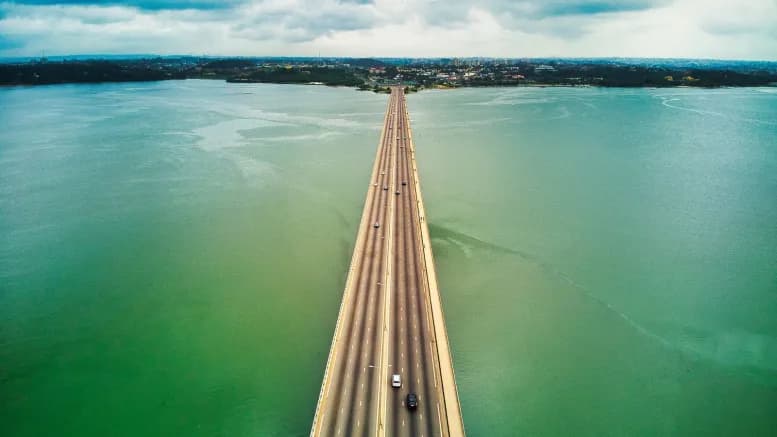
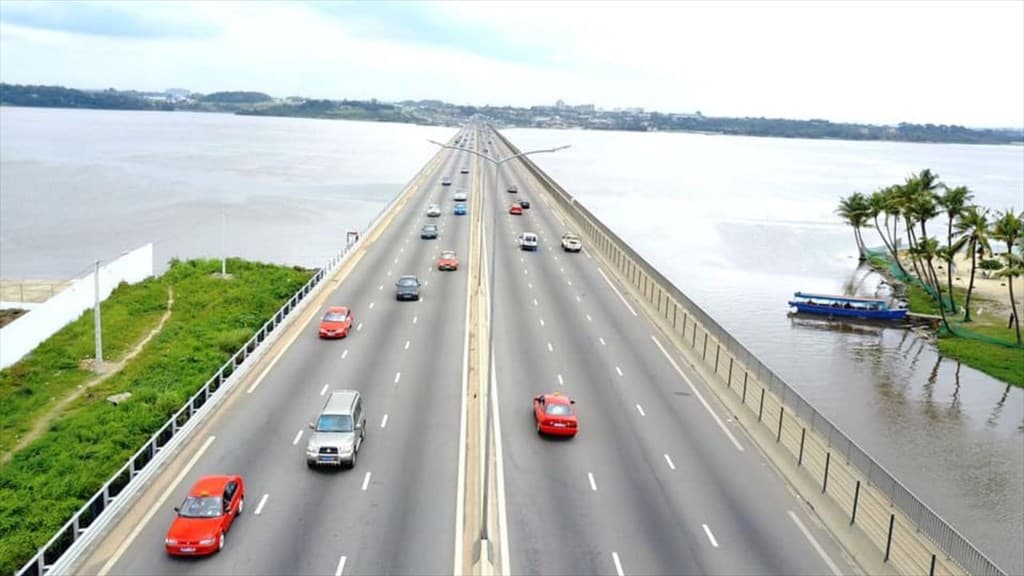
The Abidjan sixth bridge illustrates this well. It has been in the portfolio of the National Steering Committee for Public-Private Partnerships (CNP-PPP) for several years. A memorandum of understanding with a first partner, the Chinese group China Civil Engineering Construction Corporation (CCECC), expired in September 2024 without work having started, and the reasons for this timeline have not been made public. In late August 2026, the press names the Société concessionnaire du pont Riviera-Marcory (SOCOPRIM) as the favorite, without any official decision being published. We have summarized the state of the file in our article on the sixth bridge. Listed prices in Abatta, meanwhile, have priced in the bridge for a long time.
Check 1: the right-of-way — is your plot on the alignment?
This is the first question, and it's the one sellers avoid. The right-of-way is the strip of land that the works and their access roads will occupy. It is only known precisely after detailed studies, but elements exist beforehand: the CNP-PPP project sheet, preliminary design studies, planning documents.
Three concrete steps:
- Read the public project sheet. For the sixth bridge, the CNP-PPP sheet describes two sections (Abatta to Koumassi, Koumassi to Port-Bouët) and already mentions points of attention: an AFREXIMBANK site, part of the Exhibition Park, the interface with the Aérocité. A plot adjacent to these points calls for a written inquiry.
- Consult the applicable urban planning document. In Abidjan, this is the Greater Abidjan Urban Master Plan (SDUGA), approved by Decree No. 2016-138 of 9 March 2016, and the detailed plans where they exist. Major planned roads appear in these documents.
- Write to the MCLU's DUDU, or to the commune's town hall, citing the plot's identifier. A written response is worth more than 10 verbal promises.
Until the situation has been clarified in writing, treat the plot as potentially affected. And if no response comes back, draw the consequences on the price, or walk away.
Check 2: the public utility declaration and expropriation — what the law says
If the plot is within the right-of-way, it is intended to be acquired by the public authorities. Article 238 of Law No. 2020-624 of 14 August 2020 establishing the Urban Planning and Urban Land Code defines expropriation for reasons of public utility as the procedure by which the public authorities compel a natural or legal person to forcibly transfer their property rights over a real estate asset, in exchange for fair and prior compensation. The procedure begins with a public utility declaration (DUP), which designates the project and the assets concerned.
Two consequences for you. First, a plot covered by a DUP may be subject to expropriation at the end of the procedure; where this is the case, the compensation is established on the value of the asset, according to the terms provided by the texts, and not on the price you paid to the seller. Second, the procedure exists and is being processed: over the 2020-2023 period, the DUDU handled 51 DUP files and issued 48 favorable opinions (MCLU 2018-2023 statistical yearbook, Table 11). This ratio applies to the files processed; it does not measure the probability that a given plot will be affected. We have detailed the procedure in our article on declassification and DUP, and the term is defined in our glossary.
On land still held under customary rights, another mechanism applies: the purge of customary rights, which compensates holders of rights on the land when a zone is incorporated into the urban domain for a project of general interest (see our purge calculator). A plot arising from a village-level transfer may therefore fall under one mechanism or the other depending on its stage of regularization: two distinct procedures, not to be confused.
Check 3: the land status report and easements
The land status report (état domanial), issued by the MCLU, indicates the official purpose of the plot and the procedures that apply to it. It is the document that states whether the land is in a building zone, held in reserve, or subject to an easement. A road easement or a land reserve recorded along a planned road are clear signals, and they are binding on the owner as well as the buyer.
We request a land status report less than three months old, in the seller's name, with the plot's unique identifier. Since Decree No. 2019-221 of 13 March 2019, each urban plot receives a Unique Land Identifier of Côte d'Ivoire (IDUFCI), and Decree No. 2021-862 of 15 December 2021 organizes the Integrated Urban Land Management System (SIGFU) which centralizes this data. A seller who cannot produce the identifier of their plot cannot prove either that it lies outside the alignment.
Check 4: approved subdivision, or opportunistic extension?
An announced infrastructure attracts two things: serious projects and quick subdivisions. The risk of unapproved subdivisions is not uniform around Abidjan; our Bingerville, Songon, Grand-Bassam comparison classifies it zone by zone. In Abatta, the same pattern emerges: a village, approved subdivisions, and extensions whose status varies from one street to another.
The check does not change because a bridge is announced. The number of the approval decree for the subdivision should be requested from the seller and verified on the MCLU portal; we have described the process step by step in our tutorial, and our search tool allows a subdivision to be found by name. A plot "under regularization" near an alignment is not a good deal; it is an irregular plot with an additional sales pitch.
Check 5: the real timeline, from announcement to commissioning
A major public-private partnership project goes through the selection of a partner and the signing of a contract, under the framework set by Decree No. 2018-358 of 29 March 2018, then through financial close. Then come the detailed studies, the land acquisitions, the construction site, and the access roads, which often arrive after the main works themselves. Each stage can take years, and each can slip.
The Abidjan sixth bridge is at the selection stage, and even that without any official publication. Works had been mentioned for 2024, then for 2026. A buyer paying today for "the bridge" is funding a wait whose duration no one knows. The useful question is not "will the bridge happen?" but "what stage is it at, and what has been published?"
Pay the premium, negotiate it, or wait: a simple grid
Our reading, to be adapted to each situation:
| Situation observed | What the requested premium is worth | Recommended reflex |
|---|---|---|
| Contract signed, right-of-way published, plot outside the right-of-way, approved subdivision, construction launched | Defensible | Negotiate on the plot's actual access, not on the name of the bridge |
| Press announcement, no published contract, unknown right-of-way | A bet | Pay the price of the land without the bridge, or wait for publication |
| Plot possibly within the right-of-way, situation not clarified in writing | Without verifiable consideration at this stage | Do not sign until the situation is clarified; without a response, draw the consequences on the price or walk away |
| Unapproved subdivision "under regularization" near the alignment | Without consideration, whatever the bridge | Refuse |
This grid is a decision-support tool, not individualized advice: each situation must be verified against the documents.
What the diaspora investor can take away
- Request written documents before the price. Project sheet, land status report, response from the DUDU or the town hall: three documents that can be requested from abroad.
- An announced infrastructure does not fix a flawed title. A plot outside an approved subdivision remains irregular, bridge or no bridge.
- Time does not work against a properly documented plot. Years pass between announcement and construction; nothing forces you to pay today for a stage that has not begun.
What Capital Foncier takes away
We do not present infrastructure projects as a price argument. When an alignment is known, we flag it, with its source and stage of progress; when it is not, we say so. A plot is assessed on its documents and on its access on the day of the visit. Whatever comes afterwards is a premium the investor should not have to pay in advance.
Further reading
- Abidjan sixth bridge: what the alignment changes for a plot
- Declassification and public utility declaration: what it changes for a buyer
- Abidjan land prices: why three official sources give three different prices
- Land status report, land record, tax situation certificate: the three documents to request
- Master Urban Plan (PUD)
Securing your land project
Is a seller justifying their price with a bridge, road or interchange to come? A Capital Foncier advisor will check the land status report, the subdivision and the published planning documents before you pay anything, and will tell you what has not yet been published.
Get my land diagnosis: two minutes to describe your project, and a response from an advisor on the administrative status of the plot.
Sources
- Law No. 2020-624 of 14 August 2020 establishing the Urban Planning and Urban Land Code, article 238
- Decree No. 2018-358 of 29 March 2018 setting out the rules relating to public-private partnership contracts
- Decree No. 2019-221 of 13 March 2019 establishing the Unique Land Identifier of Côte d'Ivoire (IDUFCI)
- Decree No. 2021-862 of 15 December 2021 relating to the Integrated Urban Land Management System (SIGFU)
- Decree No. 2016-138 of 9 March 2016 approving the Greater Abidjan Urban Master Plan (SDUGA)
- MCLU statistical yearbook 2018-2023, Table 11 (DUDU)
- National Steering Committee for Public-Private Partnerships (CNP-PPP), project sheet "Development of the Abatta-Koumassi-Port-Bouët road link: construction of the Abidjan sixth bridge", project portfolio, consulted on 28 August 2026
- Ivorian press of 26, 27 and 28 August 2026 on the sixth bridge (Sikafinance, Journal d'Abidjan, Infos d'Ivoire, Connectionivoirienne, Financial Afrik), according to Africa Intelligence
About this article
Article written by the Capital Foncier team based on the texts and sources cited, verified on 28 August 2026. This article is educational in purpose. It does not constitute legal advice or individualized investment advice.
The Capital Foncier team, Abidjan, Côte d'Ivoire
"Our mission is to secure every square metre purchased by our investors."
?Frequently asked questions
How do I know if my plot is within the right-of-way of a bridge or road?+
In writing and in steps: the public project sheet (CNP-PPP or ministry), the applicable urban planning document (SDUGA in Abidjan), a recent land status report for the plot, and a written inquiry to the DUDU or the town hall with the plot's identifier. Without a published right-of-way, a verbal response does not replace a written answer from the DUDU.
Does a public utility declaration give a right to compensation?+
The DUP opens the procedure; it is expropriation, if pronounced, that gives rise to fair and prior compensation (article 238 of Law No. 2020-624 of 14 August 2020). Compensation is based on the value of the asset, under terms governed by the texts; it does not reimburse a purchase price inflated by the announcement of the project.
Does an announced bridge push land prices up?+
Listed prices, often yes, from the announcement onwards. Resale prices, later and only if the project actually happens, at the planned location, with useful access for the plot. In between, the buyer who paid the premium carries the timeline risk alone.
Is it better to buy before or after construction?+
It depends on what you are paying for. Before construction, the price incorporates a hypothesis and the plot must be judged without the bridge. After commissioning, access is known and the price reflects it. In both cases, the plot's documents matter more than the date.