
Why Private Deeds (Acte Sous Seing Privé) Have Been Banned Since 2013
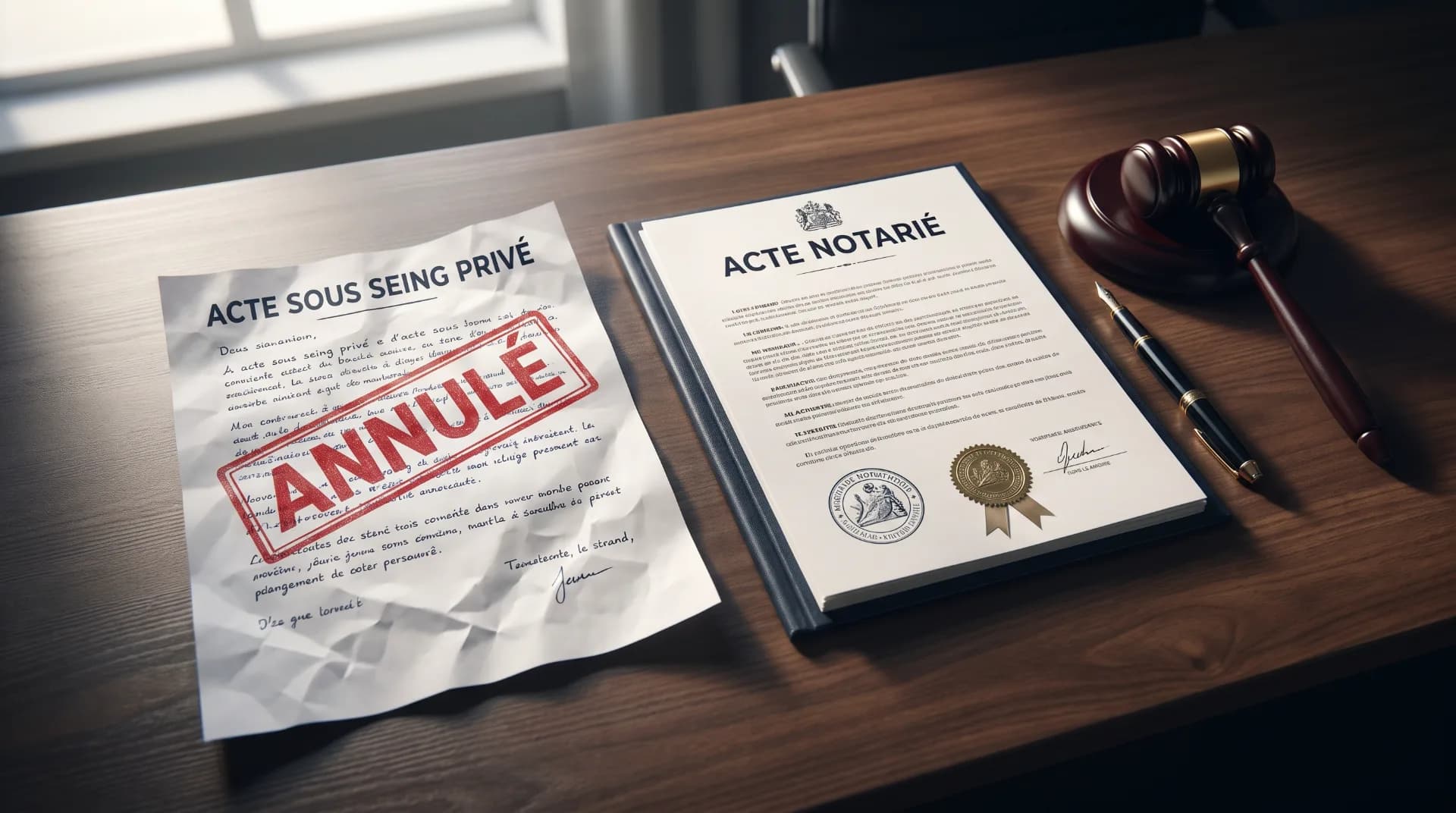
Ordinance 2013-481, reaffirmed by Law 2020-624: privately signed deeds (actes sous seing privé) are strictly prohibited in urban land transactions. A "contract between private individuals" has no legal value. Here is why, and what to do instead.
Need a land expert?
Speak with an advisor for free. Response within 2 hours.
During a trip to Abidjan, a diaspora professional signs a hand-to-hand "promise of sale" with the cousin of a seller he met online. Amount: 12 million FCFA. Two years later, he discovers that the same plot has been resold three times and that no notary was ever involved. His "private deed" contract has no legal value.
This scenario comes up often. It stems from ignorance of a rule that has nonetheless been repeated since the land reform: since Ordinance No. 2013-481 of July 2, 2013, private deeds (actes sous seing privé) are formally prohibited in urban land transactions in Ivory Coast (Côte d'Ivoire).
What the Ministry's Official Magazine Literally Says
The Ministry of Construction, Housing and Urban Planning (MCLU) devotes a text box to the reform of the ACD (Arrêté de Concession Définitive, the definitive concession order) on page 17 of its Magazine BÂTIR No. 000, dated October-December 2019. Here is what it states about the obligations placed on private sellers and buyers:
"Obligation to produce authentic deeds in land transactions between private parties. N.B.: private deeds are prohibited. "
This sentence does not create the rule: it restates the one laid down by the 2013 ordinance. Its merit lies elsewhere. It is written in black and white in a ministerial publication, which cuts short any on-the-ground arguments about a supposed "sale contract" signed without a notary.
What Exactly Is a Private Deed?
A private deed is a contract drafted and signed directly by the parties, without the involvement of a public officer. In other areas, such as leases, service agreements or commercial contracts, it is a perfectly valid legal form.
In Ivorian urban land matters, it is not. Ordinance 2013-481, followed by Law No. 2020-624 of August 14, 2020 establishing the Urban Planning and Urban Land Code, requires an authentic deed, that is, a deed executed before a notary registered with the Order of Notaries.
In practical terms, none of the following documents transfers ownership of an urban plot:
- a "sale contract" signed on plain paper;
- a "promise of sale" signed between the parties, without a notary;
- a "payment receipt" handwritten by the seller;
- a "transfer attestation" drawn up by the seller alone;
- an agreement exchanged by email or on WhatsApp.
Why This Requirement? The Notary's Three Functions
Law 2020-624 relies on the notary for three specific reasons.
The first concerns verification. The notary checks the identity of the parties, their legal capacity and the origin of the funds, under the due diligence obligation set out in Law No. 2016-992 against money laundering. The notary also examines the documents produced: the land status report, the state land status report, and the Unique Land Identifier of Ivory Coast (IDUFCI), which can be consulted on the Integrated Urban Land Management System (SIGFU).
The second relates to land registration. The notary opens the administrative chain that leads to the issuance of a certificate of land ownership transfer (CMPF) by the Land Registry, and then to the recording of the transfer in the Land Register (Livre Foncier). Without a notary, there is no registration, and therefore nothing enforceable against a third party.
The third concerns the funds. The notarial escrow account blocks the payment until the formalities are completed. If the sale falls through, the money returns to the buyer: it has not been paid out with no way back.
The Concrete Consequences of a Private Deed
A buyer who has "purchased" through a private deed is left without any effective recourse:
- they are not recorded in the Land Register and therefore have nothing to assert against a third party claiming ownership;
- their deed is treated as nonexistent, so that even in good faith they cannot seek its enforcement;
- if the seller resells the same property to a third party through a notarized deed, that third party becomes the owner, and the first "buyer" has lost their money;
- no bank will accept the property as collateral for a mortgage, since there is no enforceable deed;
- nothing can be recorded in the tax cadastre: neither the property tax in their name, nor the benefit of exemptions (the 5% first-time buyer tax credit, 2026 Tax Annex).
The Specific Case of [Stellionate](/glossaire/stellionat)
Article 3 of Law 2020-624 precisely defines the fraud that thrives in the ecosystem of private deeds: stellionate, that is, selling a property one no longer owns, mortgaging it a second time, or presenting it as free of encumbrances when it is mortgaged.
The perpetrator of stellionate faces the nullity of the deed, criminal prosecution and damages. But the victim of stellionate committed through a private deed has little recourse: their contract is not enforceable, and tracking down the fraudster is often difficult.
The defense comes down to two reflexes. Require a land status report and a state land status report less than 15 days old. Use a notary you choose yourself, never the one imposed by the seller.
What the Buyer Should Do Instead
The legal procedure comes down to five steps.
- Verify the title and the status reports, land and state land, with the MCLU and the Land Registry.
- Choose your own notary, independent of the seller.
- Sign the authentic deed before that notary.
- Pay through a notarial escrow account, never directly into the seller's personal account.
- Follow the transfer through to the issuance of the CMPF and the recording in the Land Register.
Going through a notary has a cost. It remains nothing compared to losing a plot that was paid for and never transferred. Moreover, the 2026 Tax Annex exempted notarial fees from VAT for purchases made through a specialized company, and abolished registration duties for first-time buyers.
To go further: The 11 official steps to obtain your ACD, Attribution letter, ACP, CPF: documents that no longer exist, Challenging a fraudulent ACD before the Council of State.
Official sources
- Ministry of Construction, Magazine BÂTIR No. 000, October-December 2019, p. 17
- Ordinance No. 2013-481 of July 2, 2013 (founding land reform)
- Law No. 2020-624 of August 14, 2020, Urban Planning and Urban Land Code, Article 3 (definition of stellionate)
- Law No. 2024-351 of June 6, 2024 (amending law)
- Law No. 2016-992 (anti-money laundering, due diligence on the origin of funds)
- servicepublic.gouv.ci, land procedures
Is a seller suggesting you sign "just between yourselves" to save on notary fees? That is a red flag. Our advisors can review your file and guide you toward a legal and secure structure.