Regular subdivision, regularization, subdivision permit: 2,440 official applications decoded (2020-2023)
Between 2020 and 2023 the DUDU processed 2,440 subdivision applications. Three procedures, three levels of security for anyone buying a plot: what the MCLU figures say.
Need a land expert?
Speak with an advisor for free. Response within 2 hours.
Key quotes
The sentences below can be quoted on their own. Every figure is tied to its dated official source.
- "Between 2020 and 2023, the Urban Planning and Urban Development Directorate (Direction de l'Urbanisme et du Développement Urbain, DUDU) of the Ministry of Construction, Housing and Urban Planning (Ministère de la Construction, du Logement et de l'Urbanisme, MCLU) processed 2,440 subdivision applications: 1,394 regular subdivisions, 996 subdivisions under regularization, and 50 subdivision permits." (source: MCLU statistical yearbook 2018-2023, Table 11)
- "In 2023 the volume rose sharply: 805 applications for regular subdivisions and 648 applications for regularization, against 234 and 101 respectively in 2022." (source: MCLU yearbook, Table 11)
- "The rate at which favorable opinions are issued stands at 78.5% for regular subdivisions and 81.5% for regularizations." (source: MCLU yearbook, Table 11)
In brief
Between 2020 and 2023, the DUDU of the MCLU processed 2,440 applications relating to subdivisions, split across three categories: 1,394 applications for regular subdivisions (1,095 favorable opinions), 996 applications for subdivisions under regularization (812 opinions), and 50 applications for subdivision permits (30 opinions). These three procedures do not describe the same legal situation, and above all not the same level of security for anyone buying a plot. Confusing them means taking on risks that a prior review can rule out.
Key figures: subdivisions processed by the DUDU (2020-2023)
| Procedure | Applications | Favorable opinions | Issuance rate |
|---|---|---|---|
| Regular subdivision | 1,394 | 1,095 | 78.5% |
| Subdivision under regularization | 996 | 812 | 81.5% |
| Subdivision permit | 50 | 30 | 60.0% |
| Total 2020-2023 | 2,440 | 1,937 | 79.4% |
Source: MCLU statistical yearbook 2018-2023, Table 11 (DUDU).
Year-by-year trend
| Year | Regular subdivision | Subdivision under regularization | Subdivision permit |
|---|---|---|---|
| 2020 | 195 | 173 | n/a |
| 2021 | 160 | 74 | n/a |
| 2022 | 234 | 101 | 25 |
| 2023 | 805 | 648 | 25 |
Source: MCLU yearbook, Table 11. Reading note: "n/a" means the source table leaves that line blank. The 50 subdivision permits counted in the total are therefore spread over two years only, 2022 and 2023. The acceleration seen in 2023 shows up in the first two columns.
Weighing up several subdivisions? A Capital Foncier adviser verifies the precise administrative status for you. Start my diagnostic, answer within two hours.
1. The regular subdivision: the security standard
A regular subdivision followed the official procedure from the outset: initial declaration, review by the DUDU, approval, and compliant registration.
What that means with the file in hand:
- Compliance with the applicable planning rules: Master Urban Plan (Plan d'Urbanisme Directeur, PUD), Urban Development Master Scheme (Schéma Directeur d'Urbanisme, SDU), and the Urban Planning Code.
- Conformity with the zoning set for the area concerned.
- Servicing planned or already carried out in line with regulatory obligations.
- The most solid legal security of the three cases for the plots put on the market, provided the deeds of sale are themselves properly formalized.
The figures: 1,394 applications filed, 1,095 opinions issued, an issuance rate of 78.5%. Roughly one file in five is suspended, deferred, or sent back for additional documents. In 2023 the volume rose sharply, with 805 applications against 234 in 2022. The pace has clearly picked up.
On the buyer's side, a plot located in a regular subdivision that has received a favorable DUDU opinion is the ideal case. The verification comes down to a single request: asking the developer or the owner for the reference of the DUDU opinion.
2. The subdivision under regularization: an intermediate procedure
A subdivision under regularization already existed before being approved. Either it never received formal approval at the outset, or that approval was suspended. In both cases, an administrative process is under way to bring it into compliance.
The most frequent situations:
- Older subdivisions created before the current administrative procedures were introduced.
- Subdivisions carried out without a compliant initial declaration.
- Subdivisions whose approval has been called into question by the administration.
- Subdivisions containing undeclared changes to the original plan.
The figures: 996 applications for regularization filed in four years, 812 opinions issued, an issuance rate of 81.5%, slightly above that of the regular subdivision. In 2023 the volume jumped, with 648 applications against 101 in 2022. Ivorian land holdings are being brought into compliance at an accelerating pace.
On the buyer's side, buying a plot in a subdivision under regularization is not disqualifying, but it does call for a specific verification:
- At exactly what stage is the regularization file?
- Who is carrying the procedure (developer, owner, or local authority)?
- What are the residual risks (refusal, compliance requirements, compensation payments)?
- What is the realistic timetable for obtaining final approval?
A subdivision under regularization can end in full approval, and that is the favorable scenario. It can also stay blocked for years, or be refused. Without a professional reading of the file, there is no way to tell which of the two situations you are in.
3. The subdivision permit: the act that comes before creation
The subdivision permit (autorisation de lotir) is the administrative act that allows a parcel to be divided into several plots. It is the step that precedes the creation of a subdivision, and it is distinct from the regular subdivision application, which is the one that finalizes the approval.
What this act does, and what it does not do:
- It covers the opening of the procedure, that is, the planned division and servicing.
- On its own, it does not allow the plots to be marketed.
- It does not authorize individual construction on the plots, which falls under the building permit.
The figures: only 50 applications in four years, making it the least used category, with 30 opinions issued (60%). Marginal in volume, it is still worth knowing about in order to tell apart the acts that punctuate the administrative life of a subdivision.
A summary comparison for the buyer
The table below puts the three procedures side by side, including on the point that matters most to a buyer: the possibility of later obtaining a Definitive Concession Decree (Arrêté de Concession Définitive, ACD) on the plot.
| Criterion | Regular subdivision | Subdivision under regularization | Subdivision permit |
|---|---|---|---|
| Legal status | Fully approved | Being brought into compliance | Preliminary step |
| Security for the buyer | High | Variable, to be assessed file by file | None, no sale possible |
| Possibility of obtaining an ACD on the plot | Yes, standard procedure | Possible but contingent | Not applicable |
| Capital Foncier recommendation | Ideal case | Specialist verification required | Not a plot that is for sale |
The questions to ask before buying a plot
Before any signature, promise, or deed, four questions really count.
- Which category does the subdivision fall into: regular, under regularization, or not approved?
- What is the reference of the DUDU opinion? A regular subdivision has an identifiable opinion, a subdivision under regularization has a file number. A subdivision that has not been approved has neither.
- Does the subdivision plan you are shown match the approved plan? Undeclared changes are a frequent source of disputes.
- Which ownership deed is provided for at the end of the process? An approved regular subdivision normally makes it possible to apply for an ACD on each plot. A subdivision that has not been approved does not.
The classic traps to avoid
- "The subdivision is in the process of being approved", with no verifiable file. That phrase can just as easily describe a regularization already well advanced as a subdivision that has never started any procedure at all.
- An attractive site plan that matches no official document. A plan with no administrative reference cannot be relied on against third parties.
- Inflated "diaspora" prices that do not reflect the administrative reality. A plot at 15 million FCFA in a subdivision that has not been approved can cost far more, in litigation and lost time, than a plot at 20 million FCFA in a regular subdivision.
- Verbal commitments about future servicing. Only the servicing written into the specifications (cahier des charges) of the approved subdivision can be enforced against the developer.
What the diaspora can take away
For an investor buying from abroad:
- Give priority to approved regular subdivisions. That is the framework which best protects a buyer who cannot travel for every verification.
- Never buy in a subdivision that has not been approved without a solid support file: a specialist firm, an administrative attestation, a regularization timetable. That is the minimum for taking the risk with full knowledge of the facts.
- Systematically ask for the official documents: approved plan, DUDU opinion, prefectoral or ministerial order, and the position on plots already sold.
What the individual buyer can take away
For an Ivorian resident who is buying:
- The price per square meter is not the only criterion. A cheaper plot in a fragile subdivision costs more, all things considered, than a slightly more expensive plot in a regular subdivision.
- Working with a notary is a structural safeguard. The notary has a duty to verify ownership and administrative compliance before drafting the deed.
- Verification with the DUDU remains a marginal expense set against the amount of an acquisition. It is the line in the budget that pays for itself fastest.
What Capital Foncier takes away
Our reading:
- Regularization is picking up speed. The 648 applications for regularization recorded in 2023 show that Ivorian land holdings are gradually being brought into compliance.
- The category a subdivision falls into is public information. It can be verified. Never skip that check.
- Between security and price, the gap is narrower than it looks. The cost of a plot that was never properly made secure does not show on the price tag: it is paid later, in litigation.
Further reading
- The 6 types of urban planning opinions in Ivory Coast
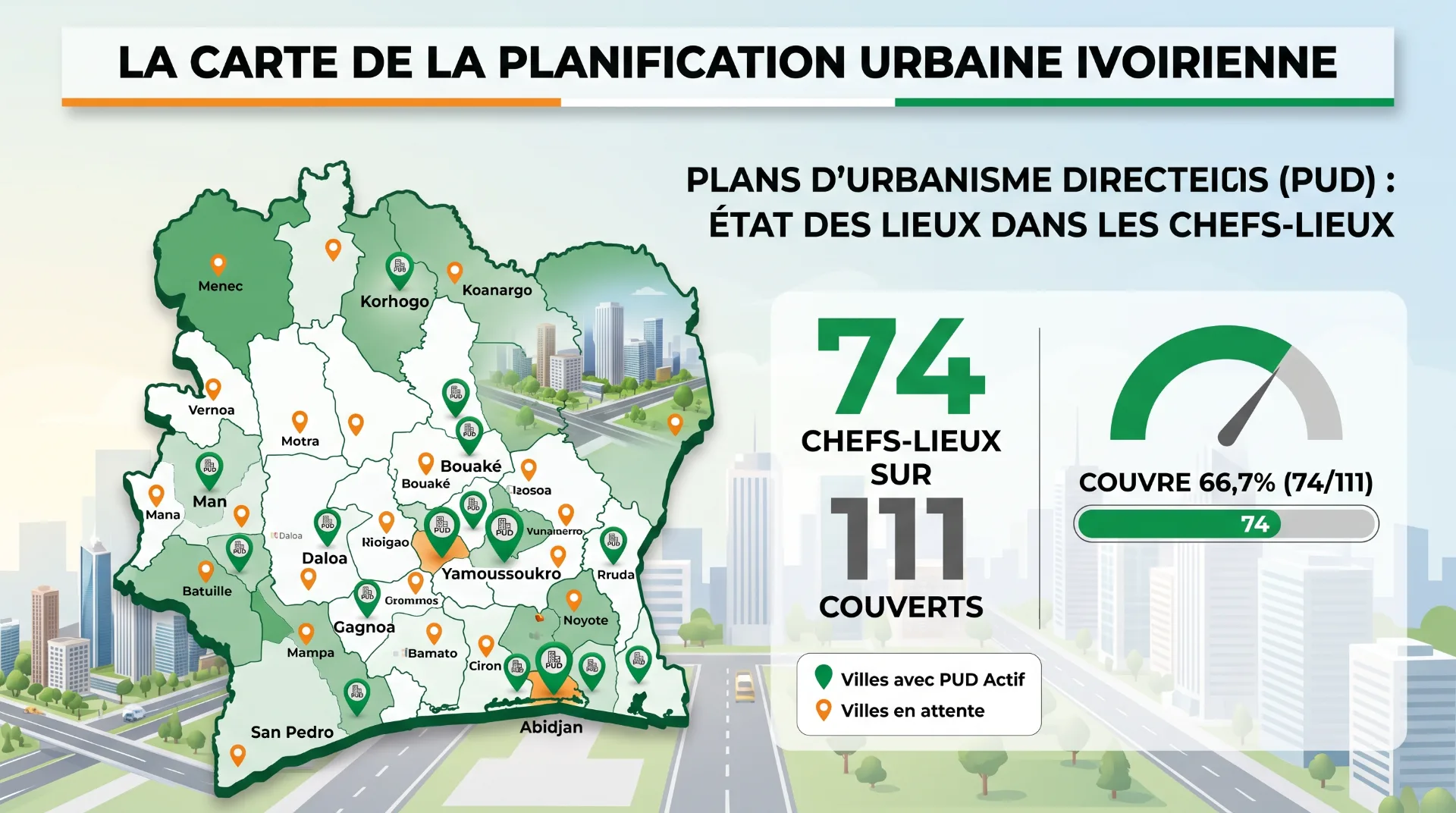
- Master Urban Plans: 74 departmental capitals out of 111 covered
- Due diligence guide: how to verify a subdivision
- ACD procedure: steps and documents
Securing your land project
Have you spotted a subdivision and do you want its official status verified before you sign? A Capital Foncier adviser does it for you within two hours.
Start my diagnostic, two minutes to describe your project.
Sources
- Statistical yearbook of the MCLU 2018-2023, Table 11 (DUDU)
- Law No. 2020-624 of 14 August 2020 establishing the Urban Planning and Urban Land Code
- Ordinance No. 2013-481 of 2 July 2013 on the management of urban land
- Decree No. 2013-482 setting out the terms of application
About this article
Article written by the Capital Foncier team from the MCLU statistical yearbook 2018-2023. Initial publication: 10 May 2026. This article has an educational purpose. It constitutes neither legal advice nor individualized investment advice.
The Capital Foncier team, Abidjan, Ivory Coast
"Our mission is to secure every square meter bought by our investors, so that investing stays a pleasure."
?Frequently asked questions
Can building work go ahead in a subdivision under regularization?+
That depends on how far the procedure has progressed. In some subdivisions under regularization, construction is authorized on a conditional basis; others are frozen until the DUDU issues its favorable opinion. Examining the file with the relevant departments is essential before committing to any building work.
How do you find out whether a subdivision is approved?+
By asking the developer or the owner for the reference of the DUDU opinion, then checking that information directly with the administration. A DUDU opinion carries a number, a date, and the identification of the subdivision concerned.
Can a notary draft a deed for a plot in a subdivision that has not been approved?+
The notary has a duty to verify administrative compliance before drafting an authenticated deed. A deed covering a plot from a subdivision that has not been approved is exposed to legal difficulties. In practice, a rigorous notary will ask for the administrative documents before formalizing the transaction.
What separates a regularization from a simple modification?+
A regularization concerns a subdivision that has never been approved, or whose approval has been suspended. A modification concerns a regular subdivision where one feature is to be changed: perimeter, site plan, or specifications. That second process falls under the yearbook's "declassification and modification" category, which totals 1,048 applications over four years.
Is a refusal rate of 20 to 40% normal?+
Yes. On complex planning files, a refusal or deferral rate of 20 to 40% reflects a serious review. A poorly prepared file, a plan that does not comply with the PUD, an uncertain underlying title: these are all grounds for refusal or for a request for additional documents.