Chargement...
Chargement...
Starlink is now available for order in Ivory Coast. Kit and subscription pricing, coverage map, and an honest comparison with CanalBox, Orange, and Moov fiber. How connectivity is changing land value.
Need a land expert?
Speak with an advisor for free. Response within 2 hours.
Starlink is now available to order in Ivory Coast (Côte d'Ivoire). On July 16, 2026, SpaceX confirmed the commercial launch of the service on its official account, with a coverage map to back it up. The country becomes the operator's 27th African market, after a twelve-month provisional authorization issued by the Telecommunications Regulatory Authority of Ivory Coast (ARTCI) in June 2026.
In a country where fiber and 4G still stop at the edge of many localities, satellite internet moves one line in particular: the coverage line. Price and real-world speed, on the other hand, have to be measured against the offers already in place.
ARTCI has granted Starlink Network CIV a twelve-month provisional license to supply fixed high-speed satellite internet across the whole territory. Low Earth Orbit (LEO) frequency bands had already been opened in September 2025. During this experimental period, the regulator keeps a right of oversight over those frequencies.
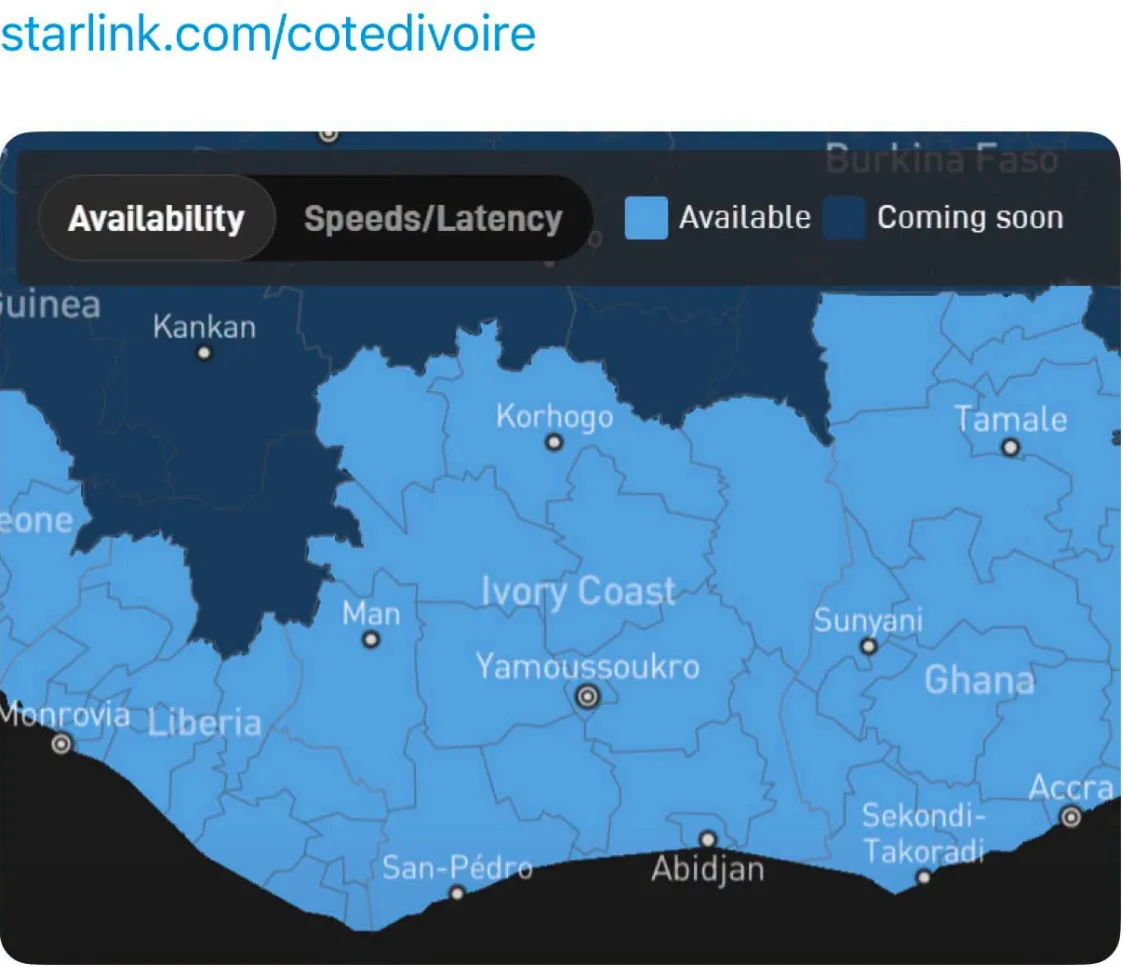
The map published by Starlink shows "available" coverage over most of the country, including Abidjan, Yamoussoukro, Bouaké, Daloa, San-Pédro, and Korhogo. A few areas in the North and the West are still marked "coming soon".
On speed, Starlink announces up to 100 Mbps downstream, with latency of 25 to 60 milliseconds depending on conditions. That latency comes down to altitude: satellites in low orbit travel much closer to the ground than the old geostationary ones, whose response time was far longer.
The service is paid for in two stages: the hardware once, then the subscription every month.
The Standard kit is listed at 247,466 FCFA (about 377 EUR / 431 USD). The Mini kit, more compact, comes down to 148,148 FCFA (about 226 EUR / 258 USD). The residential subscription costs 28,746 FCFA per month (about 44 EUR / 50 USD), for speeds of up to 100 Mbps.
Beware of intermediaries. In Ivory Coast as elsewhere in West Africa, resellers list the kit between 400,000 and 699,000 FCFA, sometimes with "installation" fees of 50,000 FCFA on top. None of those amounts are official. The reference price is the one you pay by ordering directly at starlink.com/cotedivoire.
Starlink is not arriving on an empty market. Fiber is already deployed in the large urban areas, often at lower rates. The table below places the offers side by side.
| Offer | Technology | Speed | Monthly subscription | Hardware and installation |
|---|---|---|---|---|
| Starlink Residential | Satellite (low orbit) | up to 100 Mbps | 28,746 FCFA | Kit 148,148 to 247,466 FCFA |
| CanalBox Start | Fiber | 50 Mbps | 15,000 FCFA | Free box and installation |
| CanalBox Premium | Fiber | 200 Mbps | 30,000 FCFA | Free box and installation |
| Orange Fibre (residential) | Fiber | depending on plan | from 15,000 FCFA | depending on plan |
| Moov Africa (Ma fibre) | Fiber | depending on plan | from 15,000 FCFA | depending on plan |
| MTN HomeBox | Fixed 4.5G | depending on plan | about 19,900 FCFA | Box approx. 10,000 to 19,900 FCFA |
Where fiber runs, it costs about half as much per month as Starlink, with no hardware to buy. CanalBox Premium even climbs to 200 Mbps for 30,000 FCFA, box included. Satellite internet does not play on the same field as urban fiber.
It all depends first on your address. In a connected city, fiber wins on nearly everything: lower monthly price, stable speed, low latency, and no antenna to buy. For a household already eligible for CanalBox, Orange or Moov, the appeal of Starlink stays limited.
Outside fiber zones, the equation flips. Village, hamlet, farm, worksite, remote tourist site, peri-urban plot not yet served: neither fiber nor decent 4G reaches them. Starlink brings a connection where the alternative was often no network at all. That is where it earns its place, and nowhere else.
Two reservations before you buy in. The antenna needs mains power, so in areas prone to outages a UPS (50,000 to 100,000 FCFA) is quickly added to the bill. The entry ticket also stays higher than that of an ordinary home box, which weighs on a household budget.
At Capital Foncier, this launch interests us for one precise reason: an available network changes what you can do with a piece of land.
A plot is judged on its title, its location, and how well it is serviced. Connectivity now joins that list. A peri-urban lot considered "too far from everything" yesterday becomes usable as soon as a stable connection is possible there: main or second home, remote work, farming monitored from a distance, a small shop or workshop. What used to hold back the appeal of certain areas loses ground.
For a diaspora investor, the effect works twice over. The area gains use potential, and following a construction or operating project from abroad becomes simpler when the site is connected. A municipality long seen as cut off may see its land demand shift as coverage spreads.
None of this replaces checking a land title or analyzing an area. But connectivity is one more criterion to fold into a buying decision, in the same way as road access or the water and electricity supply.
Prices are those recorded in mid-July 2026 and may change. Always check the current price on the official websites before ordering.
The Mini kit is 148,148 FCFA and the Standard kit 247,466 FCFA. The residential subscription costs 28,746 FCFA per month, for speeds that can reach 100 Mbps.
Coverage is announced as "available" over most of the country, including Abidjan, Yamoussoukro, Bouaké, San-Pédro, and Korhogo. A few areas in the North and the West are still shown as "coming soon" on the official map.
In a fiber-connected city, fiber is cheaper and more stable. Starlink takes the lead in areas with no fiber and no decent 4G: rural, underserved peri-urban, worksites and remote sites.
No, no intermediary is needed. The kit is ordered directly from Starlink's official website. Inflated prices between 400,000 and 699,000 FCFA and the "installation" fees offered by third parties are not official rates.
The low-orbit constellation delivers latency of 25 to 60 milliseconds, well below that of geostationary satellites, which makes video calls and browsing comfortable.
Capital Foncier verifies: title deed published, subdivision status checked, and state land status cross-referenced.
Songon
4 / 5 lots available
TER-2026-67Q8L
Abidjan
1 / 1 lots available
TER-2026-35B29
Yamoussoukro
2 / 2 lots available
TER-2026-74D9CWiden your reading with other facets of Ivorian land.
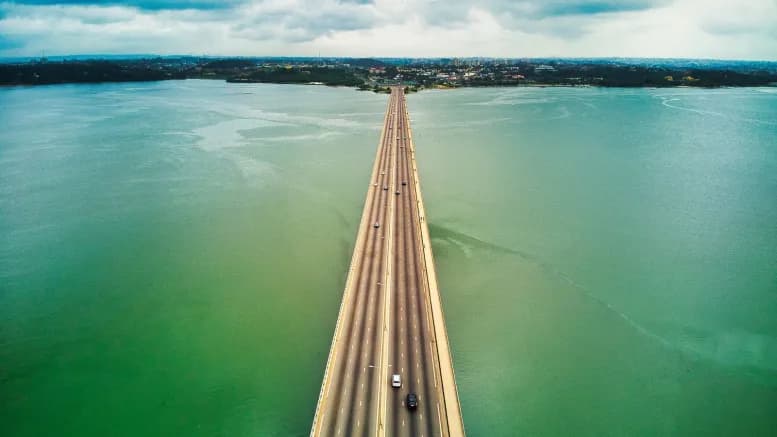
Abatta, Koumassi, Port-Bouët: 200 billion FCFA, a toll, SOCOPRIM tipped as frontrunner, no construction date. Facts verified as of August 28, 2026 — checks to make before buying.
Read article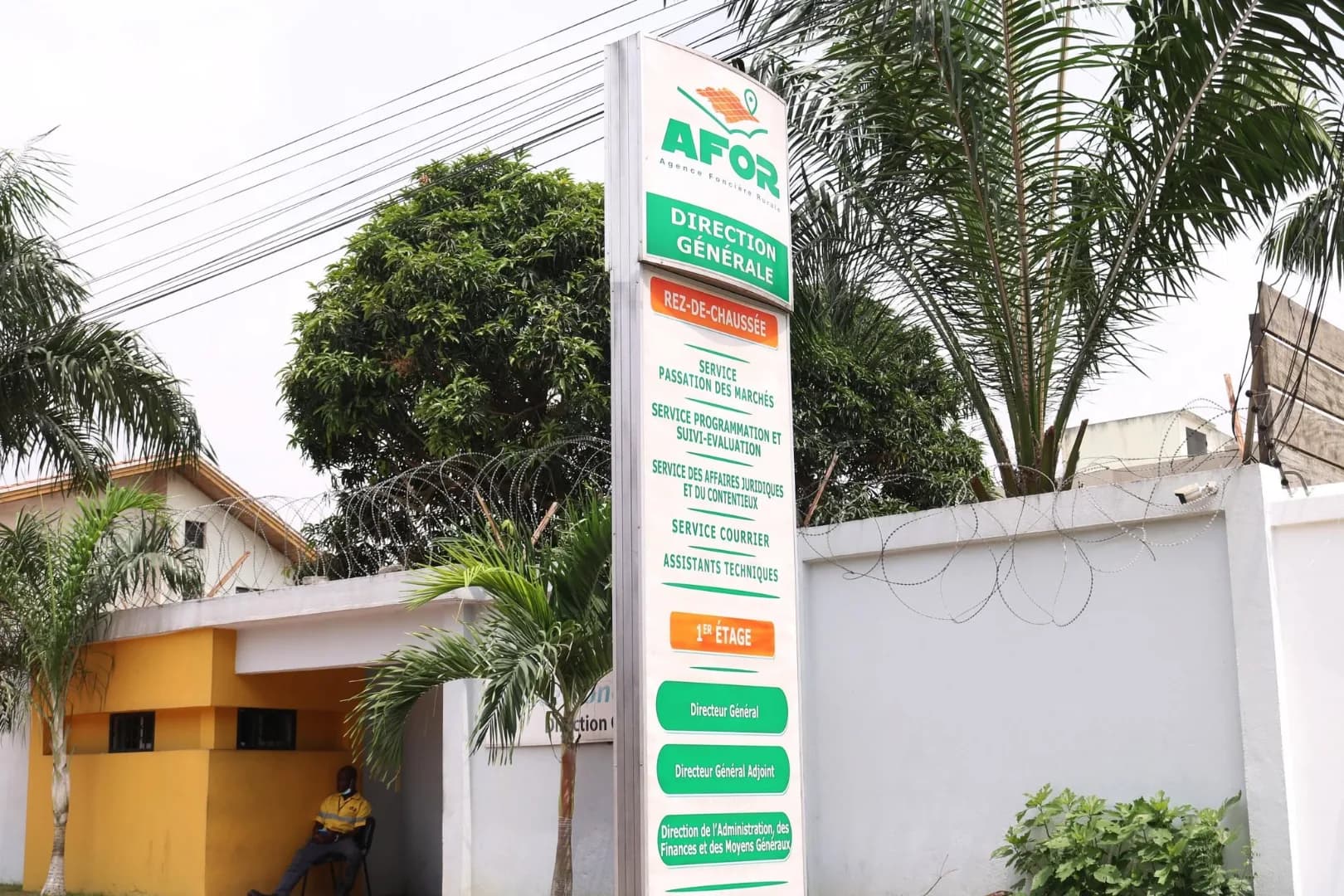
The Rural Land Agency (AFOR) reminds us that seven categories of land cannot be covered by a land certificate: public domain, urban perimeters, deferred development zones, classified forests and protected areas, tourist zones, granted land, and land already registered. Before any transaction, verify the legal status of the plot and the date the certificate was issued.
Read article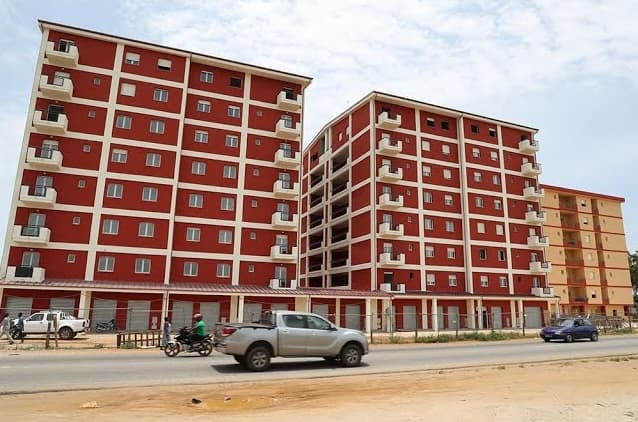
Three appeals by the developer dismissed by the Council of State between 2021 and 2025, and a demolition order withdrawn in 2026: what the Modeste case teaches every buyer.
Read article