SIGFU and IDUFCI: How Cadastral Digitalization is Transforming Ivorian Land Management
The Land One-Stop Shop Information System and the unique IDUFCI identifier are revolutionizing land management in Ivory Coast. Analysis of a major technological reform.
Need a land expert?
Speak with an advisor for free. Response within 2 hours.
Introduction
Three digital tools are changing the way a plot of land is proved and tracked in Ivory Coast (Côte d'Ivoire): SIGFU (Système Intégré de Gestion du Foncier Urbain / Integrated Urban Land Management System), IDUFCI (Identifiant Unique du Foncier de Côte d'Ivoire / Unique Land Identifier of Ivory Coast) and, since January 2024, the electronic signature (SIGNE) of the Ministry of Construction, Housing and Urban Planning (MCLU).
These three mechanisms are still poorly known to the general public. They nonetheless go after the four chronic ailments of the sector: opacity, fraud, administrative slowness, and disputes. In other words, everything that keeps a land purchase an anxious business for many families.
Whether you are an investor, a property owner, or simply curious about Ivorian land matters, sooner or later these three acronyms will turn up in your file. You may as well know what they do, what they do not yet do, and how to use them.
SIGFU: the digital brain of Ivorian land management
What is SIGFU?
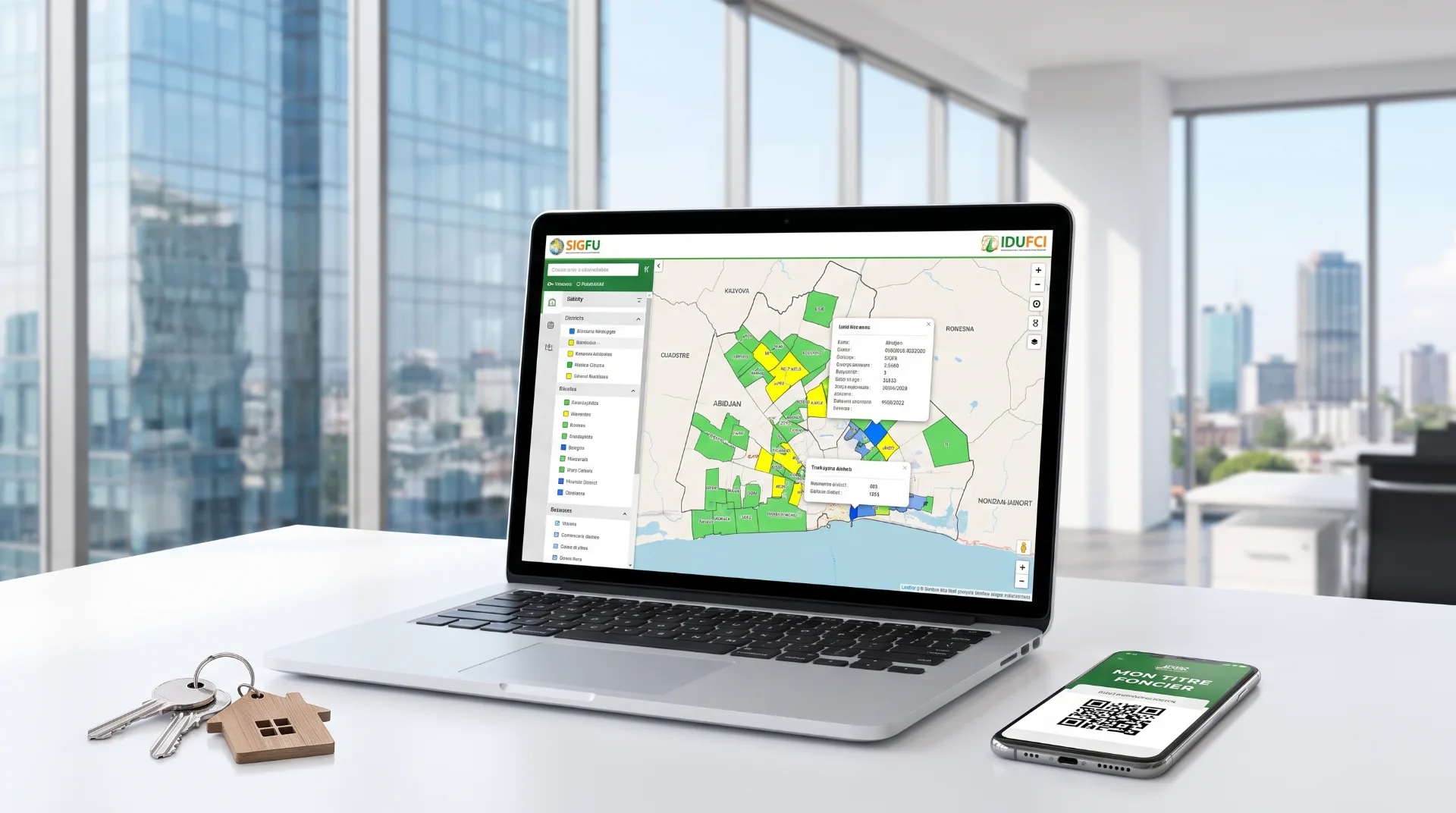
SIGFU (Système Intégré de Gestion du Foncier Urbain / Integrated Urban Land Management System) is the centralized digital platform that handles land operations in Ivory Coast. It was established by Decree No. 2021-862 of December 15, 2021.
In practice, it is the computer system that records every land application (arrêté de concession définitive or ACD, subdivision, transfer), tracks file processing in real time, stores the history of each parcel, and connects the administrations involved: the Direction Générale des Impôts (DGI / General Tax Directorate), the Land Registry, the Cadastre, and Urban Planning. Each of those administrations used to keep its own records, with no technical obligation to talk to the others.
The nine official components of SIGFU
According to the Ministry of Construction (BÂTIR N°004, Jan-March 2022), the Urban Land Simplification and Digital Transformation project is built around nine components:
- Single geodetic reference system (Decree No. 2019-220, RGCI-2019)
- Unique parcel identifier (IDUFCI, Decree No. 2019-221)
- Standardization and reengineering of administrative procedures
- Change management: training, support, communication
- Geographic information reference system (LIDAR, orthophotos, Digital Terrain Model), with coverage of Greater Abidjan and Assinie
- IT infrastructure and equipment (high-capacity servers, replication)
- Conversion of existing data, that is the digitization of land registers and village guides
- SIGFU proper, the single database that holds all spatial and textual data
- User service (web and mobile portals, reception centers)
The initial project was planned over five years, in two phases: two years for Greater Abidjan and the Assinie area, then three years for national expansion. The stated objective at the end of the work was to divide ACD timelines by ten and raise capacity to 60,000-100,000 ACDs per year. That is a project target, not a measured performance.
Why SIGFU changes the picture
Before SIGFU, a land file lived on paper. It could vanish, or be falsified. Each administration worked in its own corridor, which stretched delays out without anyone being able to say where a file had got to. Checking quickly whether a parcel was free or already allocated was a matter of resourcefulness and connections, and double allocations were frequent, along with the sometimes violent conflicts that come with them.
SIGFU brings a concrete answer to each of these problems:
| Old problem | SIGFU solution |
|---|---|
| Lost paper files | Secure digital archiving |
| Long processing times | Automated workflow between services |
| Impossible verification | Online status consultation |
| Double allocations | Single, centralized database |
| Corruption | Traceability of every action |
SIGNE: the electronic signature that has sped up the ACD since January 2024
What is SIGNE?
SIGNE is the electronic signature mechanism put in place jointly by the MCLU, through its Direction de la Modernisation, de l'Informatique, de la Simplification et de la Sécurisation des Actes (DMISSA / Directorate of Modernization, IT, Simplification and Security of Acts), and by the Ministry of Public Service and Administrative Modernization. It has been operational since January 2024.
It lets the Minister, or the Prefect by delegation, sign land acts (ACDs, land titles, approvals) from any geographic location, on a secure tablet. Gone is the pile of physical binders waiting for the signatory to get back to the office.
The figures published by the Ministry
According to the Service du Contrôle et de la Production des Actes (SCPA / Acts Control and Production Service) of the MCLU, cited in BÂTIR N°008 (Jan-March 2024), manual signature on paper let the Minister process roughly 1,000 ACDs per month. With SIGNE, that rate rises to 2,000-2,500 ACDs per month. The annual volume targeted is 24,000 to 30,000 ACDs per year, against 17,000 in 2020.
In practice, an act follows this route:
- Produced and controlled by the SCPA in SIGFU
- Printed on secure paper after internal validation
- Transmitted electronically to the Minister
- Signed remotely via SIGNE
- Returned to the SCPA for registration
"Electronic signature in no way compromises the quality of the act. All processing steps are respected," specifies the head of the SCPA in the Ministry's magazine.
IDUFCI: a unique identity for each parcel
What is IDUFCI?
IDUFCI is a 20-character alphanumeric code assigned to each land parcel, established by Decree No. 2019-221 of March 13, 2019. It applies without exception to every parcel of the urban and rural land domain (Article 2).
It is the equivalent of a social security number, but for land. Each parcel has its own, and that number follows it throughout its existence. It is also the only land reference system recognized by the administrations (Article 5), which puts an end to loose descriptions of the "the plot behind the school, on the right" kind.
A territory recorded to the square meter
According to the Ministry of Construction (BÂTIR N°008, Jan-March 2024), the 322,462 km² of Ivorian territory are now recorded in the unique identifier, accurate to one square meter. The Ministry speaks of "registration in a single register": the point is to identify each parcel, not to issue it a land title. Parcels are also classified according to their use: classified forest, military establishment, residential area, plantation, industrial establishment.
How IDUFCI works (Article 4)
The 20 characters are not drawn at random. The first three carry the international codification of Ivory Coast, which prepares the ground for cross-border interoperability. Three more identify the land district, giving immediate administrative geolocation. Then come 11 characters of sequential number, which opens up 100 billion combinations per district. The last three encode the destination, meaning the domain allocation: urban, rural, public, forestry, industrial, or military. In the background, a QR security code serves to certify authenticity.
The principle laid down by Article 7 deserves to be remembered by any buyer. Any modification of the boundaries or surface area of a parcel triggers the automatic and irreversible cancellation of its IDUFCI. In case of subdivision, the original IDUFCI is struck off and new identifiers are generated (Article 8). In case of merger, the respective IDUFCIs are cancelled in favor of a single registration number (Article 9). An identifier that no longer matches the real perimeter of the land has therefore lost its value, and that is precisely what makes it useful.
What IDUFCI changes in practice
Double sales first. Two files lodged against the same identifier show up in the database, which makes a double allocation far harder to hide than it was in the days of paper registers.
Then traceability. Operations recorded against a parcel stay attached to its identifier, with their dates and the parties concerned.
Then verification before purchase. Armed with the IDUFCI, a buyer can have the legal status and the history of the parcel checked at the Guichet Unique du Foncier (GUF / Single Land Window), instead of relying on the seller's word.
Interoperability last. The same identifier is recognized by the DGI, notaries, banks, and the cadastre, which saves rebuilding the file at every counter.
What changes in practice for the land buyer
Before SIGFU/IDUFCI (the old world)
You bought land on the strength of a village certificate or ADU, with no serious way to check that the seller really was the owner. Your ACD file could drag on for years without news, and nobody could tell you which office it was sleeping in. And land scams were commonplace.
With SIGFU/IDUFCI/SIGNE (the new world)
Each piece of land has a verifiable identity, its IDUFCI. The history of a parcel can be consulted before purchase. File tracking becomes transparent and available in real time. The ministerial signature is electronic, so it comes back faster. The risk of fraud drops noticeably, without vanishing altogether.
On timelines: the official timeline set by the texts for issuing an ACD on an approved subdivision is 180 calendar days at the MCLU (excluding taxes) according to Ivorian administration texts (BÂTIR N°004, Jan-March 2022). In practice, this timeline can be significantly longer for various reasons that are not always explainable. The SIGFU and SIGNE effect is to speed up files without disputes, but it does not remove every administrative uncertainty.
The context: 70% of administrative disputes concern urban land
According to the Minister of Construction, in the interview published in BÂTIR N°008 (Jan-March 2024), 70% of disputes brought before the former Administrative Chamber, now the Council of State, concern urban land. That figure explains the priority the Ivorian State has given to digital reform: when seven contentious files out of ten touch on land, one more circular will not repair the problem.
Minister Bruno Nabagné Koné recalls that the causes are multiple:
- Historical anarchy of the land market
- Management rules that varied over time
- Presence of "wheeler-dealers" in the chain
- Chieftaincy problems and village territory delimitation issues
- Multiple allocations by bad-faith communities
SIGFU, IDUFCI, and SIGNE are the technical tools mobilized against each of these risks.
Where deployment stands
What is operational
- SIGFU is deployed at 100% according to the Ministry (BÂTIR N°008, Jan-March 2024)
- SIGNE has been operational since January 2024 for signing ACDs
- The GUF of the Plateau, in Abidjan, runs on SIGFU
- Several regional branches are connected to the system, including DRCLU Sud-Comoé, with 5,760 ACDs issued in 2024 (MCLU Newsletter August 2025)
- IDUFCI allocation covers the whole territory, that is 322,462 km² accurate to one square meter
- Electronic payment works for certain operations via Trésor Pay / TrésorMoney (pay.tresor.gouv.ci)
What changed in 2025
Since March 31, 2025, a land position request is mandatory before any ACD application (MCLU Newsletter August 2025). It is one more step in the journey, but it serves to check upstream what used to surface only during processing. Circular note No. 0174/MCLU-CAB of April 1, 2025 also frames the securing of customary information for subdivisions predating the reform.
What is under way
Extension to the interior cities of the country continues. Retroactive digitization of old paper files is moving forward as well: 1,605 land registers and 708 village guides were identified for digitization according to BÂTIR N°0001 of 2018, with an IGN-FI partnership for digitization since Order No. 0040 of 04/06/2017, which created the SP-STD. Two further projects have been announced: integration with banking systems for taking real security over land, and a mobile consultation application.
The remaining challenges
Network coverage is still uneven, and some rural areas have no reliable internet access yet. Administrative staff have to be trained on the new tools, which takes time in each regional branch. Thousands of historical paper files are still waiting to be brought in. And the general public has to be made aware of these tools, hence the 2025 ADU Caravan in 16 cities.
How to use SIGFU for your procedures
Step 1: create an account on the platform
Go to the GUF portal to create your personal space. You will need your identity document and a phone number.
Step 2: check the land before purchase
Before any transaction, ask for the land's IDUFCI and consult its history on the platform. Check as well that it sits in an approved subdivision, which a ministerial decree confirms.
Step 3: lodge a land position request
Since March 31, 2025, this is a mandatory step ahead of the ACD application.
Step 4: submit your ACD application online
Digitize your documents (ADU, boundary plan, identity documents) and submit your application directly online.
Step 5: track progress
Your file number lets you follow processing in real time, with a notification at each stage. For any question, the MCLU call center 1378 answers Monday to Friday, 8am to 4:30pm.
Step 6: pay online
Rights and taxes calculated by the DGI are settled by mobile money or bank transfer via TrésorMoney (short number 9969, option 2 then 3). To estimate these costs upstream, use our land cost simulator.
Practical advice for investors
Seven reflexes are enough to rule out most bad surprises.
Ask for the parcel's IDUFCI before you buy, and have it written into the paperwork. Check the land's status on SIGFU as a matter of course rather than trusting what the seller says. Anticipate the land position request, mandatory since March 31, 2025 and now the first lock on the journey. Keep your credentials, because your SIGFU file number counts as much as your paper documents.
Report any inconsistency you notice to call center 1378 or to the MCLU WhatsApp number 07 89 04 87 36: an anomaly raised early costs far less than a dispute. Budget the whole set of fees with our land cost simulator, rights and taxes included. And get support: whether you are a first-time buyer or looking to buy land from the diaspora, a professional will spare you the costliest wrong turns.
The future: toward a fully digital cadastre
The Ivorian government has announced four projects for what comes next: progressive extension of SIGFU to the interior of the country until national coverage is reached, harmonization with the land systems of neighboring WAEMU countries, publication of anonymized land data for research and investment, and automatic detection of anomalies and attempted fraud through artificial intelligence.
No official schedule accompanies these four projects to date. They are announced directions, not dated deliveries.
Conclusion
SIGFU, IDUFCI, and SIGNE move Ivorian land management up a step. Each parcel is now digitally identifiable, traceable, and verifiable, and the ministerial signature no longer depends on the signatory being physically present at the office.
For a buyer, the gain is real. A parcel sold twice leaves a trace, a file no longer disappears into a drawer, and the status of a piece of land stops being information reserved for a few insiders.
The transition will still take time, and official timelines are not always met in practice. As long as coverage is incomplete and the historical backlog is not digested, good practice keeps its full value: check the land, go through a notary, and never stop at a simple village certificate or ADU.
At Capital Foncier, we build these tools into our support. Each piece of land we offer is subject to thorough verification, and we guide our investors in using SIGFU to follow their files.
Official sources:
- servicepublic.gouv.ci: ACD/CMPF procedures
- construction.gouv.ci: Ministry of Construction (MCLU)
- idufci.construction.gouv.ci: IDUFCI platform
- pay.tresor.gouv.ci: Trésor Pay / TrésorMoney
- Decree No. 2019-220 of 03/13/2019: single geodetic reference system
- Decree No. 2019-221 of 03/13/2019: creation of IDUFCI
- Interministerial Order No. 757 of 07/24/2020: IDUFCI procedures
- Decree No. 2021-862 of 12/15/2021: creation of SIGFU
- Order No. 0040 of 04/06/2017: SP-STD (digitization)
- Circular note No. 0174/MCLU-CAB of 04/01/2025: securing customary information
- Magazine BÂTIR N°0001 (Jan-Feb 2018), N°004 (Jan-March 2022), N°008 (Jan-March 2024), Ministry of Construction
- MCLU Newsletter N°028 (August 2025): National ADU Caravan
To go further:
?Frequently asked questions
Is SIGFU accessible to the general public or only to professionals?+
SIGFU is designed to be accessible to all citizens. Anyone can create an account on the GUF platform to lodge an application, track a file, or check a land's status. In practice, the interface remains technical, and it is often better to be accompanied by a professional (notary, surveyor, or land consultant) for the first few uses.
What is SIGNE concretely?+
SIGNE is the electronic signature platform put in place by the MCLU (DMISSA) and the Ministry of Public Service. It lets the Minister sign ACDs from anywhere. Operational since January 2024, it takes the rate from 1,000 to 2,000-2,500 ACD signatures per month according to the Ministry.
How do I obtain the IDUFCI of land I wish to purchase?+
IDUFCI is assigned automatically when a parcel is registered in SIGFU. If the land has already been the subject of an ACD application or an operation registered at the GUF, it has one. Ask the seller to pass it on to you, or go to the GUF with the land's references to obtain the information.
Does SIGFU replace going to the notary?+
No, in no way. SIGFU is an administrative tool that eases procedures with the land administration (GUF, DGI, Land Registry). The notary remains essential for sale deeds, transfers, and establishing the Certificat de Mutation de Propriété Foncière (CMPF). The two functions are complementary, not competing.
Are old land titles (before SIGFU) still valid?+
Yes. All land titles issued before SIGFU came into service remain fully valid. The administration is progressively digitizing them and assigning an IDUFCI to these existing parcels.
Are the timelines announced by the administration respected?+
The displayed timelines (180 calendar days for the ACD at the MCLU) are the ones set by the official texts of the Ivorian administration. In practice, they can be much longer for various reasons that are not always explainable. The arrival of SIGNE in 2024 speeds up the ministerial signature phase, but does not remove the other bottlenecks in the process.
Does SIGFU work in all cities of Ivory Coast?+
SIGFU is deployed at 100% according to the Ministry since 2024. It is fully operational in Abidjan (GUF of the Plateau) and in the regional capitals. Progressive extension to secondary cities and rural areas is under way.