ADU, SIGFU, PRESFOR: the reforms transforming Ivorian land management

The Ivorian State launched between 2024 and 2026 an unprecedented series of reforms to clean up the land market. ADU, digital cadastre, World Bank audits: what is concretely changing for investors.
Need a land expert?
Speak with an advisor for free. Response within 2 hours.
Four acronyms, one shared ambition: making land ownership transparent
For decades, buying land in Ivory Coast (Côte d'Ivoire) was an act of faith. Village certificates carried no legal value, paper registries sat scattered across administrations, and procedures could drag on for years without anyone explaining why. Multiple sales were routine: the same plot sold to three, four, sometimes five different buyers.
Since 2019, the Ivorian State has undertaken a series of deep reforms, and they took the form of working tools rather than announcements: digital platforms, and technical locks written into the procedure itself. If you are buying land in Ivory Coast today, you need to know what those tools do, and where they stop.
"Our sole objective is to eliminate multiple attributions on the same plot," emphasized the Minister of Construction during the National ADU Caravan, which toured 16 cities across Ivory Coast between May 16 and August 1, 2025 (MCLU Newsletter N°028, August 2025).
1. The ADU: the end of the village certificate
What changed on July 1, 2024
The Attestation de Droit d'Usage Coutumier (ADU / Customary Land Use Certificate) came into force on July 1, 2024 and has been free of charge since January 1, 2025. It officially replaces the village certificate. The name changed, and so did the legal nature of the document.
The village certificate was non-standardized, issued by the village chief, with no administrative oversight. It fueled decades of fraud: forgeries, multiple sales, disputes among heirs. In the strict sense of land law, it carried no legal value at all.
The ADU is a standardized document, issued by the administration through the Guichet Unique du Foncier et de l'Habitat (GUFH / One-Stop Shop for Land and Housing) of the Ministère de la Construction, du Logement et de l'Urbanisme (MCLU / Ministry of Construction, Housing and Urban Planning). According to the Ministry (ADU Caravan, Agboville, May 22-23, 2025), the ADU is now the only document recognized by the State to attest to customary rights on land from an approved subdivision.
"The ADU is in no way a threat to community rights. On the contrary, it constitutes legal recognition of customary rights and protects buyers against double attributions. The ADU does not remove any power from Traditional Chiefs," clarified Minister Bruno Koné (National Assembly, June 17, 2025).
What the ADU changes concretely
| Village certificate | ADU |
|---|---|
| Issued by village chief | Issued by MCLU via GUFH |
| No standard format | Standardized document with security codes |
| Easily forged | Difficult to forge (secure printing + QR code + IDUFCI) |
| Variable cost (sometimes misappropriated) | Free since January 1, 2025 |
| No administrative control | Verified by administration |
| Local recognition only | Only document recognized by the State |
The lock is sequential: since July 1, 2024, an ACD application cannot be filed without an ADU. The ADU has become the mandatory entry point for any urban land registration procedure on subdivisions.
Circular note 0174/2025: the bridge with the old system
Circular note n° 0174/MCLU-CAB of April 1, 2025 implements provisions relating to securing customary information for managing subdivisions approved prior to the implementation of the mass titling reform. It extends the same protections to older subdivisions.
The new step: mandatory land position request since March 31, 2025
According to the Regional Directorate of Construction of Sud-Comoé (MCLU Newsletter, August 2025), since March 31, 2025, any ACD application must be preceded by a land position request with the One-Stop Land Shop of the locality. Plan for it before you file.
Volume and timelines
The official ACD timeline set by the law is 180 calendar days at MCLU for plots from approved subdivisions (BÂTIR N°004, Jan-March 2022). In practice, this timeline can be significantly longer, for reasons that are not always clearly explained.
National volume stood at 17,000 ACDs in 2020, and with SIGNE the target is 24,000 to 30,000 per year (BÂTIR N°008, Jan-March 2024). One field indicator, for Sud-Comoé: 5,760 ACDs issued in 2024, broken down as Aboisso 388, Adiaké 913, Grand-Bassam 876, Tiapoum 8, Assinie-Mafia 1,280, and Bonoua 2,295 (MCLU Newsletter, August 2025).
GUFH contact: 27 20 21 74 78 | Email: info@ministere-construction.ci
MCLU call center: 1378 (Monday-Friday 8am-4:30pm) | WhatsApp for complaints: 07 89 04 87 36
Source: servicepublic.gouv.ci
2. SIGNE: the MCLU's electronic signature since January 2024
An invisible but decisive reform
SIGNE is the electronic signature mechanism deployed jointly by the DMISSA (Directorate of Modernization, IT, Simplification and Securing of Acts of the MCLU) and the Ministry of Public Service and Administrative Modernization. It has been operational since January 2024.
In practice, the Minister no longer works through stacks of paper binders piled on his desk. He signs ACDs from anywhere (office, home, car, international travel), on a secure tablet, after quality control by the Service du Contrôle et de la Production des Actes (SCPA / Service for Control and Production of Acts) of the MCLU.
The quantified impact
The figures come from SCPA, in BÂTIR magazine N°008 (Jan-March 2024). Manual signature cleared about 1,000 ACDs a month. Electronic signature via SIGNE clears 2,000 to 2,500 a month.
That gain is one of the main levers for raising annual ACD volume from 17,000 (2020) to the targeted 24,000-30,000.
3. The SIGFU: the digital cadastre that blocks multiple sales
A unique identifier for each plot
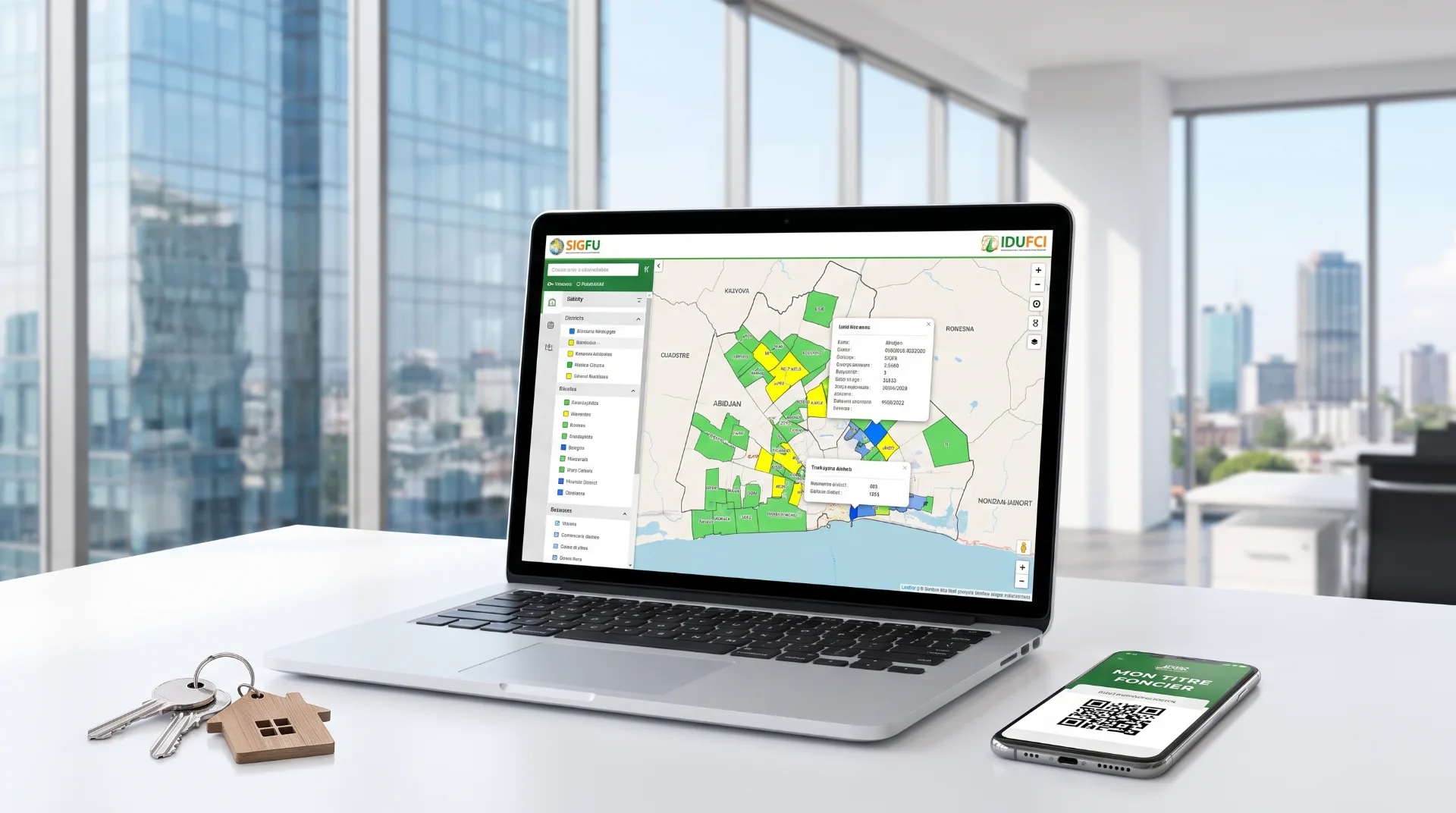
The Système Intégré de Gestion du Foncier Urbain (SIGFU / Integrated Urban Land Management System), established by Decree n° 2021-862 of December 15, 2021, is the technical backbone of the reform. It assigns each georeferenced plot a unique identifier, the IDUFCI (Identifiant Unique du Foncier de Côte d'Ivoire / Unique Land Identifier of Ivory Coast), created by Decree n° 2019-221 of March 13, 2019 and specified by Interministerial Order n° 757 of July 24, 2020.
According to the Ministry (BÂTIR N°008, Jan-March 2024), the 322,462 km² of Ivorian territory are now recorded to within 1 m² in the SIGFU.
How the multiple sales block works
As soon as a transaction is recorded on a given IDUFCI, the system automatically blocks any concurrent registration attempt. The lock is technical rather than administrative, so it does not depend on one civil servant's diligence.
The 7 SIGFU operations
The system manages seven types of land operation:
- Reservation: preventive blocking of a plot
- Pre-attribution: formal commitment before ACD
- Attribution: issuance of the ACD
- Association: grouping of plots
- Subdivision / Merger: modification of division
- Revocation: cancellation of an attribution
- Information exchange: sharing among authorized parties
The 9 components of the SIGFU project (BÂTIR N°004, 2022)
- Unified geodetic reference system (Decree 2019-220, RGCI-2019)
- Unique plot identifier (IDUFCI)
- Standardization and reengineering of procedures
- Change management
- Geographic information reference system (LIDAR, orthophotos, and DTM, for Greater Abidjan and Assinie)
- IT infrastructure and equipment
- Conversion of existing data
- SIGFU (unified database)
- User service (web/mobile portals)
Who accesses the SIGFU?
Seven categories of users are authorized: public entities, notaries and lawyers, banks, forestry and mining operators, real estate professionals, surveyor-experts, and system administrators.
IDUFCI platform: idufci.construction.gouv.ci
One caveat: the SIGFU is officially 100% deployed according to the Ministry (BÂTIR N°008, 2024), but its complete absorption of historical records and its adoption by users are still work in progress.
Source: idufci.construction.gouv.ci, Decree n° 2019-221
4. The PRESFOR: 3,353 villages under international oversight
A program financed and audited by the World Bank
The Programme de Renforcement de la Sécurisation Foncière Rurale (PRESFOR / Program for Strengthening Rural Land Security), financed by the International Development Association (IDA, World Bank Group) for the period 2024-2029, covers 3,353 villages distributed across 16 regions of Ivory Coast.
PRESFOR does more than issue land certificates. It also covers the delimitation of village territories, a 12-step procedure governed by Decree n° 2019-263, rural land certification, and the strengthening of Comités Villageois de Gestion Foncière Rurale (CVGFR / Village Rural Land Management Committees). Its digital arm is SIFOR (Système d'Information Foncier Rural / Rural Land Information System), created by Ordinance 2025-85 of 02/12/2025, with operationalization planned in Bongouanou in March 2026.
Who audits the program
External control is what sets PRESFOR apart from earlier programs. The Agence Foncière Rurale (AFOR / Rural Land Agency) must produce semi-annual reports on the fight against fraud and corruption, and those reports are examined by the World Bank, the Court of Auditors, and the Haute Autorité pour la Bonne Gouvernance (HABG / High Authority for Good Governance).
A sector long used to working without outside review now has three bodies reading the same reports.
Source: afor.ci/programmes-projets/presfor
5. Screening of real estate developers
The Commission d'Agrément des Promoteurs et Programmes Immobiliers (CAPPI / Commission for Approval of Real Estate Developers and Programs) of the MCLU, created by Decree n° 2013-223 of March 22, 2013, has strengthened its verification procedures. According to the CAPPI Secretary (BÂTIR N°008, Jan-March 2024), it holds 12 deliberations per year (one per month, exceptions aside) and brings together about twenty members from several ministries (Justice, Interior, Mines, Finance, MCLU, Transport, Equipment, Hydraulics, Commerce) and the company CI-ENERGIES.
When a developer now submits a project, the CENTIF (Cellule Nationale de Traitement des Informations Financières / National Financial Intelligence Unit) verifies the origin of the funds, and a site visit is mandatory before any deliberation. The list of approved developers is published and updated, as is the list of approved real estate agents.
Before investing with a developer, check that they appear on these official lists.
Source: construction.gouv.ci, MCLU
6. Domain status and land status: verification tools
Two documents let you check a plot's status directly:
| Document | When? | Where? | Cost |
|---|---|---|---|
| Domain status | BEFORE TF creation | MCLU ([construction.gouv.ci](https://www.construction.gouv.ci)) | 5,000 FCFA |
| Land status | AFTER TF creation | Land Registry ([dgi.gouv.ci](https://www.dgi.gouv.ci)) | 3,000 FCFA |
The domain status confirms that you are the recognized applicant in the SIGFU. The land status identifies the definitive owner and the absence of encumbrances such as mortgages or seizures.
Source: servicepublic.gouv.ci
What remains to be done
These reforms are real. They are also not yet fully deployed across the territory:
- The SIGFU is 100% deployed according to the Ministry, but its absorption of historical records and its adoption by users remain partial
- The ADU is still unknown to part of the population and to informal intermediaries, which is why the national caravan visited 16 cities in 2025
- SIFOR is in its initial deployment phase, with Bongouanou operationalization set for March 2026
- Courts remain overwhelmed by disputes inherited from the old system: 70% of disputes at the Council of State concern urban land, according to the Minister (BÂTIR N°008, 2024)
- The official timelines set by the law (180 days at MCLU for an ACD on an approved subdivision) are not systematically met in practice, for reasons that are not always clearly explained
The infrastructure is being built. Until it is fully in place, checking each document and each plot yourself is what protects a buyer.
Official sources:
- servicepublic.gouv.ci: ADU, ACD, domain status, and land status fact sheets
- construction.gouv.ci: Ministry of Construction (MCLU)
- idufci.construction.gouv.ci: IDUFCI platform
- dgi.gouv.ci: General Tax Directorate (Land Registry)
- afor.ci: Rural Land Agency (AFOR)
- Ordinance n° 2013-481 of 02/07/2013: urban land domain
- Decree n° 2013-223 of 22/03/2013: creation of CAPPI
- Decree n° 2019-221 of 13/03/2019: creation of IDUFCI
- Interministerial Order n° 757 of 24/07/2020: implementation of IDUFCI
- Decree n° 2019-263: delimitation of village territories
- Decree n° 2021-784 of 08/12/2021: subdivision procedures (article 31)
- Decree n° 2021-862 of 15/12/2021: creation of SIGFU
- Ordinance n° 2025-85 of 12/02/2025: creation of SIFOR-CI
- Law n° 2020-624 of 14/08/2020: Urban Planning and Urban Land Code
- Law n° 2024-351 of 06/06/2024: amendment
- Circular note n° 0174/MCLU-CAB of 01/04/2025: securing customary information
- BÂTIR magazine N°0001 (Jan-Feb 2018), N°000 (Oct-Dec 2019), N°004 (Jan-March 2022), N°008 (Jan-March 2024): Ministry of Construction
- MCLU Newsletter N°028 (August 2025): National ADU Caravan
To go further:
- The ADU: the reform securing land since 2024
- SIGFU, IDUFCI and SIGNE: digitalization of the cadastre
- ACD, Land Title and CMPF: clearly distinguishing the three
- ACD procedure: steps and documents
- PRESFOR and SIFOR: digitalization of rural land
- Delimitation of village territories
- Our ethical commitments
?Frequently asked questions
Since when has the ADU been in force?+
Since July 1, 2024, and free since January 1, 2025. It has since been the only document recognized by the State to attest to customary rights on land from a subdivision.
Does the SIGFU really prevent multiple sales?+
The block is technical: as soon as a transaction is recorded on an IDUFCI, the system blocks any concurrent registration. Plots not yet integrated into the SIGFU do not benefit from this protection, so check that yours is in the system.
What is SIGNE?+
The ministerial electronic signature, operational since January 2024. It allows the Minister to sign ACDs from anywhere and raises signing capacity from 1,000 to 2,000-2,500 ACDs/month.
Which regions are covered by PRESFOR?+
PRESFOR covers 16 regions and 3,353 villages. The list of covered areas can be verified at afor.ci/programmes-projets/presfor or by contacting AFOR directly.
How do I verify that a developer is approved?+
Consult the official list published by the MCLU at officielimmobilier.net.
Does the village certificate still have value?+
No, not as an official document recognized by the State for new transactions on subdivisions. If you hold land with only a village certificate, you are at the very beginning of the securing process. The next step is to obtain an ADU from the GUFH, possibly under circular note 0174/2025 for older subdivisions.
What is the difference between SIGFU and IDUFCI?+
SIGFU is the overall computer system, the platform itself. IDUFCI is the unique identifier assigned to each plot inside it, much like a chassis number on a vehicle. The 322,462 km² were already recorded to within 1 m² in 2024.
Are the timelines announced by the administration respected?+
The displayed timelines (180 days for the ACD at MCLU, for example) are those provided by the official texts of the Ivorian administration. In practice, they can be significantly longer, for reasons that are not always clearly explained. The arrival of SIGNE in 2024 accelerates the ministerial signature phase, but it does not remove the other bottlenecks in the process.
What is the land position request?+
A mandatory preliminary step since March 31, 2025 before any ACD application, introduced by the MCLU and documented by the Regional Directorate of Construction of Aboisso (MCLU Newsletter, August 2025).