IDUFCI: The Chassis Number of Your Plot

The IDUFCI is the unique identifier assigned to every plot of land in Ivory Coast (Côte d'Ivoire). Understand what it does, how to verify it, and why it changes everything for investors.
A question about a plot?
Send the first page of a document on WhatsApp: we tell you what it is, free of charge.
Imagine buying a car with no serial number. Two dealers show you the same vehicle. One calls it "lot 14B", the other "the plot in the northern district". Nobody knows which of the two actually owns it. This situation, absurd for a car, was the daily reality of the Ivorian land market until 2019: a single plot could carry four different identifiers depending on which administration had registered it.
The Identifiant Unique du Foncier de Côte d'Ivoire (IDUFCI), the unique land identifier of Ivory Coast (Côte d'Ivoire), is the official answer to this problem. The Ministry of Construction, Housing and Urban Planning (MCLU) itself uses the automotive analogy in its publication BÂTIR No. 000 (October-December 2019): "it is the vehicle's chassis number, which never changes". That phrase captures the essence of what the IDUFCI means for an investor.
What the problem looked like before 2019
Before the IDUFCI was introduced, a single plot could be designated by several simultaneous and incompatible references: the application number for the ACD (Arrêté de Concession Définitive, the definitive concession order) assigned by the one-stop land office (Guichet Unique du Foncier, GUF), the Land Title (Titre Foncier, TF) number opened at the Land Registry (Conservation Foncière), the cadastral number assigned by the Cadastre under the Ministry of Budget, and the reference of the surveyor who had carried out the boundary survey. These four numbering systems coexisted with no bridge between them.
The practical result directly penalised the investor. Reconciling a state land status report with a land registry extract was an obstacle course. Checking for yourself whether a plot had been the subject of several simultaneous applications was out of reach, and a bank could not cross-check its mortgage registers against those of the MCLU. Double allocations, meaning two different ACDs issued for the same plot in the names of two different people, were made directly easier as a result.
The founding decree: 2019-221 of March 13, 2019
The Ivorian Government responded to this structural problem with Decree No. 2019-221 of March 13, 2019, which establishes the IDUFCI. This text creates a unique identifier of 20 alphanumeric characters, assigned to every urban plot regardless of its legal status at the time: bare plot, approved subdivision, plot under ACD, or plot registered under a land title.
Interministerial Order No. 757 of July 24, 2020 then set out its operational details, in particular the conditions for pre-registering plots and the coordination between the administrations involved (MCLU, Land Registry, Cadastre, licensed surveyors).
The fundamental characteristic of the IDUFCI is that it never changes. The number remains attached to the plot, whatever its legal status, however many transfers it goes through, and whoever holds it. Just as a vehicle's chassis number does not change when the vehicle changes owner, passes its roadworthiness test or is pledged as collateral, the IDUFCI follows the plot, not the person who holds it.
How the IDUFCI is structured
The 20-character alphanumeric number is not arbitrary. It encodes a precise geographic location, tied to the unified geodetic reference system established by Decree No. 2019-220 of March 13, 2019, the Référentiel Géodésique de Côte d'Ivoire (RGCI-2019). The characters include coordinates aligned to this reference system. The IDUFCI is therefore, by design, a geolocated identifier and not a mere sequential administrative number.
This technical choice has a major practical consequence: the IDUFCI can be shared among all players in the land market without ambiguity. A surveyor, a notary, a banker and the administration can cite the same number knowing they are all talking about the same plot, at the same location, with the same boundaries. This is the break with the administrative silos of the past.
Progressive rollout: from Marcory to nationwide coverage
The IDUFCI was rolled out in phases. The pilot phase started in the commune of Marcory in Abidjan, then extended to the communes of Cocody, Bingerville and Songon. Since 2025, the rollout has been extending across the entire national territory for new plots and active files.
This gradual approach matters for the investor. A plot acquired within an area already covered by the rollout has an identifier that can be verified immediately. A plot located in an area not yet covered will be registered at the time of the next administrative procedure concerning it: an ACD application, a boundary survey or a subdivision.
Verifying the IDUFCI: two official portals
The Government has set up two access points for verifying an IDUFCI.
The portal idufci.construction.gouv.ci is dedicated to direct verification of the identifier. The investor enters the 20-character number and obtains the public information associated with the plot: commune, status, and reference geographic coordinates.
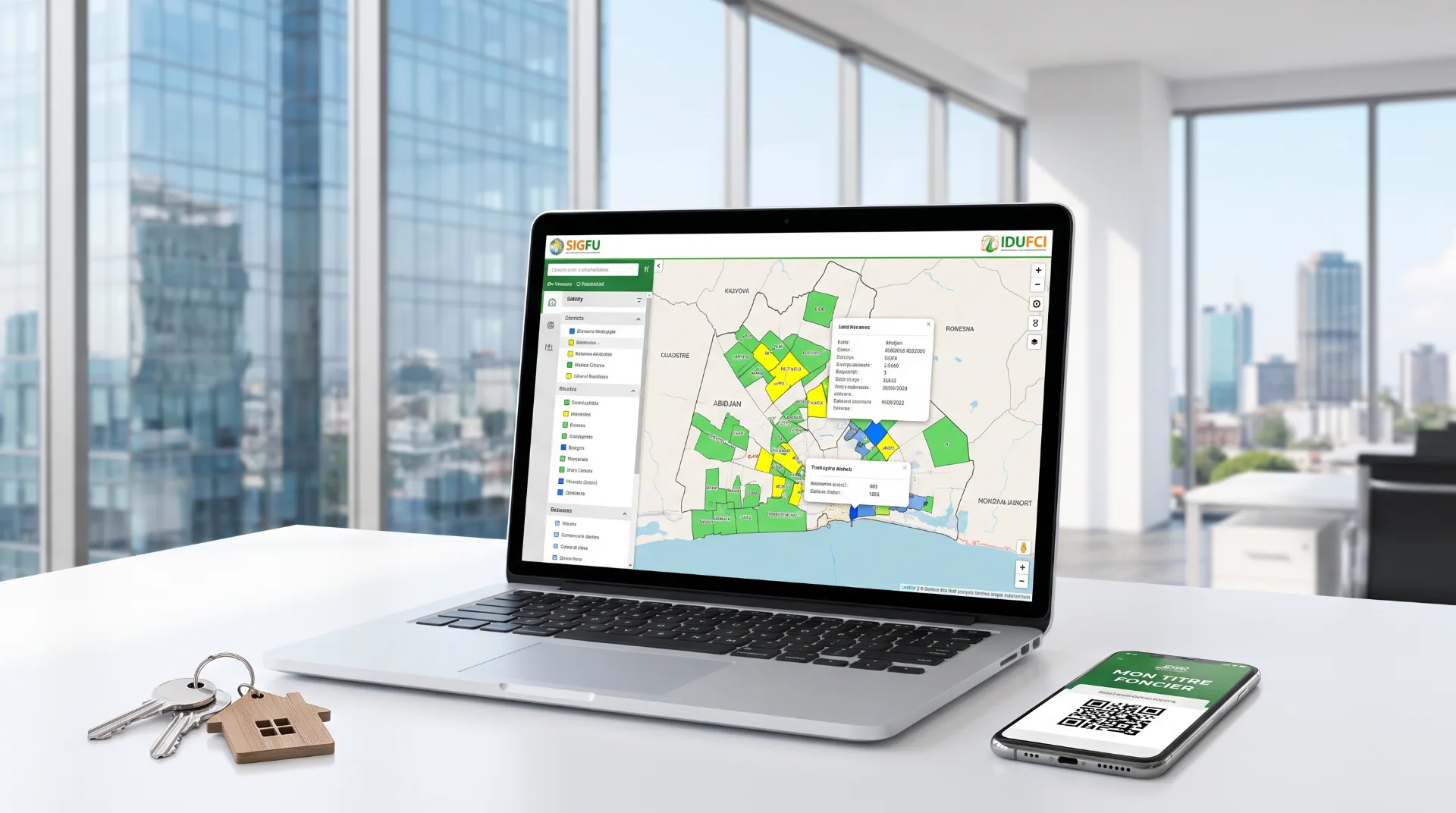
The Integrated Urban Land Management System (Système Intégré de Gestion du Foncier Urbain, SIGFU), accessible via sigfu.gouv.ci, is the digital one-stop shop established by Decree No. 2021-862 of December 15, 2021 and fully operational since March 2025. It has hosted all information exchanges between land administrations since February 2026 and enables a more complete cross-check, including the progress status of pending files.
The two portals complement each other: idufci.construction.gouv.ci for quick verification of the identifier, sigfu.gouv.ci for extended documentary verification. Neither replaces the state land status report (5,000 FCFA, MCLU) or the land registry extract (3,000 FCFA, Land Registry, General Directorate of Taxes, DGI), which respectively trace the administrative life and the legal life of the plot.
For the distinction between these two documents, see our glossary entries on the land registry extract (état foncier) and the state land status report (état domanial).
What the IDUFCI changes in practice for the investor
Cross-checking becomes possible
Before the IDUFCI, an investor who wanted to verify a plot had to compare documents that did not speak the same language. The unique identifier now links the ACD application file, the TF number, the surveyor's file and the Land Registry's records. An authentic ACD leaves a trace in all three systems (MCLU, Land Registry, SIGFU) under the same number. A fraudulent ACD, on the other hand, will struggle to present an IDUFCI consistent with these three sources.
The risk of double allocation becomes detectable
Stellionat, classified as such by Article 3 of the Urban Planning Code (Law No. 2020-624), consists of selling the same plot several times to different buyers. With the IDUFCI, each plot carries only one number in the system. If two deeds claim the same location, the system detects the collision. The risk is not eliminated, but it is structurally reduced compared to the previous situation, where registers were siloed.
Mortgage security becomes simpler to establish
In practice, Ivorian banks expect the ACD to be published in the Land Register, that is, the Land Title to be recorded, before attaching mortgage security to a plot. One of the historical reasons for this requirement was the difficulty of verifying consistency across registers. By creating a single bridge between administrative databases, the IDUFCI lowers verification costs for lenders and creates the conditions for a more fluid mortgage market.
Mass titling becomes operational
Decree No. 2021-784 of December 08, 2021 requires developers to carry out mass titling of the plots in their subdivision in the name of the State before putting them on the market. This mechanism, announced by the Ministry of Construction in 2019, is fully operational only because each plot can be identified by its IDUFCI even before it is titled. The buyer of a lot in a recent subdivision therefore no longer starts from an ACD yet to be opened: a land title already exists, and the buyer receives, along with the payment receipt, the IDUFCI number of the plot.
The IDUFCI in the Capital Foncier verification chain
For every file submitted to Capital Foncier for analysis, verification of the IDUFCI is one of the systematic documentary steps, alongside consultation of the state land status report, the land registry extract, and verification with the Land and Mortgage Registry (Conservation de la Propriété Foncière et des Hypothèques). This cross-checking is at the heart of the method we apply before any sale.
Let us be direct: Capital Foncier is neither a notary, nor a chartered surveyor, nor a public land authority. We do not issue TFs, ACDs or land registry extracts. These documents fall exclusively within the remit of the competent authorities: the Minister in charge of Construction or the Prefect for the ACD, and the Land Registry (DGI) for the TF and the land registry extract. Our role is to organise the verifications, coordinate them with licensed professionals, and document them in our internal Land Compliance Certificate (Certificat de Conformité Foncière, CCF).
What the IDUFCI does not do
The IDUFCI is an identifier, not a legal instrument. It does not confer ownership. It does not replace the ACD, the TF or the CMPF. Nor does it certify that the documents presented by a seller are authentic: it serves to verify the consistency between what is declared and what appears in the official databases.
An IDUFCI number on its own is therefore not proof of ownership. A seller who presents it without being able to produce the corresponding state land status report and land registry extract is presenting an incomplete file. A serious verification always brings together all three elements.
Outlook 2025-2026: towards stronger security
As early as 2019, in BÂTIR No. 000, the Ministry of Construction was already citing blockchain technology as a strategic vision for making Ivorian land titles unassailable. In 2026, this remains a project not yet publicly deployed. On the other hand, the full operationalisation of the SIGFU since March 2025 and the hosting of inter-administration exchanges since February 2026 are concrete advances, which strengthen the reliability of the IDUFCI as a verification tool.
The nationwide rollout of the IDUFCI, combined with the unified RGCI-2019 geodetic reference system, creates the technical conditions for a more transparent land market and simplified access to mortgage security. This is what the Ministry of Construction described in 2019 as the central objective of the digital transformation of Ivorian land administration.
To understand the role of the SIGFU in land verification, see our glossary entry on the SIGFU. To understand what the ACD is and how it relates to the TF, read our article ACD vs Land Title: the Ministry's official truth.
Would you like to verify a plot's IDUFCI before investing? Our teams organise the cross-checked documentary verifications for you. Book an appointment with a Capital Foncier advisor.
Main source: BÂTIR Magazine No. 000, October-December 2019, Ministry of Construction, Housing and Urban Planning (MCLU). Reference texts: Decree No. 2019-221 of March 13, 2019 (IDUFCI), Interministerial Order No. 757 of July 24, 2020, Decree No. 2021-862 of December 15, 2021 (SIGFU), idufci.construction.gouv.ci, sigfu.gouv.ci.