MCLU in Figures: The Rise of Ivory Coast's Land Administration over Five Years (2018-2023)
Between 2018 and 2023, the Ministry of Construction (MCLU) grew from 1,056 to 2,903 staff (+175%). Its total budget was multiplied by 1.6, with a 95.97% execution rate. Ivorian land administration is scaling up: here is what that changes for investors' and buyers' projects.
Need a land expert?
Speak with an advisor for free. Response within 2 hours.
Key Quotes
The sentences below can be quoted independently. Each figure is tied to its dated official source.
- "Staff numbers at the Ministry of Construction rose from 1,056 agents in 2018 to 2,903 in 2023, a 175% increase over five years." (MCLU statistical yearbook 2018-2023, human resources.)
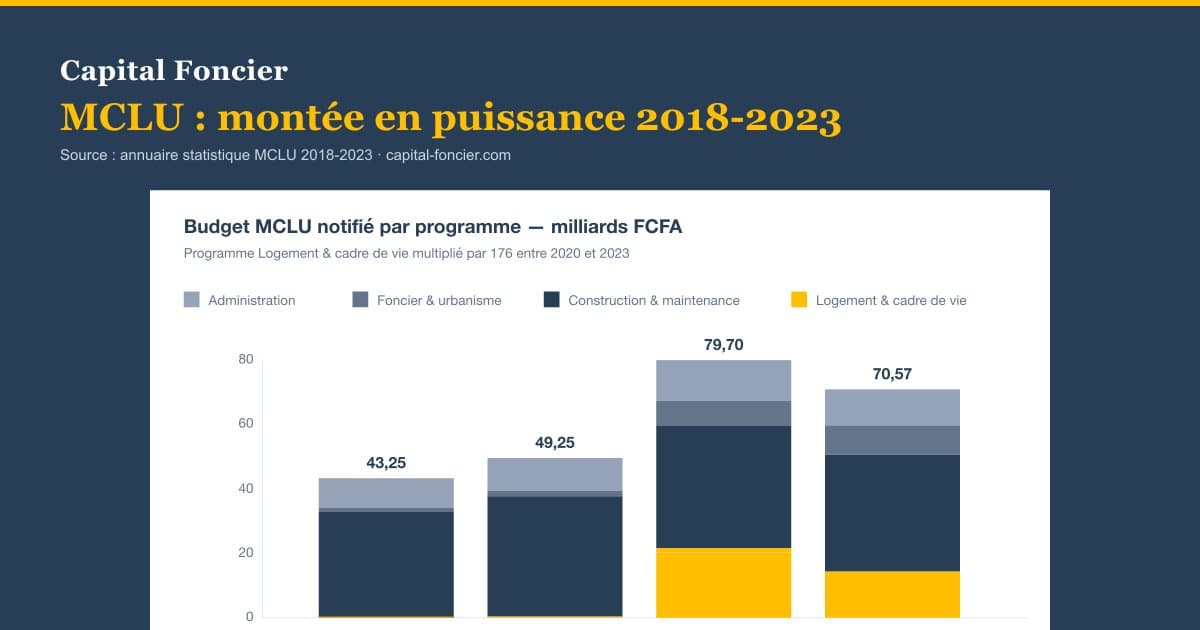
- "The MCLU's total notified budget rose from 43.25 billion FCFA in 2020 to 79.70 billion in 2022, with an execution rate of 95.97% in 2023." (MCLU yearbook, Table 6.)
- "The Housing and Living Environment programme was multiplied by 176 between 2020 and 2023, growing from 81 million to 14.3 billion FCFA." (MCLU yearbook, Table 7.)
At a Glance
The 2018-2023 statistical yearbook of the Ministry of Construction, Housing and Urban Planning (MCLU) offers an unprecedented institutional portrait. Staff numbers rose from 1,056 to 2,903 agents, an increase of 175%. The office stock doubled, from 653 to 1,316 units. The number of computers climbed from 808 to 1,317, and the vehicle fleet from 153 to 350. On the budget side, the total notified envelope reached 79.70 billion FCFA in 2022, with an overall execution rate of 95.97% in 2023. The Housing and Living Environment programme was multiplied by 176 in four years, from an envelope of 81 million to 14.3 billion FCFA. This upgrade changes the conditions under which land files from investors and buyers are processed.
Key Figures: the MCLU in 2023 Compared with 2018
| Indicator | 2018 | 2023 | Change | Source |
|---|---|---|---|---|
| MCLU staff | 1,056 | 2,903 | +175% | MCLU yearbook, human resources |
| Offices | 653 (2020) | 1,316 | x2 | MCLU yearbook, Table 5 |
| Computers | 808 (2020) | 1,317 | +63% | MCLU yearbook, Table 5 |
| Vehicle fleet | 153 (2020) | 350 | +129% | MCLU yearbook, Table 5 |
| Total notified budget (FCFA billions) | 43.25 (2020) | 70.57 | +63% | MCLU yearbook, Table 6 |
| Executed budget (FCFA billions) | 41.95 (2020) | 67.73 | +61% | MCLU yearbook, Table 6 |
| Overall execution rate | 97.00% (2020) | 95.97% | nearly stable | MCLU yearbook, Table 6 |
| Housing programme (FCFA billions) | 0.081 (2020) | 14.306 | x176 | MCLU yearbook, Table 7 |
| Land & Urban Planning programme (FCFA billions) | 1.272 (2020) | 8.899 | x7 | MCLU yearbook, Table 7 |
Wondering how this scaling-up affects your land project? A Capital Foncier advisor will call you back within two hours. Get my assessment.
+175% More Staff: the MCLU Has Nearly Tripled Its Workforce in Five Years
The MCLU yearbook puts precise figures on the evolution of human resources. As of 31 December 2023, the ministry counted 2,903 agents, up from 1,056 in 2018, a 175% increase over five years. Most of the positions are technical, administrative and support roles.
This expansion accompanies several major projects launched over the same period:
- the implementing regulations of land law (Urban Planning Code 2020-624, Ordinance 2013-481, successive decrees);
- the rollout of national information systems: SIGFU (Système Intégré de Gestion du Foncier Urbain, the integrated urban land management system) for urban land, SIFOR (the rural land information system) for rural land, and IDUFCI (Identifiant Unique du Foncier de Côte d'Ivoire, the national unique parcel identifier) for identifying parcels;
- the strengthening of decentralised administrations in the regions, in line with planning documents such as the Master Urban Plans (Plans d'Urbanisme Directeurs, PUD);
- support for housing policy and the gradual reduction of the housing deficit, estimated at 827,753 units in 2023 by the same yearbook.
For an investor or a buyer, this increase in human resources is a structural signal: the land administration now has the capacity to process a growing volume of files. Processing times observed on the ground, according to professionals, often remain longer than the official timeframes.
Physical Resources Are Keeping Pace: Offices, Computers, Vehicles
The yearbook also publishes, in its Table 5, the detail of the MCLU's material resources as of 31 December 2023:
| Category | Abidjan | Interior | Total |
|---|---|---|---|
| Offices | 943 | 388 | 1,331 |
| Desktop computers | 884 | 215 | 1,099 |
| Laptops | 167 | 51 | 218 |
| Printers | 588 | 258 | 846 |
| Scanners | 54 | 3 | 57 |
| Photocopiers | 46 | 6 | 52 |
| Motorcycles | 68 | 23 | 91 |
| Sedans | 80 | 0 | 80 |
| Pick-up trucks | 98 | 75 | 173 |
| Total stations (surveying) | 3 | 0 | 3 |
| GPS units | 10 | 7 | 17 |
Source: MCLU statistical yearbook 2018-2023, Table 5, MCLU material resources.
The gap between Abidjan and the interior of the country remains pronounced: Abidjan accounts for 72% of offices, 80% of desktop computers, and more than 75% of printers. This concentration reflects the historical centralisation of the land administration, but it is evolving: decentralised services are gradually being strengthened.
A Budget That Grew by 63% in Three Years
On the financial side, the MCLU yearbook publishes the budget breakdown programme by programme (Tables 6 and 7):
| Indicator | 2020 | 2021 | 2022 | 2023 |
|---|---|---|---|---|
| Total notified budget (FCFA billions) | 43.25 | 49.25 | 79.70 | 70.57 |
| Total executed budget (FCFA billions) | 41.95 | 48.96 | 79.00 | 67.73 |
| Overall execution rate | 97.00% | 99.42% | 99.12% | 95.97% |
| Operating expenditure executed (FCFA billions) | 26.82 | 29.86 | 33.17 | 33.62 |
| Investment executed (FCFA billions) | 15.14 | 19.11 | 45.83 | 34.12 |
Source: MCLU statistical yearbook 2018-2023, Table 6.
The table calls for three observations.
- The total notified budget jumped from 43.25 to 79.70 billion FCFA between 2020 and 2022, an increase of 84%. It came back down to 70.57 billion in 2023 after a budget adjustment, but remains well above the 2020 level.
- The budget execution rate is structurally high, between 95 and 99% every year. The MCLU spends what it is allocated, an indicator of an administration in genuine operation.
- Investment more than doubled over the period: 15.14 billion in 2020, 45.83 billion in 2022, then 34.12 billion in 2023. This is the most visible portion for the public, as it funds infrastructure, housing programmes and information systems.
Housing Programme: Multiplied by 176 in Four Years
The most striking budget figure concerns the "Housing and Living Environment" programme.
| Programme | 2020 (FCFA millions) | 2023 (FCFA millions) | Change |
|---|---|---|---|
| General administration | 9,077 | 11,296 | +24% |
| Land and urban planning | 1,272 | 8,899 | x7 |
| Construction and maintenance | 32,820 | 36,070 | +10% |
| Housing and living environment | 81 | 14,306 | x176 |
| Total notified budget | 43,251 | 70,571 | +63% |
Source: MCLU statistical yearbook 2018-2023, Table 7. Units: FCFA millions.
The Housing and Living Environment programme was multiplied by 176 in four years, from a symbolic envelope of 81 million FCFA in 2020 to 14.3 billion in 2023. This acceleration reflects the political priority given to closing the housing deficit.
The Land and Urban Planning programme, which notably funds planning documents (PUD, SDU), information systems (SIGFU, SIFOR, IDUFCI) and the Direction de l'Urbanisme et du Développement Urbain (DUDU, the urban planning and urban development directorate), was multiplied by 7 over the same period.
What This Scaling-Up Changes in Practice
For an investor or a buyer, the MCLU's institutional momentum has several practical implications.
1. Files Are Being Processed, but Not Always Within Official Timeframes
With 2,903 agents, 1,316 offices and 1,317 computers, the administration has the material capacity to handle the flow of files. The DUDU issued 19,945 urban planning opinions out of 20,150 applications between 2020 and 2023, a response rate of 99%. The time between application and issuance, however, remains variable. Regulations set benchmarks, for example 180 calendar days for an ACD (Arrêté de Concession Définitive, the definitive concession order) on an approved subdivision according to BÂTIR N°004 of 2022, whereas practice often shows longer total timeframes, or even longer.
2. Digitalisation Is Speeding Up Verification
The growth of the IT stock (+63% more computers in three years) and the rollout of information systems (SIGFU for urban land, SIFOR for rural land) are gradually making it possible to verify the consistency of a file online. For a remote investor, this is real progress. Legal deeds, however, still rely largely on physical exchanges.
3. The Larger Budget Translates into Projects
A Housing programme at 14.3 billion FCFA in 2023 means public projects are being implemented: social housing programmes, development operations, upgrading of precarious housing. An investor can factor this momentum into a location analysis, because a neighbourhood targeted by a public programme sees its urban trajectory accelerate.
4. The Planning Map Is Filling In
With a Land and Urban Planning programme multiplied by 7, the resources dedicated to planning (PUD, SDU) are increasing. The yearbook already reports 74 department capitals out of 111 covered by a PUD in progress, and that ratio keeps improving.
What the Diaspora Can Take Away
Three lessons for an Ivorian living abroad.
- The land administration is no longer a structural bottleneck. Every file still needs to be pushed forward, but staffing, equipment and budget have been substantially reinforced.
- Decentralised services are being strengthened in the interior of the country. This matters for an investment in a secondary city such as San Pedro, Bouaké, Yamoussoukro or Korhogo, where document verification was historically slower.
- Digitalisation is progressing. Asking your advisor to cross-check the data of a title offered for sale against public registries (SIGFU, IDUFCI) is becoming a standard step.
What an Individual Buyer Can Take Away
Four reference points for a resident preparing a purchase.
- Files move forward. The budget execution figures (95 to 99%) and urban planning opinion figures (a 99% response rate) describe an administration at work. This does not mean delays disappear, but it does signal that a compliant file gets processed.
- Official timeframes should still be taken with caution. Regulations set benchmarks; reality on the ground often exceeds them, due to volume, complexity, missing documents, or the signature circuit. It is better to plan with a margin.
- The process rests on verifiable documentation. The state land status check at the MCLU, the land registry check at the Conservation de la Propriété Foncière et des Hypothèques, and the notarised deed: this triptych remains the backbone of any secure acquisition.
- The administration's progress does not replace your own vigilance. Public resources are increasing; individual verification remains the primary tool for securing a project.
What Capital Foncier Takes Away
Our reading:
- The Ivorian land administration is scaling up, in continuity with the 2013-2020 reforms. The yearbook's figures document a significant budgetary and human upgrade.
- Digitalisation is advancing without replacing due diligence. Information systems make verification easier, but a file is not secured merely by accessing registries: it is secured through a complete verification method.
- Administrative time remains a project parameter. Official timeframes are benchmarks; the timeframes actually experienced on the ground remain a variable to factor into any land planning.
Further Reading
- Housing deficit: 827,753 units to build (MCLU analysis)
- Urbanisation map: 5.6 million households (MCLU analysis)
- Master Urban Plans: 74 department capitals out of 111 covered
- SIGFU, IDUFCI and the digital cadastre in Ivory Coast (Côte d'Ivoire)
Securing Your Land Project
Want to understand how these institutional changes affect your project, your timelines, your verifications, your target areas? A Capital Foncier advisor will review your situation with you and call you back within two hours.
Get my free assessment: two minutes is all it takes to describe your project.
Sources
- MCLU statistical yearbook 2018-2023, published July 2024
- Tables 5 (material resources), 6 (executed budget), 7 (budget by programme), and 11 (DUDU) of the MCLU yearbook
- Law No. 2020-624 of 14 August 2020 on the Urban Planning and Urban Land Code
- Ordinance No. 2013-481 of 2 July 2013 on the management of urban land
- Decree No. 2021-785, ACD procedure
- BÂTIR N°004 (2022), official processing timeframes for ACD files
About This Article
Article written by the Capital Foncier team based on the official MCLU statistical yearbook 2018-2023. Initial publication: 5 May 2026. This article is for educational purposes. It constitutes neither legal advice nor individualised investment advice.
The Capital Foncier team, Abidjan, Ivory Coast
"Our mission is to secure every square metre purchased by our investors."
?Frequently asked questions
Does the MCLU report to the Ministry of the Economy?+
The MCLU is a fully-fledged ministry. The Conservation de la Propriété Foncière et des Hypothèques (CPFH, the land registry and mortgages office), which maintains the Land Register (Livre Foncier) and issues Land Titles (Titres Fonciers, TF), reports to the State Secretariat to the Prime Minister in charge of the Budget and the State Portfolio (SEPMBPE / MCBPE), not to the MCLU. The distinction is legally important: two administrations coordinate the steps of the urban land process.
Is a Budget Execution Rate of 95% Good?+
Yes. In international comparisons of public administrations, an execution rate above 90% is considered high. The MCLU sits between 95% and 99% over the 2020-2023 period, which reflects an administration that actually uses its allocated funds.
Why Was the Housing Programme Multiplied by 176?+
Because the starting envelope, 81 million FCFA in 2020, was symbolic: the programme had not yet been genuinely activated in budget terms. The yearbook indicates an accelerated operational rollout from 2022-2023 onwards, linked to the programmes aimed at closing the housing deficit.
Does the Increase in Staff Translate into Shorter Processing Times?+
Partially. Administrative processing capacity has increased, but the timeframes experienced on the ground vary according to the type of file, the geographical area, the complexity of the signature circuit, and any documents missing at submission. A complete, well-structured file has better chances of being processed quickly.
Can I Access MCLU Services Online?+
Partially. The information systems (SIGFU, SIFOR, IDUFCI) and certain dedicated portals allow you to verify information and track certain procedures. Submitting and signing legal deeds still mostly requires in-person steps or a notary.