Chargement...
Chargement...
This article is only available in French.
The English version hasn't been published yet. Read it in French →
La loi ne fait aucune distinction entre hommes et femmes pour le certificat foncier rural. Pourtant, sur le terrain, l'accès reste inégal. Ce qui change en 2026.
Need a land expert?
Speak with an advisor for free. Response within 2 hours.
Dans beaucoup de villages ivoiriens, cette phrase n'est pas un dicton. C'est une règle non écrite qui structure l'accès au foncier depuis des générations. La terre se transmet de père en fils. Les femmes cultivent, mais ne possèdent pas. Elles exploitent des parcelles prêtées, héritées indirectement, ou attribuées de manière informelle — sans document, sans protection, sans recours en cas de conflit.
Pourtant, les femmes représentent une part essentielle de la main-d'œuvre agricole ivoirienne. Dans les zones rurales du centre et du nord, elles sont souvent les premières à travailler la terre, à entretenir les cultures vivrières, à assurer la subsistance alimentaire de la famille.
Et la loi, elle, ne fait aucune distinction entre les sexes.
La Loi n° 98-750 relative au domaine foncier rural — le texte fondateur du foncier rural ivoirien — ne fait aucune distinction entre les hommes et les femmes pour l'acquisition d'un Certificat Foncier Rural (CF). Toute personne physique de nationalité ivoirienne peut demander et obtenir un certificat foncier.
En droit, une femme a les mêmes prérogatives qu'un homme pour :
L'Agence Foncière Rurale (AFOR) est claire sur ce point : un Comité Villageois de Gestion Foncière Rurale (CVGFR) constitué sans y inclure au moins une femme est irrégulier (FAQ AFOR).
Ce n'est pas une recommandation. C'est une condition de validité. Un CVGFR composé exclusivement d'hommes ne peut pas légalement instruire des demandes de certificat foncier.
Le Code de la Famille ivoirien (Loi n° 2019-570) a renforcé les droits successoraux des femmes. L'épouse survivante hérite d'une part du patrimoine conjugal — y compris les biens fonciers. Les filles héritent au même titre que les fils.
Mais entre le texte de loi et la pratique au village, il y a un fossé considérable.
Le PAMOFOR (Programme d'Appui à la Mise en Œuvre du Foncier Rural), prédécesseur du PRESFOR, a délivré 48 070 certificats fonciers. Parmi eux, 31 % ont été délivrés au bénéfice de femmes.
Le programme PRESFOR (2024-2029), financé par la Banque Mondiale, a fixé des objectifs explicites en matière de genre. Les rapports semestriels soumis à la Banque Mondiale, à la Cour des Comptes et à la Haute Autorité pour la Bonne Gouvernance (HABG) incluent des indicateurs sur la participation des femmes.
Source : afor.ci/programmes-projets/presfor
31 %, c'est un progrès réel par rapport à la situation d'il y a dix ans, où les femmes titulaires de droits fonciers formalisés étaient quasiment inexistantes dans les registres.
Mais c'est encore loin de la parité. Et ces 31 % masquent des disparités régionales importantes : dans certaines zones du nord, la proportion de femmes titulaires de CF est nettement inférieure, en raison de la rigidité des structures coutumières locales.
Dans la majorité des communautés rurales ivoiriennes, la terre se transmet de père en fils. Les filles ne sont pas considérées comme des héritières foncières légitimes par la coutume — même si la loi dit le contraire. Cette norme sociale est profondément enracinée et ne disparaît pas par décret.
De nombreuses femmes exploitent des parcelles sur la base d'accords oraux : un mari qui prête une parcelle, un frère qui autorise la culture, un beau-père qui tolère l'occupation. Ces arrangements fonctionnent — jusqu'au jour où un conflit éclate (divorce, décès, dispute familiale). Sans document écrit, la femme n'a aucune preuve de ses droits.
Demander un certificat foncier en son propre nom est un acte qui peut être perçu comme une remise en cause de l'ordre social. Dans certains villages, une femme qui revendique un droit foncier individuel risque d'être marginalisée, critiquée, voire intimidée. La pression sociale est un frein souvent plus puissant que les obstacles administratifs.
Le Certificat Foncier Rural est gratuit dans les zones couvertes par le PRESFOR. Mais les démarches annexes — déplacement vers la sous-préfecture, frais de géomètre pour les cas hors PRESFOR, absence de la parcelle pendant les réunions — représentent des coûts indirects qui pèsent proportionnellement plus sur les femmes, souvent dans des situations économiques plus précaires.
C'est l'un des outils les plus accessibles pour sécuriser les droits d'une femme sur une parcelle qu'elle exploite sans en être propriétaire coutumière.
L'AFOR propose des modèles de contrats agraires qui nécessitent 5 signatures :
Ce contrat, même s'il n'est pas un certificat foncier, crée une preuve écrite opposable en cas de conflit. Pour une femme qui cultive une parcelle depuis des années, c'est une protection concrète.
Pour approfondir : Les 10 types de contrats agraires
La loi permet l'inscription collective sur un même certificat foncier. Une famille entière — hommes et femmes — peut être inscrite comme co-titulaire des droits coutumiers sur une parcelle.
C'est une option particulièrement pertinente pour les femmes qui ne peuvent pas (ou ne souhaitent pas) demander un certificat individuel, mais qui veulent voir leurs droits formellement reconnus dans le cadre familial.
Pour les femmes qui en ont la possibilité et le soutien, le certificat foncier individuel reste la meilleure protection. Il donne un droit documenté, vérifiable, et inscrit dans les registres officiels de l'AFOR.
La procédure est la même que pour les hommes :
La délimitation des territoires de village (Décret n° 2019-263) a un impact direct sur les droits des femmes. Quand les limites d'un village sont floues, c'est souvent dans les zones de jonction — précisément là où les femmes cultivent — que les conflits éclatent.
Un village délimité offre un cadre plus sûr pour toute demande de certificat foncier, y compris par des femmes.
Sources :
Pour aller plus loin :
Oui. La Loi n° 98-750 ne fait aucune distinction de genre. Toute personne physique de nationalité ivoirienne peut demander et obtenir un CF. La procédure est identique pour les hommes et les femmes.
Le Code de la Famille (Loi n° 2019-570) prévoit que l'épouse survivante hérite d'une part du patrimoine conjugal, y compris les biens fonciers. Cependant, en l'absence de certificat foncier ou de titre foncier, la preuve de la propriété est plus difficile à établir — et la famille élargie peut contester les droits de la veuve.
Découvrez les terrains que Capital Foncier a vérifiés : titre publié, statut du lotissement contrôlé, et état domanial croisé.
Un CVGFR ne peut pas légalement refuser une demande au motif du genre. Si un refus discriminatoire est constaté, la femme peut saisir le Sous-préfet ou l'AFOR. L'AFOR rappelle que les CVGFR constitués sans femmes sont irréguliers.
Le PRESFOR inclut des objectifs de genre dans ses indicateurs de performance. Les opérations de certification dans les 3 353 villages couverts prennent en compte la participation des femmes, et les rapports semestriels à la Banque Mondiale suivent ces indicateurs.
Le contrat agraire formalisé (5 signatures, écrit, enregistré) est l'outil le plus accessible. Il ne remplace pas un certificat foncier, mais crée une preuve écrite opposable. Le certificat foncier collectif (inscription familiale) est une autre option.
Oui, aux mêmes conditions que les hommes. La seule restriction concerne la nationalité : seuls les Ivoiriens peuvent être propriétaires en foncier rural. Les Ivoiriennes de la diaspora ont exactement les mêmes droits que les hommes de la diaspora.
Élargissez votre lecture avec d'autres facettes du foncier ivoirien.

The official platform construction.gouv.ci/mclulotissement makes it possible to verify whether a subdivision is approved, cancelled, or suspended — free of charge, in 5 minutes. Visual guide with the 7 form fields, the 3 statuses, and the pitfalls to avoid.
Lire l'article
Five bilateral tax treaties, one notable absence (USA-CI), four mandatory forms (2047, 2044, T1135, 8938): navigating the cross-border taxation of land investment in Ivory Coast from the diaspora. Educational guide, not personalized tax advice.
Lire l'article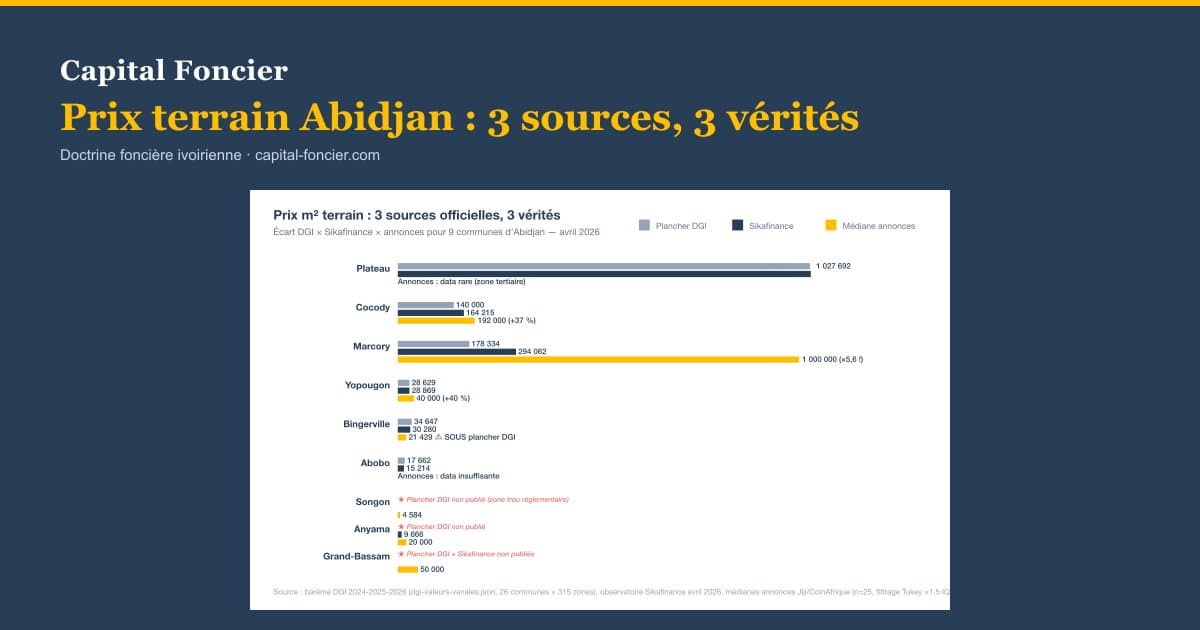
For the same plot in Marcory Zone 4, the DGI (Tax Authority) benchmark states 178,334 FCFA/m², the Sikafinance observatory reports 294,062 FCFA/m², and listings reach up to 1,000,000 FCFA/m². Who's right? All three. Breaking down the price gaps that can make or break a land investment.
Lire l'article