The Rural Land Certificate (Certificat Foncier Rural): The Complete Guide for Investors in 2026
The Rural Land Certificate (Certificat Foncier Rural) is the first document for securing agricultural land in Ivory Coast (Côte d'Ivoire). Procedure, costs, timelines: everything you need to know.
A question about a plot?
Send the first page of a document on WhatsApp: we tell you what it is, free of charge.
Are you planning to acquire farmland in Ivory Coast (Côte d'Ivoire)? Before talking about cocoa or rubber, there is one document you need to know: the Rural Land Certificate (Certificat Foncier Rural).
Without it, since the 2019 law, you can no longer sell or transfer customary land. It is now a mandatory step.
What is the Rural Land Certificate?
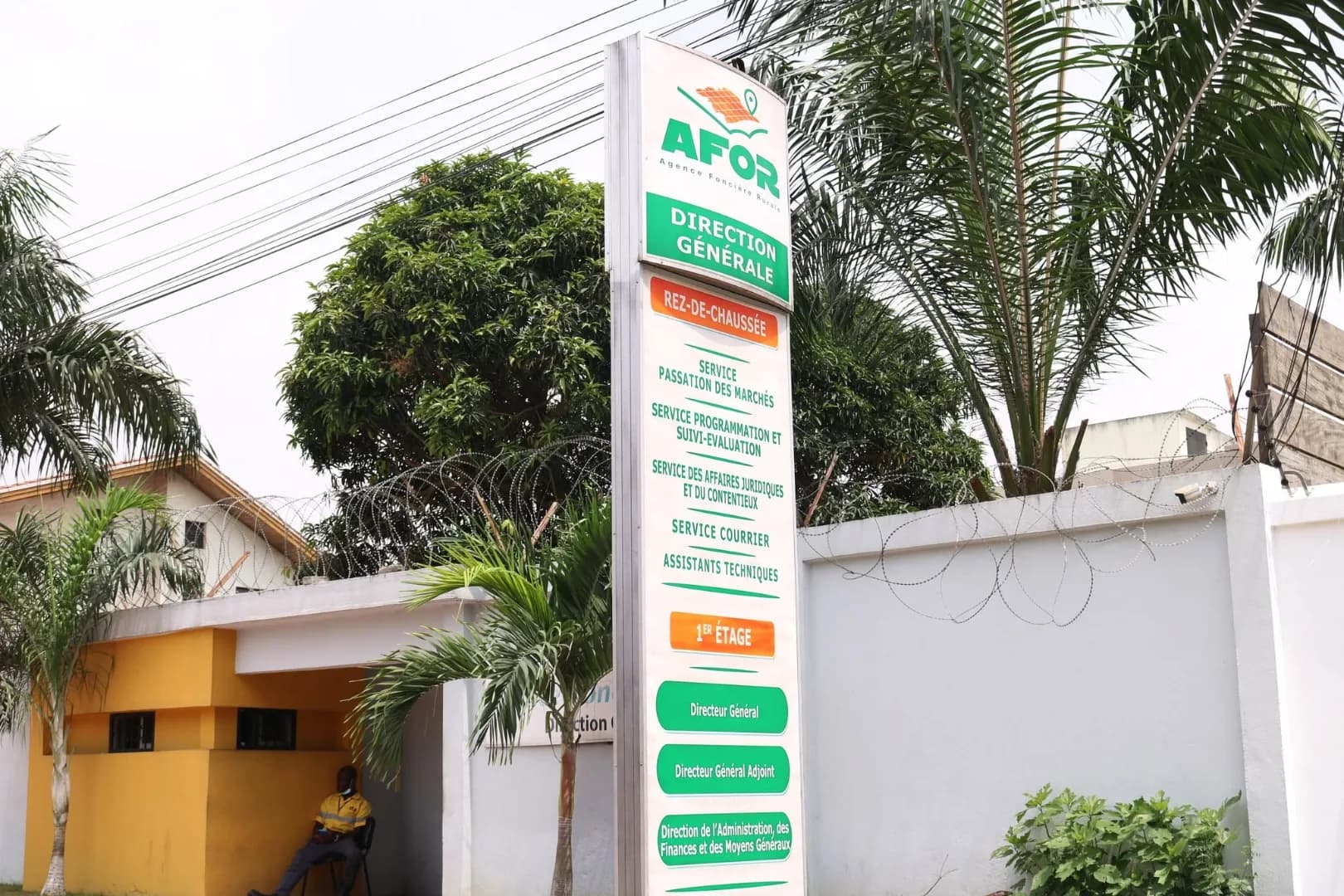
According to AFOR (Agence Foncière Rurale, the Rural Land Agency), it is an administrative document certifying that a person or group of persons holds customary rights over a rural plot. It is issued in accordance with Decree No. 2019-266 of 27 March 2019.
It is not a definitive title of ownership. It is the first step towards the Land Title (Titre Foncier, TF), and you have 10 years from its signature to launch the land registration process.
Procedure for issuing the Rural Land Certificate. Source: AFOR (afor.ci)
The seven-step procedure
You file an inquiry application with the Sub-prefect of the locality. The application file, form and supporting documents, costs 10,000 FCFA payable to AFOR.
AFOR appoints a sworn investigating commissioner, who assembles their team: a village representative, the neighbouring landholders, and the applicant.
The official inquiry takes place on site. The applicant clears the boundaries of the plot, a licensed chartered surveyor carries out the boundary survey, and the investigator draws up the official record of customary rights.
The findings are posted in the village for one month. Third parties record their agreement or objection in a register.
The Village Rural Land Management Committee (Comité Villageois de Gestion Foncière Rurale, CVGFR) approves the findings. Its chairman signs the attestation.
The sub-prefectoral committee validates the file, then the Sub-prefect forwards it to AFOR.
The Departmental Prefect signs the certificate. AFOR publishes it in the Official Gazette, and a copy is delivered to you.
Who can apply for a certificate?
The certificate records existing customary rights. It can be requested by an individual, a legal entity, or an identified group that holds those rights. The law makes no distinction between men and women (AFOR FAQ).
There is, however, a nationality requirement. Article 1 of Law No. 98-750 reserves rural land ownership for the State, public authorities, and individuals of Ivorian nationality. Non-Ivorians are therefore not eligible for the Rural Land Certificate. Article 8 bis, introduced by Law No. 2019-868, recognises them as good-faith occupants: the certificate holder confirms their rights in a fair and equitable manner, by contract (long-term rural lease, agricultural sharecropping).
What a certificate cannot cover
The certificate cannot be issued for public domain land, urban areas, classified forests, protected zones, or land already granted by the State (AFOR FAQ).
The PRESFOR programme: 500,000 free certificates
The PRESFOR programme, funded by the World Bank over five years, aims to issue 500,000 land certificates free of charge across five million hectares, in 16 regions and 3,353 villages (AFOR - PRESFOR).
If your land is located in an area covered by PRESFOR, the procedure is paid for by the State.
Ban on transferring land without a certificate
Since Law No. 2019-868 of 14 October 2019, customary land without a Rural Land Certificate can no longer be transferred, sold or donated. The certificate is now a precondition for any transaction.
To go further:
?Frequently asked questions
How much does a Rural Land Certificate cost?+
The application file costs 10,000 FCFA. In areas covered by the PRESFOR programme (World Bank), the entire procedure is completely free.
Who signs the Rural Land Certificate?+
The Departmental Prefect. It is an official administrative document published in the Official Gazette (source: AFOR).
Can land be sold without a Rural Land Certificate?+
No. Since Law No. 2019-868 of 14 October 2019, customary land without a certificate can no longer be transferred, sold or donated.
Are women entitled to the Rural Land Certificate?+
Yes. The law makes no distinction between men and women. The PRESFOR programme has already issued 31% of its certificates to women.